Humanoid Summit Seoul 2026 Puts 'On-Site Deployment' in Focus Amid Physical AI Commercialization Race
TECHWORLD ·
✦ AI Summary
At Humanoid Summit Seoul 2026, the real-world industrial deployment of physical AI and hardware optimization were key topics.
RLWRLD presented a strategy centered on field data, improved manipulation capabilities, and 'Deployment-First,' while Nota disclosed results showing faster inference for robot AI models in NPU and GPU environments.
Nota validated 7 robot AI models on Qualcomm Dragonwing IQ-9075 and NVIDIA Jetson Thor, and some models saw slightly lower or unchanged success rates alongside speed improvements.
At Humanoid Summit Seoul 2026, held at COEX in Seoul on the 22nd and 23rd, global robotics and AI companies, researchers, investors, and policy officials discussed technological advances in humanoid and physical AI, along with directions for industrial adoption. The event's central theme was the real-world deployment of physical AI and hardware optimization, and the competition to commercialize physical AI stood out throughout the event.
The event centered on the conditions needed to move physical AI beyond the research stage and into industrial settings. Key challenges included running AI stably in real robotic and industrial environments, beyond lab-level performance. As a result, the event highlighted securing field data, advancing robotic dexterity, and model optimization technologies tailored to different hardware setups.
RLWRLD presented a strategy for advancing robot manipulation capabilities centered on field data. It was introduced in the context of a broader push to link improvements in manipulation performance based on field data to the key task of deploying physical AI in actual industrial settings.
Nota unveiled optimization results that improve the inference speed of robot AI models in NPU and GPU environments. The presentation aligned with the event's broader emphasis on hardware-specific model optimization as a key issue in the commercialization of physical AI.
RLWRLD participated as an official technology partner and also took the stage as a keynote speaker to present its 'Deployment-First' strategy. The strategy prioritizes applying technology in real industrial settings first, then reusing data gathered during deployment to train models again. Through this approach, RLWRLD said it aims to improve robot manipulation capabilities.
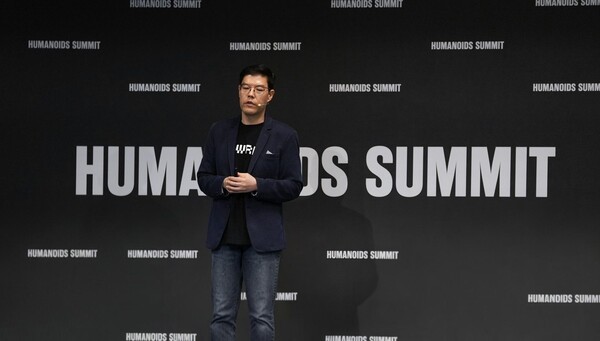
In his keynote on the 22nd, RLWRLD CEO Ryu Joong-hee explained a structure that links on-site deployment, industrial data, and Dexterity in a virtuous cycle of improvement. He said the company is focusing on identifying problems and data from the field first, then developing technology based on that, rather than completing the technology in the lab and applying it later in the field.
In her presentation on the 23rd, RLWRLD CSO Ahn Ji-yoon introduced a technology development direction that expands data secured in industrial settings to various robot hardware platforms and work environments. She said RLWRLD is developing a robotic foundation model (RFM) for this purpose and aims to train manipulation capabilities so robots can handle a wide range of objects with precision in complex industrial environments.
Nota is also conducting field validation alongside its robot AI business. Recently, it expanded its physical AI collaboration focused on logistics with CJ Logistics, and it is gradually integrating robot hands and sensors for actual logistics processes. It is also gradually carrying out field data training and fine-tuning for actual logistics processes.
At the same event, Nota also disclosed optimization results tailored to various edge hardware platforms for robot AI models. The company used its AI optimization platform, Netspresso, in the process and validated the results on Qualcomm Neural Processing Unit (NPU)- and NVIDIA Graphics Processing Unit (GPU)-based environments.
On the 23rd, Nota AI researcher Kim Geon-min gave a presentation titled 'Optimizing the Operation of Robot Foundation Models Across Diverse Hardware Environments Using Netspresso.' He introduced model-specific hardware deployment methods and performance improvements. For validation, the company used Qualcomm Dragonwing IQ-9075 and NVIDIA Jetson Thor across a total of 7 robot AI models.
The models optimized were NVIDIA Groot N1.7, NVIDIA Cosmos 3 Edge, Physical Intelligence π0.5, Hugging Face SmolVLA, MolmoAct2, X-VLA, and VLA-JEPA.
As a result of lightening and optimizing the robot models, clear improvements were seen in speed metrics. Inference time for Groot N1.7 fell from 1602 ms to 228 ms, making it about 7 times faster, and the actual robot arm task speed improved 3 times. On NVIDIA Jetson Thor, inference time for Cosmos 3 Edge dropped from 1711 ms to 739 ms, for a roughly 2.3-fold speedup.
While speed improved, task success rates either declined slightly or held steady. In the simulation benchmark LIBERO, the task success rate fell by 1 percentage point from 93% to 92%, and the company said the decline was limited. In RoboLab evaluations, the model maintained the same task success rate as the original model.
VLA is responsible for interpreting surroundings based on video, understanding language commands, and determining robot actions. For that reason, real-world deployment requires considering not only model performance but also inference latency, memory usage, and hardware-specific computational characteristics. Accordingly, optimizing the model and the execution environment together was presented as a key task.
Through Netspresso, Nota is working to reduce model computation and memory usage while improving execution performance to match the computational characteristics of each hardware platform. The company plans to expand the optimization technologies it has accumulated in mobile, edge, and data center environments into physical AI areas such as robotics and humanoids.
The approaches presented at this event highlighted a difference in direction between RLWRLD and Nota. RLWRLD focused on a virtuous cycle between field data and improved robot manipulation capabilities, while Nota focused on securing real-time execution performance through optimization between models and hardware. Still, both companies shared the goal of deploying their technology in actual industrial settings.
In this context, for physical AI to spread into manufacturing and logistics sites, it must combine the ability to understand complex environments, perform precise actions, and run models quickly and reliably on limited edge resources. Humanoid Summit Seoul 2026 highlighted this potential for on-site deployment as a core axis of technological competition.
Source: TECHWORLD · Kim Seung-gi
Original: https://www.epnc.co.kr/news/articleView.html?idxno=407372
References
This article was produced with the help of an automated content generation algorithm.
Source: TECHWORLD
View originalThis article was summarized and organized by BizCrush based on the original article from TECHWORLD. For exact quotations and full details, please refer to the original article.