AI Users Choose Models Based on the Task... KT Ranks No. 2 Globally in Model Routing
IT DAILY ·
✦ AI Summary
KT said on the 28th that it had entered the technology competition by presenting its results on a global public benchmark for its in-house AI model routing technology.
AutoModelRouter ranked second overall in RouterArena's 'Acc-Cost Arena' evaluation, and KT said it was listed on the leaderboard under the name 'KT-ModelRouter.'
KT has also applied AutoModelRouter to Token Factory's model routing function and plans to build a multi-model operating environment that can add new AI models.
KT said on the 28th that it had formally entered the technology competition in the field by presenting its results on a global public benchmark for its in-house AI model routing technology.
KT's AutoModelRouter ranked second overall in the Acc-Cost Arena evaluation on RouterArena, an LLM router evaluation platform.
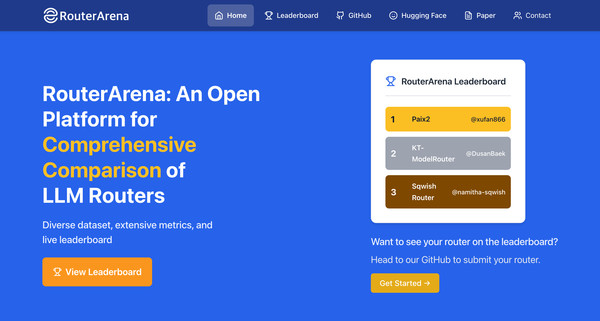
KT also released a screen showing that 'KT-ModelRouter' had climbed to No. 2 on the RouterArena leaderboard in the Acc-Cost Arena category.
AI model routing refers to the concept of connecting responses from different AI models behind a single AI service query based on the type and difficulty of the request. To users, it appears to be a single AI service, but internally it works by selecting the most appropriate AI model according to the request characteristics.
In the generative AI market, models have different strengths depending on the task, such as translation, summarization, coding and reasoning, and their usage costs also vary. As a result, deploying a high-performance AI model for every task improves quality but raises costs. On the other hand, relying only on cheaper models can reduce the quality of complex analysis and reasoning.
Model routers play a coordinating role between these conflicting quality and cost conditions. KT's AutoModelRouter uses task type, difficulty and knowledge domain as criteria when analyzing user requests. It also considers each model's response quality and usage cost together.
Based on those analysis results, KT's AutoModelRouter automatically selects the AI model for handling a request. For simple translation and information-checking requests, it assigns a lower-cost model while maintaining the required quality. When specialized analysis or complex reasoning is needed, it connects the request to a higher-performance model.
This means companies no longer need employees or developers to compare and choose AI models for each task themselves, since the model suited to the nature and difficulty of the request is assigned automatically.
Companies can also cut unnecessary AI usage costs that arise when all requests are handled with an expensive model. KT's AutoModelRouter delivers this effect by weighing quality and cost together and assigning the appropriate model.
KT's technology was listed on RouterArena's public leaderboard under the name 'KT-ModelRouter.' RouterArena is a specialized LLM router evaluation platform developed by researchers at Rice University in the U.S.
The platform verifies router performance based on about 8,400 evaluation queries. The evaluation categories are router accuracy, cost efficiency and robustness to input changes. The related research was accepted as an official paper at ICLR 2026.
In the results, KT-ModelRouter ranked second overall in the Acc-Cost Arena. Acc-Cost Arena is a category that evaluates accuracy and cost together.
The leaderboard included routers developed by academics and independent researchers, as well as Microsoft's commercial 'Azure Model Router.' KT-ModelRouter ranked above 'Azure Model Router.'
The comparison in this evaluation was not about the performance of the AI models themselves. It was an evaluation comparing the technology used to decide which model to select from among multiple models.
As the scope of corporate AI use expands, the importance of not only securing a single high-performance model but also the ability to deploy and manage multiple models for different purposes is likely to grow. This suggests that the ability to operate multiple models according to the situation could emerge as a core element of enterprise AI operations.
In response to this need, KT has also applied AutoModelRouter to the model routing function of Token Factory. AutoModelRouter is responsible for selecting the AI model best suited to the user's request.
Token Factory is KT's AI platform for integrated operation of multiple AI models and token usage environments. Token Factory operates various models based on AutoModelRouter's selection.
Behind KT's focus on model routing is the cost issue in the enterprise generative AI market. As the number of generative AI models used by companies increases, the complexity of deciding how to deploy models by task grows, and the complexity of usage and cost management expands as well.
As a result, competition among future enterprise AI platforms may shift away from simply offering more AI models. The ability to handle the same task at the required quality while spending less is emerging as a likely key factor in future enterprise AI platform competition.
Model routing is one of the core technologies for automatically managing a multi-model environment. Based on this, KT plans to continue enhancing AutoModelRouter and establish a multi-model operating environment that can add new AI models.
Kim Jun-seok, head of KT's Agentic AI Lab and an executive vice president, said that in the AI era, an important factor is not only securing a single outstanding model but also intelligently using the optimal model for each situation. He described AutoModelRouter as a technology that implements AI orchestration capabilities and said it would become a core technology supporting KT's agentic AI service competitiveness, including Token Factory.
Source: IT DAILY · Lee Jae-young
Original: https://www.itdaily.kr/news/articleView.html?idxno=241841
References
This article was produced with the help of an automated content generation algorithm.
Source: IT DAILY
View originalThis article was summarized and organized by BizCrush based on the original article from IT DAILY. For exact quotations and full details, please refer to the original article.