Gartner Says AI-Ready Data Must Expand to Agent-Ready
IT DAILY ·
✦ AI Summary
Gartner said that, as AI agent adoption expands, existing AI-Ready data management frameworks need to be expanded to Agent-Ready.
It explained that the scope of expansion covers data exchange between agents and the entire work execution process, and that continuous validation of data suitability and the application of governance are required.
Gartner said Data Contracts and metadata use are needed, along with collaboration between data and analytics leaders and AI and software development leaders.
According to IT Daily, Gartner recently released its recommendation that, amid the growing adoption of AI agents, existing AI-Ready data management frameworks need to be expanded to Agent-Ready. The point is contained in Gartner's report, "AI-Ready Data Needs to Expand to Agent-Ready Data."
Gartner said the need for expansion goes beyond the existing practice of verifying data suitability for individual AI use cases. The scope of expansion covers data exchange between agents and the entire work execution process, and Gartner said this requires continuous validation of data suitability and the application of governance.
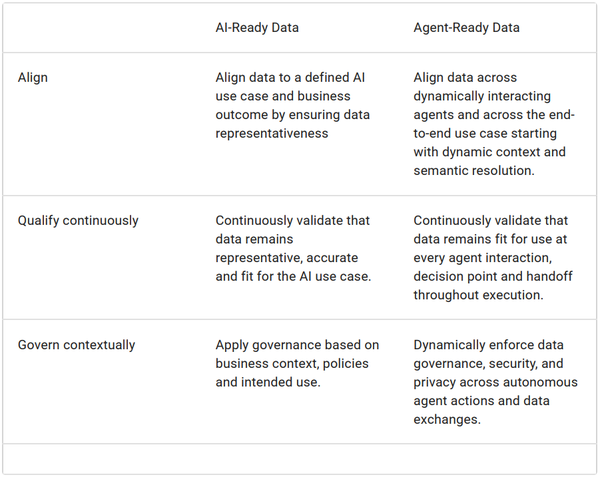
Gartner also outlined the difference between AI-Ready Data and Agent-Ready Data in this report. The gist of that difference is that Agent-Ready Data requires standards that go beyond individual AI use. The image source is Gartner.
Gartner pointed out that, as companies expand AI-centered strategies and agentic AI capabilities, the task of validating data suitability has emerged. Accordingly, it said there is a need to clarify the requirements for data used by agents, and that if verification of whether those requirements are met is not carried out, inaccurate responses can occur and there is also the possibility of data misuse.
Gartner said the complexity of data validation increases in multi-agent environments. It cited the need to verify the data used by each individual agent, the need to verify task status during work handoffs, and the need to verify memory during work handoffs. It added that if the readiness of data, status, and memory is not assessed at any stage of a multi-agent workflow, trust in the overall outcome can be undermined.
Gartner explained that the scope of validation does not stop at understanding data meaning or at understanding work context. It also noted the need to check whether data quality requirements and governance requirements are met at the point of actual use. Gartner said context and semantics are central to guiding data use in agentic AI, but that context and semantics alone are insufficient to judge whether use is appropriate at the time of execution.
As ways to verify whether data satisfies requirements, Gartner proposed Data Contracts and the use of metadata. A Data Contract is a method of specifying data compliance conditions in a machine-readable way. In this regard, Gartner said data-consuming agents need to define required conditions, while data-providing agents need to present machine-verifiable evidence that the conditions have been met.
Gartner also recommended using metadata for this purpose. The metadata should be used to verify data quality, provenance, and governance requirements. The verification method is continuous validation.
Gartner said it expects the amount of enterprise data generated by agentic AI to increase exponentially by 2029. It said the verification burden on data and analytics teams will also rise accordingly. In that context, Gartner said a continuous and autonomous validation system is needed.
Gartner said collaboration between data and analytics leaders and AI and software development leaders is necessary to manage the entire agentic AI workflow. It added that the purpose of such collaboration is to establish a dynamic framework for defining the data requirements needed at each stage, as well as a framework for verifying those data requirements.
Source: IT DAILY · Yang Seung-gap
Original: https://www.itdaily.kr/news/articleView.html?idxno=241806
References
This article was produced with the help of an automated content generation algorithm.
Source: IT DAILY
View originalThis article was summarized and organized by BizCrush based on the original article from IT DAILY. For exact quotations and full details, please refer to the original article.