How Far Can AI Help During the Chuseok Holiday?
IT DAILY ·
✦ AI Summary
AI is expanding beyond simple question and answer into a personal assistant that helps with everyday tasks such as planning travel itineraries, writing messages, analyzing photo information, and holding voice conversations.
Gartner identified the spread of agentic AI and multimodal capabilities as key directions, and also emphasized the importance of "digital provenance" for verifying the source and integrity of generated content.
During the Chuseok holiday, ChatGPT can be used to write greetings, Google Gemini can be used to plan family trips, and multimodal AI can be used to check shopping lists or ingredient information.
Artificial intelligence is moving beyond a simple question-and-answer tool and toward a personal assistant that supports everyday tasks. Its potential uses are expanding as it can organize travel itineraries based on user requests, draft messages tailored to specific situations, analyze information in photos, and hold voice conversations. As a result, the range of AI applications is also broadening.
This shift is also reflected in this year's AI technology outlook. In the trend of introducing AI use cases that people can easily try in daily life, the expansion of AI into a supporting role is also in line with this year's outlook.
Among the key directions Gartner has identified are the spread of agentic AI and the expansion of multimodal capabilities. In addition, as AI use expands, the importance of "digital provenance" technology for verifying the source and integrity of generated content is also being emphasized.
Based on this trend, AI can be applied to a variety of everyday tasks during the Chuseok holiday. Examples of how to use AI during the holiday include writing greetings, planning travel itineraries, and organizing shopping lists for the holiday, all of which are presented as easy ways to try AI in daily life.
Every holiday season, writing greetings to acquaintances and relatives becomes a concern. Repeating similar expressions can feel awkward, and for people you have not contacted in a long time, it becomes even more of a struggle to choose what kind of greeting to send.
In such cases, using ChatGPT can help you write greetings tailored to your relationship with the recipient. You can ask it to write a Chuseok greeting for a relative you have not contacted in a long time.
At that point, you can also add conditions such as avoiding excessive formality while maintaining politeness and keeping the wording natural. This can help create phrasing that matches the tone and mood you want.
However, if the AI-generated sentence feels too formulaic, you can ask it to rewrite the text by incorporating additional information. In that case, you can provide details about your relationship with the person or recent events involving them.
For example, if you are sending greetings to your maternal uncle, whom you had dinner with during the Lunar New Year holiday, you can ask it to reflect the conversation you had at the time and add a line saying you will visit again next time. This can make the result into a more personal message.
AI can write natural greetings, but it cannot replace sincerity. The scope of AI's usefulness lies in refining expression. Still, sometimes even if the wording is a little awkward, reaching out directly and conveying your feelings can mean more.
When planning a family trip during the Chuseok holiday, AI can be used to organize the itinerary. The tool in focus is Google's Gemini.
Gemini uses location and route information from Google Maps. Based on that, it recommends tourist spots and restaurants and builds a travel itinerary that takes the movement route into account.
As an example, a request for a family trip to Damyang, South Jeolla Province, with parents was presented. The example request is a Chuseok holiday trip to Damyang, South Jeolla Province.
In this case, the accompanying travelers are the parents, and the condition is that there should not be much walking. The request is for recommendations of major tourist attractions and an itinerary that takes the travel route into account.
When this question is entered into Google Gemini, it suggests a travel itinerary. The proposed plan includes tourist attractions and restaurants. The locations of the recommended places and the route are shown on Google Maps.
You can also ask Google Gemini again for a Damyang itinerary assuming rainy weather. You can add conditions such as the departure point, budget, transportation, and meal preferences. Adding conditions improves the specificity of the itinerary.
If the initial recommended itinerary is unsatisfactory, it is also possible to change the conditions and ask again. Gemini is used in travel itinerary recommendations by adjusting the results according to changes in conditions.
Multimodal AI processes information in various forms, including text, images, and voice. Multimodal AI has the ability to understand and process information in different formats. By using it, you can obtain the information you need with just a photo or a voice question.
Using multimodal AI can also reduce the burden of having to explain situations in detail or type them out directly. Based on this characteristic, there are also a wide variety of ways to use it during the Chuseok holiday.
For example, you can photograph the ingredients left in your refrigerator and then get recipe recommendations. You can also photograph food items you received as gifts and check how to store and use them. You can calculate the ingredients and amounts needed for holiday dishes based on the number of people, and you can also check substitutes for ingredients that are missing. Voice conversation with AI is also possible in this process.
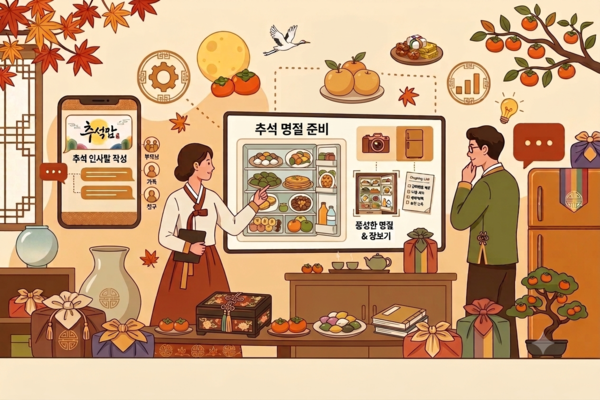
An AI-generated image for an example Chuseok shopping list implementation was presented, and it can be used for holiday grocery shopping. You can take a photo of a handwritten shopping list and input it into AI, and you can also ask AI to sort and organize items by category.
However, if the handwriting is unclear, misrecognition is possible, and misrecognition can also occur when image quality is poor. For this reason, it is a good idea to check the list organized by AI again.
As AI technology advances, answer accuracy and the range of use are improving, but hallucination, which makes false information appear plausible, can persist. In particular, during the Chuseok holiday, the opening hours of tourist attractions and restaurants may change, so information provided by AI needs to be checked again. Rather than treating AI's output as a final answer, it is important to judge and use it according to your own situation.
Source: IT DAILY · Yang Seung-gab
Original: https://www.itdaily.kr/news/articleView.html?idxno=241807
References
This article was produced with the help of an automated content generation algorithm.
Source: IT DAILY
View originalThis article was summarized and organized by BizCrush based on the original article from IT DAILY. For exact quotations and full details, please refer to the original article.