EnQurity Bolsters Data Security in the Generative AI Era, Presents Integrated Response Strategy with Akamai
TECHWORLD ·
✦ AI Summary
EnQurity said that as the use of generative AI and SaaS expands, corporate data leakage risks are rising and more areas are becoming difficult to manage with network-centric security alone.
EnQurity presented a security strategy covering browsers, applications, and APIs, and introduced new security threats and response solutions for AI environments together with Akamai.
At the event, it explained security measures for web applications, APIs, and browsers centered on Akamai App & API Protector, API Security, and Workforce Protector.
EnQurity, a security specialist, said that as the use of generative AI and SaaS expands, companies face growing risks of data leakage, and that more areas are becoming difficult to manage with network-centric security alone as data leakage channels widen. It explained that as the use of generative AI in business operations rapidly expands, employees may input source code, personal information, and corporate secrets into unauthorized generative AI services, and that there are also cases in which unmanaged APIs connect to external services.
Against this backdrop, EnQurity presented a security strategy that encompasses browsers, applications, and APIs, laying out an integrated response to complement the limitations of network-centric security. EnQurity CEO Kim Dong-wook proposed an approach that spans browsers, applications, and APIs as a security strategy for responding to corporate data leakage risks.
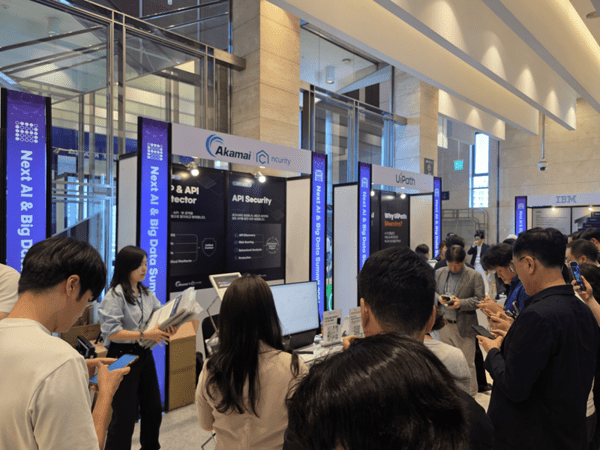
EnQurity participated in NABS(Next AI & Big Data Summit) 2026, hosted by EBN, and co-participated with Akamai Technologies to introduce new security threats in AI environments and key solutions for responding to them. Through this, EnQurity and Akamai presented new threat types in AI environments and response solutions.
As Akamai's official distributor in South Korea, EnQurity explained step-by-step security measures at the event centered on three Akamai security products. The featured products were 'Akamai App & API Protector (AAP),' 'Akamai API Security,' and 'Akamai Workforce Protector (formerly LayerX).'
AAP was introduced as a product focused on defending against attacks on web applications and APIs. AAP provides a web application firewall (WAF), bot mitigation, API protection, and DDoS defense. It also responds by using threat intelligence gathered from Akamai's global distributed network to detect and block attacks targeting web applications and APIs at the network edge.
Akamai API Security provides visibility into distributed APIs in multicloud and on-premises environments. It also supports the identification of unmanaged 'shadow APIs' and no-longer-used 'zombie APIs.' Through this, it helps companies identify security risks in areas of APIs they are unaware of and respond to those risks.
Workforce Protector is applied to the browser layer. The supported environments are existing commercial browsers such as Chrome and Edge. It is used to understand how employees are using external AI services and to track web-based data movement. It also detects and controls the input and upload of sensitive information into generative AI and SaaS services.
EnQurity said that when the solutions are linked together, companies can manage the entire data movement path starting from the user's browser and extending to applications and backend APIs. This approach manages not only information leakage during generative AI use, but also external attacks and vulnerable API areas.
Kim Do-hoon, vice president of EnQurity's CS Business Division, said that as AI usage expands, the scope of corporate security inspections is changing to an environment that extends beyond applications and networks to the actual paths by which user data is sent and received. He added that the company plans to support a security framework suited to customers' work environments based on Akamai's security technologies and its build and operations experience.
EnQurity is expanding its AI and API security business across a wide range of industries, including manufacturing, while strengthening support for security deployment and security operations that take into account each company's IT environment and work characteristics.
Source: TECHWORLD · Kim Kyung-joo
Original: https://www.epnc.co.kr/news/articleView.html?idxno=407368
References
This article was produced with the help of an automated content generation algorithm.
Source: TECHWORLD
View originalThis article was summarized and organized by BizCrush based on the original article from TECHWORLD. For exact quotations and full details, please refer to the original article.