IBEX CEO Seong Min-su: “Beyond AI Vision to Physical AI... Mass Production Competitiveness Will Decide”
TECHWORLD ·
✦ AI Summary
IBEX said it is broadening its business from AI vision inspection to AI model operations, data management, and AI robotics, accelerating its transition into an industrial physical AI company.
CEO Seong Min-su said the key conditions for spreading manufacturing physical AI are performance, stability, and maintainability, and emphasized the gaps between PoC and mass-production environments as well as the challenge of long-tail cases.
The company is connecting AI vision, AI robotics, and AI Ops into a single flow, while pursuing field deployment and global expansion through closed-network operation, selective external network connectivity, and a full-cloud transition.
IBEX is expanding beyond its AI vision inspection-centered business into industrial physical AI. The company is linking AI vision with model and data operations, as well as robot control, while focusing on building automation systems that can be deployed in manufacturing sites for mass production.
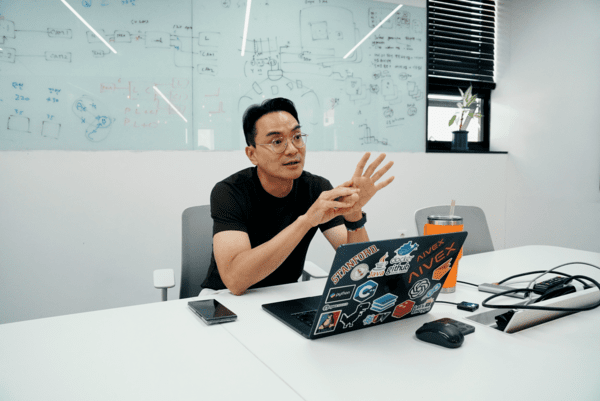
In an interview with TechWorld on the 16th, IBEX CEO Seong Min-su identified performance, stability, and maintainability as the key conditions for the spread of manufacturing physical AI. He said technologies at the PoC stage must be advanced to a level where they can operate stably for long periods on actual production lines.
Founded in 2020, IBEX began with AI vision inspection. It later expanded into an AI model operations platform, data management, and AI robotics. In January this year, it changed its name from AiV to AIVEX, formally accelerating its transition into an industrial physical AI company.
IBEX's current business structure is changing. Based on this year's revenue, AI robotics accounted for more than 30%. In the revenue mix, AI vision inspection made up about 65%, the largest share, while AI Ops accounted for about 5%.
The speaker said the inspection segment has secured stable revenue, while the robotics segment is growing rapidly. He added that AI Ops is targeting even faster growth than the other businesses.
The company has built its product lineup around the AI vision inspection platform AIVision, the AI robotics platform AIVot, AIVOps for AI model data labeling, training, verification, and deployment support, and AIVData for inspection data collection and analysis. Based on these, it provides AI inspection, AI robotics, and AI Ops solutions for manufacturing sites.
IBEX is scheduled to hold its annual AI forum on November 11. Domestic and overseas AI companies, industry leaders, researchers, and investors are expected to attend, and the forum will share the latest trends in enterprise AI, real-world industrial physical AI applications, and new business opportunities.
Seong identified the first problem in the shift from PoC to mass production for manufacturing physical AI as the gap between PoC and the actual production environment. PoCs are conducted under limited conditions and with small test volumes.
By contrast, in mass production, previously unidentified exceptions and data emerge as production scales up. Seong explained that long tails are inevitable as data increases in mass production.
Seong said the model's performance could be shaken again during the inference process for such data. In actual manufacturing sites, the location of raw materials may not match expectations, and packaging conditions may also differ from what was anticipated.
In real manufacturing environments, changes in dust levels occur, and surrounding environmental changes such as lighting also arise. Variables not exposed in PoC can recur during mass production, and such recurring mass-production variables can affect AI model performance.
Seong said that in manufacturing, even a single mistake is hard to tolerate. He explained that situations that posed no problem in PoC can occur in mass production, and performance gaps widen when addressing long-tail cases.
In the process of introducing AI-based manufacturing systems, securing performance alone is not enough, and stability verification is additionally required. Traditional automation equipment has operated on production lines for years and accumulated reliability, but AI-based systems have a relatively short track record in field applications.
For that reason, manufacturing companies inevitably need a process to verify stability by operating the system on an actual production line for a certain period. The speaker said that, because customers tend to be conservative, there are cases where they recognize the system only after months of operation with no problems.
The speaker said validation is needed to meet customer requirements. He also said trust must be demonstrated through existing mass-production references.
After mass production begins, maintenance issues arise. Existing manufacturing equipment can be checked and handled directly by production technology and equipment personnel when abnormalities occur.
By contrast, systems that combine AI models, vision, mechanical components, and robot control are difficult for on-site staff to manage on their own. Maintenance burdens may also increase if the department that decides to adopt the solution differs from the department that actually uses it on the production line.
Seong said physical AI can raise concerns during adoption because it is difficult for manufacturing-site personnel to perform self-maintenance. He explained that even when adoption is led by the quality department, maintenance concerns are unavoidable.
In response, IBEX has put in place remote and on-site support systems. It is also pushing to simplify the UI and UX so customers can directly change some settings.
Specifically, it provides functions to detect degraded lighting performance and to notify users when lighting should be replaced, while allowing users to directly adjust recipes for inspection and robot tasks. Seong said easy UX that increases customers' ability to operate the software directly is important.
Seong said usability, maintainability, and stability need to keep improving. He added, however, that non-technical conditions also affect adoption, and that the payback period for automation investment, workforce operations, and internal organizational perceptions of new technologies all influence adoption.
He said expected payback periods differ from company to company in manufacturing sites. He explained that 2-year, 3-year, and 4-year cases all appear. He also said price resistance exists. In addition, he said internal organizational issues between supporters of new technology adoption and conservative voices also exist.
To reduce these barriers to adoption, IBEX is emphasizing a structure aimed at solving operational problems. The company has presented a framework that connects AI vision, data, AI model operations, and robot control into a single flow. It takes the position that simple bundling of individual solutions should be avoided.
IBEX plans to build a system that links data generated on-site back to model training and deployment. The goal is to create a flow in which on-site data does not stop at operations but continues through training and deployment.
At the same time, manufacturing companies are described as highly sensitive to the external leakage of production data and process information. Accordingly, IBEX is considering a way to operate the system within an internal closed network. It also presented a method that allows selective connection to an external network only when necessary.
Seong also said manufacturers are extremely reluctant to take information and data outside the company. He said the system must be operable within a private network. He added that selective connection is needed when external network access is required.
A key element is connectivity between systems. The entire process of collecting images and sensor data generated on-site, using the collected data for additional AI model training, and then redeploying the retrained model to the production line must be linked quickly and easily to determine actual operating efficiency.
The speaker identified real-time connectivity, the degree to which various types of information are distributed in an organized form, and the extent to which human work is reduced as important factors. He also said the company is continually advancing products centered on those three areas.
VLA is in the preparation stage for mass production deployment, while AI vision guide is in the expansion stage. The scope of connectivity is expanding to robot automation.
Traditional industrial robots had strengths in repeating predetermined motions. Recently, there have been attempts to use AI vision guide and vision-language-action, or VLA, models to handle unstructured tasks.
Seong pointed out that industrial robots and AI technologies need to be viewed separately. He explained that industrial robots, collaborative robots, and humanoids correspond to hardware form factors. He added that how robots are driven is divided between traditional teaching methods and AI control, and that the decision-making domain for such driving methods belongs to software.
Under this distinction, Seong explained, AI can also be applied to industrial robots. In other words, the type of robot is a hardware issue, while how it is driven is a software issue.
At the current commercialization level, robot automation using AI vision guide is expanding rapidly. Seong said AI vision guide is now in a stage of fast diffusion.
By contrast, factory automation using VLA has not yet entered full-scale mass production. Seong explained that there are almost no mass-production cases of factory automation using VLA.
The level of automation varies by task type. Assembly processes are difficult to automate because they require the human sense of touch and vision. By contrast, tasks such as recognizing raw materials and then cutting a specific section are considered automatable with current technology. Tasks such as removing packaging materials are also considered automatable with current technology.
IBEX aims to put VLA-based robot automation technology into mass production. To that end, the company is pushing ahead with model advancement and on-site application technology advancement.
AIVot is pursuing improvements in functionality and usability. At the same time, IBEX is working in parallel on data development, model development, and control technology development.
AIVOps is pushing a full-cloud transition. The aim is to improve accessibility so overseas customers can use the product without building separate servers or going through complicated installation processes. IBEX plans to use this full-cloud transition plan to lay the groundwork for global market expansion.
Based on these preparations, IBEX aims to establish itself within the next 3 to 5 years as the industrial physical AI company that manufacturing firms turn to first when considering inspection and robot automation. The gist of the statement was that the company wants to be the first one that comes to mind when automation is being considered.
Seong said the company aims to be the first name that comes to mind in factory inspection and robotics automation demand.
As the foundation for this, he presented five technology stacks: sensing, AI models, mechatronics, control, and AI Ops. The strategy is not limited to supplying a specific model or robot, but to provide an integrated system spanning data collection, model training, robot control, and on-site operations.
Seong said the company has all five core physical AI stacks and emphasized its one-stop structure as a competitive advantage that can solve customer problems comprehensively.
He also said that in the global market, what matters more is the ability to apply and operate technology in actual manufacturing processes than competition over the performance of foundation models themselves. He added that even after the emergence of general-purpose foundation models, additional training tailored to each process is still needed, and that linking sensing, robot control, and data operations is necessary for use on actual production lines.
As a long-term direction for manufacturing, dark factories with reduced constant human intervention were presented. Seong explained that the direction of manufacturing itself is converging on dark factories.
However, he forecast that transition speeds will vary by industry depending on process characteristics and automation difficulty. Seong said that the ease of implementing dark factories differs by industry, and that progress levels are also different.
Even so, the trend toward expanding the scope of automation is expected to continue. Seong explained that AI robotics work on factory floors, data collection, and retraining are activities that manufacturing companies carry out continuously. He added that the company's competitiveness lies in being the company that does best when entrusted with the entire process.
Source: TECHWORLD · Kim Seung-gi
Original: https://www.epnc.co.kr/news/articleView.html?idxno=407240
References
This article was produced with the help of an automated content generation algorithm.
Source: TECHWORLD
View originalThis article was summarized and organized by BizCrush based on the original article from TECHWORLD. For exact quotations and full details, please refer to the original article.