[Interview] The AI Era’s Testing Lifeline Is in High-Risk Sectors: DoorooEnerAI Shifts Gears With Nuclear and Defense Software Verification
IT DAILY ·
✦ AI Summary
As generative AI and automation tools spread, the traditional SW testing market is facing lower prices and workforce reductions.
DoorooEnerAI changed its name and shifted its business focus to software verification in high-risk sectors.
The company is pursuing on-site testing at Saeul Units 3 and 4, ISO 19443 certification, KOLAS accreditation, and AI reliability verification businesses.
As generative AI technology spreads across the SW industry, the domestic and global IT services and development ecosystem is entering a major turning point. In particular, as LLM-based coding assistants become more advanced, the role of junior developers is shrinking, and that impact is also extending to the growth of the SW quality assurance (QA) and testing market.
Simeong Yu-gyu, CEO of DoorooEnerAI, says the domestic testing industry’s traditional growth base was general-purpose IT service sectors such as fintech, e-commerce, mobile apps, and home appliances. However, with the spread of automation tools, the absence of barriers to entry, and the influx of generative AI, the testing market has been thrown into a structural crisis, bringing sharp price declines and workforce reductions.
In the industry, the standard rate for 1 M/M (Man-Month) has fallen to the KRW 4 million range or lower. One M/M refers to one engineer working for one month. When labor costs, 4 insurance premiums, and statutory severance provisions are factored in, losses accumulate as staffing increases, and cutthroat competition is spreading across the industry.
DoorooEnerAI, a software testing specialist, changed its company name and shifted the center of gravity of its business to high-risk sectors. Its existing scope had been general B2C app testing, but its targeted market has shifted to high-reliability control software verification. The target industries are nuclear power plants, defense, rail, and aerospace, where system malfunctions can lead to national disasters and the loss of many lives.
As the chair company of the Korea Association for AI Software Testing, DoorooEnerAI is working with Doosan Enerbility. In that process, it assigned specialist personnel to on-site testing at the Saeul Units 3 and 4 nuclear power plants, building up its nuclear plant field references.
In October 2025, DoorooEnerAI became the first in Korea to obtain ISO 19443 certification in the field of software testing (V&V) for nuclear instrumentation and control (I&C) systems. ISO 19443 is an international standard for quality management systems in the nuclear supply chain. It is also carrying out work to meet ASME's nuclear quality assurance standard NQA-1, responding in advance to global export standards.
Simeong Yu-gyu, CEO of DoorooEnerAI, an industry practitioner in nuclear SW, has handled development and verification work for nuclear instrumentation and control systems (MMIS) software since 2014. In May 2025, he received a merit award from the Korea Association of AI Industry-Academia-Research Collaboration in recognition of his contribution to AI testing development, and in December 2025 he received a Prime Minister's commendation for contributing to the promotion of the SW industry.
This outlet interviewed Simeong Yu-gyu, CEO of DoorooEnerAI. The interview was conducted in a Q&A format, and the main focus was on the reasons behind the company’s name change and business restructuring.
The interview covered topics including how generative AI is changing the structure of the traditional testing market, institutional barriers, the turbulence of workforce reorganization, the rationale for entering high-risk industries, the rationale for entering AI reliability verification, and survival strategies.
Simeong said the name change and business shift were decisions made with survival at stake. He explained that the company’s name was changed to DoorooEnerAI, and that this decision was tied to a fundamental shift in the business model and portfolio.
Simeong diagnosed that the limits of the software testing industry had been deepening even before generative AI emerged. He explained that, in Korea's SW development environment, testing and quality management have long been treated as lower-priority tasks.
He also said that the low barrier to entry led to a proliferation of small and midsize firms, intensifying price competition. He went on to explain that there is no future in low-value-added, simple testing, and presented this environment as the backdrop for a fundamental shift aimed at survival.
Since last year, as the use of generative AI has become widespread, the amount of manpower needed for development and testing has decreased, directly affecting the testing market. Projects that once required 10 people have, after the adoption of automation tools and AI, been reduced to 7 people or less than half in some cases, and as a result the 1 M/M rate has fallen to the KRW 4 million range or lower. After deducting fixed costs such as base engineer salaries, company overhead, 4 insurance premiums, and severance provisions, losses grow as more projects are won.
In particular, in B2C platform sectors such as home appliances, e-commerce, and mobile apps, testing was undervalued as faster launches and development schedules were prioritized over quality. Because of this, business objectives shifted from securing profits to maintaining existing employment, and companies have continued to accept losses in order to preserve jobs. Many of the more than 70 member companies of the domestic testing association are facing similar difficulties, and the speaker concluded that there is no future for companies that continue with low-value-added, simple functional testing.
He explained that the new name adds a direction of expansion into the Energy and AI fields on top of the philosophy of coexistence and shared growth embodied in the existing 'Dooroo' brand. On the meaning and vision of the new name, he said 'Dooroo' is the founding philosophy and unique identity of the company. He also said that 'Dooroo' is a pure Korean word that reflects a philosophy of mutual prosperity and shared growth with clients and partners.
He added that the new combined name 'EnerAI' was introduced. EnerAI combines Energy and AI. The meaning of Energy includes the determination to bet everything on entering the nuclear power plant sector. He also said it reflects an intention to expand in the future into quality verification for renewable energy control systems such as solar and wind power.
As for AI, he first pointed to a direction of actively introducing generative AI and automation tools into testing sites to improve verification efficiency. He also said the new name reflects a vision of moving toward a specialized institution for reliability verification of AI models and training data, given the rapid growth of AI models and training data. He said the new name also expresses the will to transform the company from a traditional web and app testing service provider into a high-value-added safety and reliability verification engineering company.
The reason nuclear power, defense, rail, and aerospace were selected as high-risk sectors is that software abnormalities can lead to major damage, he explained. He sees these industries as having characteristics that make it difficult to delegate all judgments to AI, even as AI advances.
Examples include nuclear power plants, defense systems such as guided weapons, and high-speed rail control systems. In these areas, software defects and malfunctions can result in loss of life, national disasters, and massive economic losses.
For this reason, control software in those industries requires strict verification procedures based on international standards such as ISO, IEC, and IEEE. To pass regulatory reviews, test plans, test procedures, and test result reports must be prepared in accordance with the standards.
In particular, any anomalies confirmed during testing must be recorded in the test result report without omission. In such processes, the involvement of highly skilled human experts is presented as essential, since they ultimately guarantee system safety and bear legal and institutional responsibility.
Accordingly, AI is seen as being limited to simple functional checks. By contrast, the establishment of a master test plan that conforms to international standards, the design of exceptional scenarios, and the verification and approval of whether final results meet regulatory criteria are presented as tasks that AI cannot easily replace.
The company said it has filed a patent application for AI-based automation technology for nuclear SW V&V. The technology was designed to compare evidence generated by AI with the original text of regulatory provisions, and it also includes a hallucination-filtering structure. It added that items with low confidence are designed to be transferred to human experts for review, thereby securing reliability.
The speaker said that in high-risk sectors, the role of human engineers and specialized companies is likely to remain intact even in the AI era. He also expressed the view that high-risk sectors are a path for human engineers and specialized companies to secure fair compensation.
The company said it has signed a formal contract with Doosan Enerbility and is conducting on-site testing at the Saeul Nuclear Power Plant Units 3 and 4. It has assigned about 10 specialist verification personnel to remain on-site for this purpose, and it is also preparing to participate in future testing phases for Shin Hanul Units 3 and 4.
The speaker said nuclear software testing is fundamentally different from general IT testing. He explained that nuclear software testing must comprehensively verify not only the software logic but also electrical and instrumentation-and-control systems linked to physical equipment such as generators, valves, and turbines, and that on-site verification also requires precise measurements of electrical signals and communication standards. He added that nuclear software testing requires a combination of electrical engineering knowledge and a high level of reliability criteria.
The company has been carrying out MMIS software verification work since 2014 and has built an understanding of the level of MMIS software verification requirements. Initially, there were concerns about whether a software-centered company could adapt to nuclear plant sites, but by carrying out documentation work that met international standards and performing systematic on-site tests, it secured Doosan Enerbility's trust. As a result, discussions are under way on additional new contracts.
Based on this experience, the company has a Top-Down expansion plan into high-risk sectors. Its top priority is nuclear power generation, while the sequential expansion areas are defense and rail. The basis for this is safety class and regulatory intensity.
Behind this expansion trend is the view that there are structural commonalities among nuclear control SW, defense guided-weapon systems, and rail signal control SW. These fields generally share a common structure of large-scale real-time sensor data collection, situation assessment by a central computing device, and physical control by actuators and controllers, and they also share embedded software architectures.
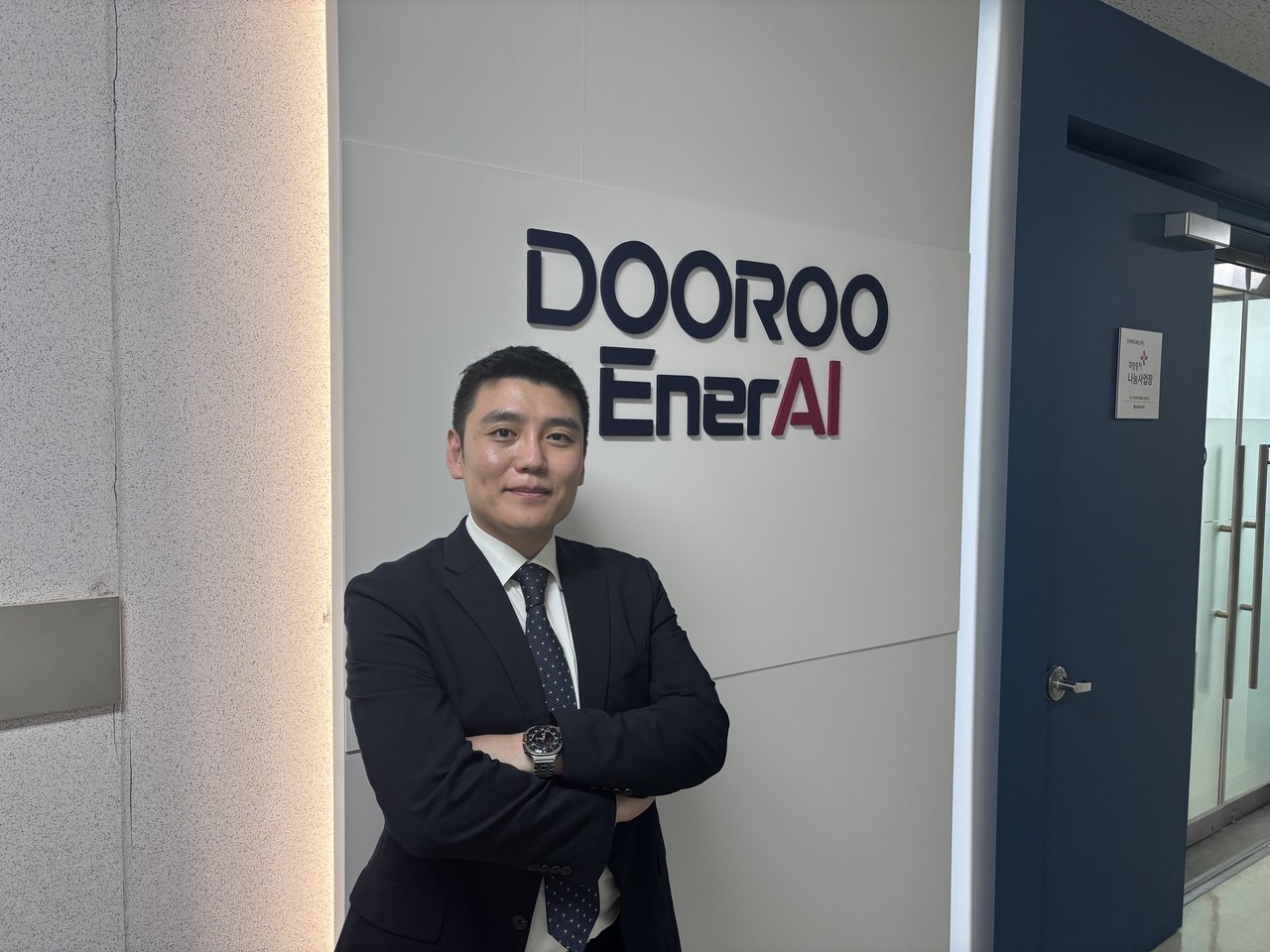
DoorooEnerAI says it possesses experience in passing nuclear safety standards, personnel for on-site quality verification, and technical capabilities, and that these capabilities provide a foundation for adapting quickly to the defense and rail sectors. In an interview with this outlet, Simeong Yu-gyu, CEO of DoorooEnerAI, said the company plans to move into the defense testing market next year based on its accumulated nuclear expertise. The photo was taken by Reporter Kwon Young-seok.
However, he said additional capabilities are being secured in parallel because defense and rail sectors differ in applicable standards and security requirements by field. To this end, he said the company is intensively studying the Defense Acquisition Program Administration's 'Weapon System Software Development and Management Manual' and related test standards in-house.
He also said the company is seeking business linkage with major domestic defense companies. In addition, he raised the need to create a new item for SW verification in the 'KHNP registered system.'
The speaker explained that in high-risk markets like nuclear power, business participation is difficult based on technology alone, and that without certified standards and certificates it is hard to secure bidding qualifications. Regarding the question of acquired technology patents and global certification status, the company said it has pursued a strategy of building a certification-centered technological moat.
As a representative achievement of that strategy, the company obtained ISO 19443:2018 in October 2025. This was an achievement in the field of software testing (V&V) for nuclear instrumentation and control systems, and it is the first such case in Korea. ISO 19443:2018 is an international certification for nuclear supply chain quality management systems and an international quality management standard for products and services in the nuclear safety impact supply chain.
The company explained that if it were only operating domestically, there would be little need to spend significant time and money obtaining this certification, but it moved ahead preemptively in anticipation of opportunities to expand together with KHNP following its bid for the new Dukovany nuclear power plant in the Czech Republic. It also said the decision reflected preparation for future entry into overseas nuclear markets such as North America. The speaker said that without certification, it is difficult to participate in bids in the nuclear and other high-risk sectors, so the company proactively secured certification in advance.
The company is carrying out a consulting project to meet ASME's nuclear quality assurance standard NQA-1 and is building a response system for North American standards. It also holds 2 registered patents, and in August 2026 it filed a patent for an 'AI-based Nuclear Software Verification and Validation Automation System and Method.' In addition, it obtained KOLAS accreditation as an internationally recognized testing laboratory under the Korea Agency for Technology and Standards.
At present, the scope of KOLAS accreditation is limited to the field of data quality evaluation. The company is focusing its capabilities on expanding into AI standard testing and is pursuing a plan to broaden the scope of accreditation into AI standard testing by the first half of 2027.
However, the biggest barrier to entering the public procurement market was identified as the item structure of Korea Hydro & Nuclear Power's KHNP Qualified Supplier Registration System. The listed items for KHNP qualified suppliers are centered on hardware manufacturing and construction, such as metals, machinery, piping, and electrical controllers. As a result, the lack of dedicated items corresponding to 'software quality verification and testing' was raised as a problem.
The speaker said software companies like theirs face restrictions in signing direct contracts with KHNP. Examples of requirements included international certifications such as ISO 19443 and ownership of technology patents. Within these constraints, the company joined the KHNP Win-Win Cooperation Council's relay division member group in April 2026, and said the purpose of joining was to expand cooperation channels.
To broaden its cooperation channels, the company is also preparing to obtain KEPIC certification from the Korea Electric Association. At the same time, it is asking the government and KHNP to create an independent item for SW quality verification within the public procurement and qualified supplier registration systems. The backdrop to this demand is the need to respond to the shift toward a software-centered society.
When asked about conflicts with existing employees during the rapid shift in the business area, the speaker said he recognizes those conflicts as the most painful and difficult part of being a manager. He explained that the company has pursued a change in business direction for survival.
The company explained the rationale for the business shift in detail through its internal bulletin board. It also surveyed the demand for role transition training for existing web and app testers to become software verification engineers in high-risk sectors. However, only some employees actively participated in the study sessions and expressed willingness to learn the new skills.
As its revenue structure has become unstable, the company is no longer maintaining the existing personnel management approach. Some employees want to keep doing the work they are used to, but the company believes it cannot stick to the old method. Accordingly, it is providing intensive standards and engineering training to those who want to change roles.
At the same time, for employees who continue with their existing work, the company is applying performance standards and job evaluations. It is adjusting roles based on those standards and evaluations. In this way, the company is reorganizing its personnel management system.
The company said it is moving away from the practice of hiring simple IT testers in order to secure specialist personnel for nuclear and defense testing in high-risk sectors. To that end, it has built a diversified university-industry cooperation pipeline, directly visiting major universities’ nuclear engineering departments and related departments tied to the defense industry, forming networks with faculty, and securing referrals for talented undergraduates and graduates. Since nuclear field testing requires both software and advanced electrical knowledge, the company does not believe it needs to insist only on highly educated master's- and Ph.D.-level candidates, and it is maintaining close ties with practical, electrical-specialty departments.
The company recently conducted in-depth interviews with 5 university seniors expected to graduate soon. Those who pass will receive on-site practical training, and those who complete the training and pass will be deployed to the field. By pursuing an organic combination of highly educated theoretical talent and field-oriented electrical technical personnel, the company is strengthening a solid talent pool.
The organization’s business sites are spread across the Anyang headquarters, the Gwangju AI research lab, and the Ulsan Saeul power plant. Because of this triangular geographic structure linking the capital area, the Honam region, and the Yeongnam region, physical distance is expanding, creating concerns that on-site personnel may feel excluded from the headquarters and from welfare benefits.
To reduce this, the company is actively securing win-win support projects from the Korea Labor-Management Development Foundation. In addition, the executive team and senior management regularly visit the Ulsan nuclear plant site and the Gwangju research lab to hold employee interviews and meal roundtables.
In training operations, the company has adopted the principle of inviting external expert instructors and providing the same high-quality program. Through this, it aims to ease feelings of discomfort arising from regional gaps and strengthen a sense of unity as 'one high-risk safety guardian team.'
Regarding structural changes in the SW quality ecosystem caused by AI, some in the market predict that the testing market will disappear as AI expands its role in coding. However, on the ground, the opposite pattern is also emerging.
As AI coding assistants spread, not only professional developers but also ordinary people can create SW and application prototypes, and the time required for ordinary people to produce them is also shortening. On the ground, while a development team's daily project code output used to be at the level of 1 case per day, the current daily project code output has risen to dozens of cases, and software output has also increased dozens of times over.
As AI agents generate more code, the amount of material that must be verified is also rising rapidly. Because AI-generated code can contain security vulnerabilities, the burden of inspection is growing as well.
With the volume of items requiring verification surging in this way, it has been pointed out that it is realistically impossible for several public institutions to verify all of them. In particular, in safety-critical fields, verification gaps can arise, and such gaps can lead to major accidents.
In the end, the view that verification of AI-generated code cannot rely entirely on AI itself is gaining traction. However, not all testing demand is increasing across the board; simple functional testing for general services is being replaced by automation. By contrast, verification linked to safety and regulation requires a responsible party, and its importance is actually rising.
As AI spreads, demand for skilled human QA architects is expected to increase sharply in the future. By contrast, the role of simple manual testers is expected to shrink. Accordingly, the importance of advanced quality specialists who oversee the design of the overall verification framework is expanding. These QA architects understand the final-stage system architecture and take on the role of judging and approving defects, while advanced quality specialists also identify AI hallucinations and errors.
Behind this change, the methodological differences between AI model verification and traditional testing play a major role. In traditional software, the core of verification is confirming whether code written in languages such as C, C++, and Java has been logically produced based on the requirements specification and design documents. But deep-learning AI models are not developed by directly defining detailed logic. Their weights are formed as the result of training on massive datasets.
For this reason, in AI testing, the quality and reliability of the training data become core verification targets in addition to the code. AI testing also requires verification of model performance, robustness, and system-level safety. Ultimately, the core of AI verification lies in confirming whether the tacit knowledge of industrial sites and the diversity of the real world are reflected in the data without distortion.
This difference is also evident in the case of autonomous vehicle perception models. A model trained mainly on car images taken from the same angle on sunny days is less likely to outperform a model trained on data covering a wide range of weather conditions such as rain, snow, and fog, as well as various vehicle types. This shows that diversity and representativeness matter more than quantity in the criteria for evaluating AI model training data.
DoorooEnerAI is operating as a testing institution for AI Trust under the Korea Association for AI Software Testing. It performs quality testing on AI software and data developed by small and midsize companies and issues test reports within its KOLAS accreditation scope. Looking ahead, the company expects the market for in-house AI model development to expand not only among large companies but also among small and venture firms, and accordingly expects demand for AI data quality testing to rise as well.
Simeong Yu-gyu, CEO of DoorooEnerAI, said the share of revenue from new energy and high-risk sector businesses rose sharply starting in May this year. He explained that the current share of revenue from these new businesses is about 30% of the total.
DoorooEnerAI is setting a target of 70% of revenue from high-risk sectors and AI reliability by 2030. This aligns with its goal of growing as a technology-driven company.
Among the related questions was a discussion of new R&D results, including on-device AI, being pursued by the Gwangju AI research lab. The photo was credited to Reporter Kwon Young-seok.
At the Gwangju lab, the company carried out state-funded R&D and independently developed a voice-based on-device AI model that does not depend on the cloud, and it has completed a prototype. This model requires weight reduction for operation on the device itself, and optimization technology is a key requirement in that area.
This capability was implemented through the development of a prototype AI speaker for 3D printing, designed with the care needs of an aging society in mind. The prototype aims to analyze the vocal characteristics of older adults, using factors such as tone, subtle tremors, and breathing changes to detect emergency signs and alert caregivers and related institutions. It also has an on-device voice analysis function and a structure for delivering alerts through a communications network when abnormal signs are detected.
However, because functions related to health status require consideration of medical regulations and personal data protection requirements, the company plans to continue verifying the performance of those functions. Going forward, it plans to examine combining lightweight AI capabilities with knowledge of high-risk sectors, and it is also considering development of nuclear virtual simulation and safety-management 'nuclear Digital Twin' technology.
While many software testing companies are struggling amid an economic downturn and the impact of AI, DoorooEnerAI said it is continuing to grow based on preemptive structural reform.
DoorooEnerAI said its order backlog as of the third quarter exceeded the previous year's annual sales. However, it explained that order backlog and annual sales need to be distinguished, as revenue is recognized according to the contract period. It also said that from September through year-end, demand for KOLAS-accredited test report issuance for government-supported projects is concentrated, and that new nuclear-related contracts with Doosan Enerbility are also under discussion, so it expects this year's revenue growth to be 15% to 20% higher than last year.
It also said its revenue structure is being reorganized around new energy and high-risk sector businesses. In the past, revenue from new energy and high-risk sectors was minimal, but it expanded sharply starting in May this year. It added that the current share of revenue from these new businesses is about 30% of the total.
DoorooEnerAI said it has set a target of more than 50% of revenue from new energy and high-risk sectors next year. It then projected that by 2030, the share of high-risk mission-critical testing and AI reliability verification businesses will exceed 70% of the total.
The speaker expressed gratitude to employees who stayed on site even as the company went through major changes. The company was recognized as a leading ESG management company and received the Grand Prize at the 1st Software Company ESG Management Awards hosted by the Korea Software Industry Association (KOSA) in December 2024.
The speaker noted that in December 2025 he participated in community service, including delivering side dishes and supplies, as a volunteer with the Pangyo chapter of the Korean Red Cross, which was formed under the Korean Red Cross. He also said the company intends to maintain a corporate culture that balances technological capability with social responsibility.
He said the spread of AI is an inevitable reality and an opportunity for those who are prepared to take a leap forward. He added that DoorooEnerAI aims to move beyond being a simple testing company and to grow into a trusted specialist in SW quality verification for safety-critical sectors such as nuclear power generation and defense, as well as a trusted institution in the field of AI reliability verification.
Source: IT DAILY · Kwon Young-seok
Original: https://www.itdaily.kr/news/articleView.html?idxno=241820
References
This article was produced with the help of an automated content generation algorithm.
Source: IT DAILY
View originalThis article was summarized and organized by BizCrush based on the original article from IT DAILY. For exact quotations and full details, please refer to the original article.