KAIST, SkyIntelligence, Daim Research Build Cooperation Framework for Manufacturing Physical AI
TECHWORLD ·
✦ AI Summary
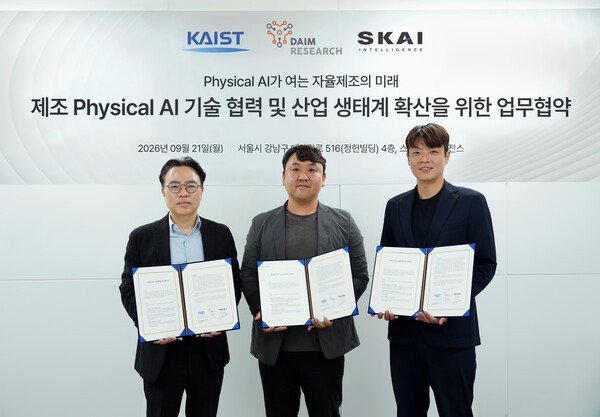
The KAIST Manufacturing Physical AI Research Institute, SkyIntelligence, and Daim Research signed a three-way MOU on the 21st.
The three organizations will pursue joint research, business development, and demonstration projects in manufacturing physical AI, while also working on training specialists, technology exchanges, and market development at home and abroad.
Each organization will be responsible for research, synthetic data and digital twin technologies, and robot integrated control and orchestration technologies, respectively, to collaborate on applying the technology to manufacturing sites and expanding the industry.
The KAIST Manufacturing Physical AI Research Institute, SkyIntelligence, and Daim Research will pursue joint research and demonstrations to apply physical AI to manufacturing sites and expand the related industrial ecosystem. SkyIntelligence announced that it signed a three-way MOU with the KAIST Manufacturing Physical AI Research Institute and Daim Research on the 21st to collaborate on physical AI technology and expand the industrial ecosystem.
Under the agreement, the three organizations will pursue joint research, business development, and demonstration projects in the manufacturing physical AI sector. They also plan to work together on training specialists, technology exchanges, and market development at home and abroad.
The KAIST Manufacturing Physical AI Research Institute will take charge of preliminary research and core technology development based on its expertise in AI, robotics, and manufacturing systems research. SkyIntelligence will focus on combining synthetic data and digital twin technologies.
Daim Research will connect its robot integrated control and orchestration technologies accumulated in manufacturing and logistics settings. Accordingly, the three organizations will pursue cooperation by dividing responsibilities for research, data, and on-site operating technologies.
Jang Young-jae, head of the KAIST Manufacturing Physical AI Research Institute, said physical AI cannot be completed with laboratory technology alone and must be verified and advanced by being combined with the complex problems of real manufacturing sites. He said that, in line with this direction, he plans to link KAIST's research capabilities with Daim Research's manufacturing-site application capabilities and SkyIntelligence's synthetic data technology.
He said this would help establish a structure that connects joint research outcomes to demonstrations and industrial expansion. SkyIntelligence has previously conducted a synthetic-data-based PoC with ABB Robotics and has also signed a strategic cooperation framework with ABB Robotics. Daim Research has autonomous manufacturing solutions that optimize the overall factory flow based on heterogeneous robot and equipment integration, and it has applied those solutions to manufacturing and logistics sites.
The three organizations plan to combine their respective technologies. They will pursue research on manufacturing physical AI that covers equipment, logistics, individual robots, and robot swarm operations, and they plan to identify joint demonstration projects to verify applicability in actual manufacturing settings.
Lee Jae-cheol, CEO of SkyIntelligence, said the three organizations aim to connect their accumulated strengths by linking expertise, technology, and manufacturing-site experience across different fields, and on that basis accelerate the industrial application of manufacturing physical AI. He also said the three organizations will work together to identify joint research, business, and demonstration projects while promoting the expansion of the related ecosystem.
The three organizations will also cooperate on training talent to expand the physical AI industry. They plan to jointly design and operate education, seminar, and technology exchange programs for corporate and industry stakeholders, centered on physical AI, digital twin, synthetic data, robots, and autonomous manufacturing.
The scope of the cooperation will also expand to market development. The three organizations plan to pursue domestic and international conferences, forums, demos, site tours, and business matching, and they will link their industry-academia and industrial networks to broaden the points of contact between technology and manufacturing sites while identifying new business opportunities.
Hwang Il-hoe, CTO of Daim Research, said a condition for creating real industrial value from manufacturing physical AI is going beyond the performance of individual AI and robots to connect various robots, equipment, and systems into a single flow. He added that the organizations will pursue on-site verification of each institution's technical capabilities and, based on that, build application cases that lead to autonomous manufacturing.
Source: TECHWORLD · Kim Seung-gi
Original: https://www.epnc.co.kr/news/articleView.html?idxno=407361
References
This article was produced with the help of an automated content generation algorithm.
Source: TECHWORLD
View originalThis article was summarized and organized by BizCrush based on the original article from TECHWORLD. For exact quotations and full details, please refer to the original article.