Funjin, KAI to Cooperate on On-Device AI Development for Autonomous Missions in Air Unmanned Systems
TECHWORLD ·
✦ AI Summary
Funjin and KAI will cooperate on developing autonomous mission AI technology for air unmanned systems based on domestically made AI semiconductors.
Funjin will participate in the third subtask of the 'K-On-Device AI Semiconductor Technology Development Project,' led by KAI, handling battlefield situational awareness AI, path generation and battlefield decision-making models, and the AI training and verification environment.
Funjin plans to use AISS and AISen to expand applications beyond air unmanned systems to various manned and unmanned systems, including ground systems.
Funjin and Korea Aerospace Industries (KAI) will cooperate on developing autonomous mission AI technology for air unmanned systems based on domestically made AI semiconductors. The target system is on-device AI.
Funjin will participate in the 'K-On-Device AI Semiconductor Technology Development Project' led by KAI. Funjin's development focus is autonomous mission AI technology for disposable air unmanned vehicles. The scope of on-device AI includes sensor data processing, battlefield situational awareness, path generation, and onboard decision-making inside the unmanned vehicle.
The 'K-On-Device AI Semiconductor Technology Development Project' is a state-led research and development program promoted by the Ministry of Trade, Industry and Energy. The project aims to apply domestically made AI semiconductors in industrial settings, strengthen product competitiveness, and reinforce the related ecosystem.
KAI is at the center of the defense industry track. The defense industry track will focus on disposable air unmanned vehicles equipped with high-performance AI semiconductors and autonomous control systems. The plan is to conduct demonstrations using actual unmanned vehicle platforms.
Funjin will participate in the third subtask, 'Development of an Autonomous Control System for Disposable Air Unmanned Vehicles Applying High-Performance AI Semiconductors.' In this task, Funjin will handle battlefield situational awareness AI based on multi-sensor data fusion, as well as path generation and battlefield decision-making models. It will also be responsible for building an AI training and verification environment.
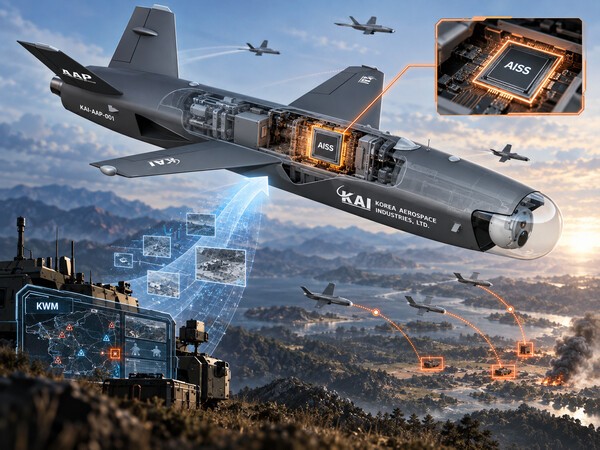
Funjin will use its on-device AI mission computer for unmanned weapon systems, called 'AISS(AI Sensor to Shooter),' and its AI sensor technology, 'AISen(AI Sensor),' in the development process.
AISS is an on-device AI technology that processes battlefield situational awareness, target identification, and attack plan recommendations on site. A defining feature of the technology is that it analyzes detected target information inside the unmanned system. It also supports automation of the 'Sensor to Shooter' process, which consists of sensor, decision, and strike.
This differs from the conventional method of sending data to a central server or external network for analysis. AISS operates by performing the necessary computations in the AI mission computer installed in the unmanned system. The concept is to support independent mission execution even in battlefield environments where communications are limited or unstable.
AISen is an AI sensor technology that supports AISS battlefield situational awareness. AISen processes various sensor data such as EO/IR, multispectral, and frequency data inside the device, and detects, classifies, and identifies objects. The identification information secured in this way is linked to the command decision-support system and used for subsequent judgments.
Funjin plans to further advance AISS and AISen through this project. The advancement will be pursued to suit the operational environment of air unmanned systems, and the standard will be compatibility with domestically made high-performance AI semiconductors.
The development targets are a situational awareness AI model based on the fusion of diverse sensor data, a situational awareness-based mission path generation AI model, and a situational awareness-based decision-making AI model. At the same time, the company plans to build a development environment that links AI training through performance verification. This development environment is intended to verify model performance under various conditions before application to actual unmanned systems and to lay the groundwork for improving operational stability.
Funjin also plans to apply world model technology to the advancement of autonomous mission AI. A world model is a method of modeling real-world states and possible changes. Through this, it can virtually predict and simulate various battlefield situations, and the goal is to train the system to make necessary judgments according to changing conditions.
The company plans to expand the technologies secured in this task beyond existing air unmanned systems to the broader field of aviation defense physical AI. As an example of the expansion target, KAI's AI pilot, 'Kairet,' which is under development, was cited.
It also plans to expand application beyond air unmanned systems to various manned and unmanned systems, including ground systems, and the technologies to be expanded are AISS and AISen. Kim Deuk-hwa, CEO of Funjin, said that AISS and AISen are network-independent on-device AI technologies developed to support autonomous situational awareness and mission execution decisions in unmanned systems. He added that the company plans to combine domestically made AI semiconductors with battlefield AI technology, enhance autonomous mission capabilities for air unmanned systems, and expand application areas to various manned and unmanned systems.
Source: TECHWORLD · Kim Seung-gi
Original: https://www.epnc.co.kr/news/articleView.html?idxno=407358
References
This article was produced with the help of an automated content generation algorithm.
Source: TECHWORLD
View originalThis article was summarized and organized by BizCrush based on the original article from TECHWORLD. For exact quotations and full details, please refer to the original article.