OpenAI and Anthropic Unveil New AI Models, Accelerating Performance and Price Competition
IT DAILY ·
✦ AI Summary
OpenAI said it unveiled GPT-6 Sol and GPT-6 Luna, aiming for faster and cheaper use than its existing models.
GPT-6 Sol strengthened enterprise workflow automation, coding, and computer use capabilities, while GPT-6 Luna improved professional task performance, factual accuracy, and coding performance.
Anthropic unveiled Claude Opus 5.5 and also highlighted coding, professional knowledge work, and computer use benchmarks, along with price cuts.
OpenAI and Anthropic unveiled new AI models on the same day. The two companies shared a common focus on improving performance over existing models while lowering usage costs. According to industry reports on the 22nd local time, OpenAI unveiled "GPT-6 Sol" and "GPT-6 Luna."
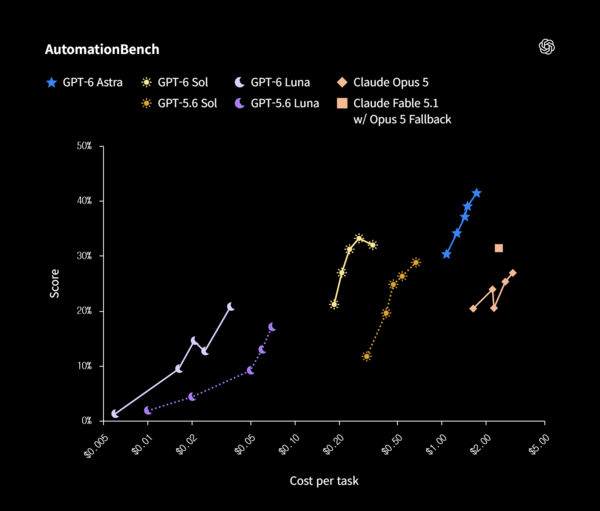
The existing top-tier model, "GPT-6 Astra," is aimed at complex tasks that require high performance. In contrast, "GPT-6 Sol" and "GPT-6 Luna" are based on technical improvements made to Astra. The design goal of these models is faster and cheaper AI use.
GPT-6 Sol strengthens capabilities across a range of tasks, including complex enterprise workflow automation, coding, and computer use. Internal OpenAI evaluations showed that GPT-6 Sol's factual errors fell by about half compared with the existing "GPT-5.6 Sol." GPT-6 Luna also improved professional task performance, factual accuracy, and coding performance.
In "DeepSWE v1.1," which measures complex software development tasks, GPT-6 Luna scored 66.6%. GPT-6 Sol scored 68.8% on the same "DeepSWE v1.1." GPT-6 Luna showed performance close to GPT-6 Sol on "DeepSWE v1.1."
OpenAI's key focus is the API price cuts. GPT-6 Sol is priced at USD 2 per 1 million input tokens and USD 10 per 1 million output tokens. Compared with the promotional price of the existing GPT-5.6 Sol, GPT-6 Sol is 50% cheaper for both input and output, and it is 80% cheaper than the top-tier GPT-6 Astra. GPT-6 Luna is priced at USD 0.1 per 1 million input tokens and USD 0.5 per 1 million output tokens.
OpenAI pointed to improvements in caching and inference technology as the reason for the price cuts. The company said these improvements reduced the cost of providing the models, and that it passed those savings directly into the Sol and Luna API prices.
The primary distribution channels for the two models are ChatGPT Work, Codex, and the OpenAI API. Free-tier users and Go-tier users can use GPT-6 Luna in the desktop app. OpenAI plans to gradually expand both models to standard ChatGPT.
OpenAI said that Astra's capabilities are needed for the most demanding and important projects. At the same time, it said that work differs by scale, speed, and budget, adding that Sol and Luna are intended to improve cost efficiency and make Astra's new intelligence benefits available more broadly.
On the same day, Anthropic unveiled its new AI model, "Claude Opus 5.5 (Opus 5.5)." Anthropic released "Claude Opus 5" last July, and the unveiling of "Claude Opus 5.5" comes about two months after the release of "Claude Opus 5." This is the first model unveiled since Anthropic CEO Dario Amodei suggested slowing the pace of advanced AI development to allow time for safety measures.
Anthropic also released benchmark results for Claude Opus 5.5. The evaluation covered coding, professional knowledge work, and computer use, and compared performance against existing models and competing models. The source attribution for the benchmark image was Anthropic. Against this backdrop, the AI industry was described as continuing to compete on product launches and cost reductions despite calls to slow down.
Anthropic announced Opus 5.5 and said the model maintained Claude Fable 5.1 (Fable 5.1)-level performance in most tasks while strengthening large-scale code modification capabilities and long-duration complex task execution. One early trial user completed a 680,000-line code migration within a day.
Anthropic said it also improved cost efficiency through price cuts. The Opus 5.5 API is priced at USD 4 per 1 million input tokens and USD 20 per 1 million output tokens, representing a 20% reduction in both input and output prices from Opus 5. The cost of cached reads for AI agents and coding tasks was cut by 60%, and token usage per task was also reduced, bringing the cost of routine tasks under the default setting down by about 40%. Output generation speed improved by more than 30% compared with the previous model.
Opus 5.5 is currently available on the Anthropic Claude platform, AWS, Google Cloud, and Microsoft Azure. Anthropic plans to release Claude Sonnet 5.5 (Sonnet 5.5) and Claude Haiku 5.5 (Haiku 5.5) within the next few weeks.
Anthropic said Opus 5.5 is the first model released since the call to slow the pace of cutting-edge AI development. It also said the model underwent external evaluation before release and that its own automated behavior audit score was the highest among its test models.
Source: IT DAILY · Yang Seung-gab
Original: https://www.itdaily.kr/news/articleView.html?idxno=241815
References
This article was produced with the help of an automated content generation algorithm.
Source: IT DAILY
View originalThis article was summarized and organized by BizCrush based on the original article from IT DAILY. For exact quotations and full details, please refer to the original article.