Korea and Sweden Step Up Offshore Wind Supply Chain Cooperation, Joining Forces on Munmu Baram Key Sectors
TECHWORLD ·
✦ AI Summary
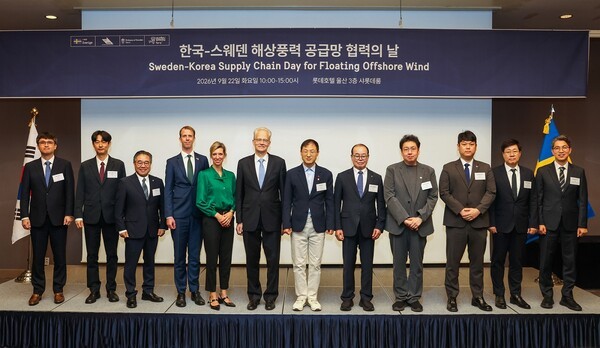
The Swedish Trade and Invest Council in Korea, the Embassy of Sweden in Korea, and floating offshore wind project Munmu Baram co-hosted the "Korea-Sweden Offshore Wind Supply Chain Cooperation Day" on the 22nd.
That day, an MOU aimed at building Munmu Baram's core supply chain was signed, and the areas of cooperation are subsea and power cables, offshore wind substructures, and ports and logistics.
The participating parties will pursue supply chain cooperation and commercialization by linking the manufacturing, shipbuilding, marine engineering, and project execution capabilities of Korean companies with Sweden's capabilities in offshore wind development, power infrastructure, engineering, and sustainable technologies.
The Swedish Trade and Invest Council in Korea, the Embassy of Sweden in Korea, and floating offshore wind project Munmu Baram co-hosted the "Korea-Sweden Offshore Wind Supply Chain Cooperation Day" on the 22nd. The event was organized as a venue for Korea and Sweden to fully step up cooperation on offshore wind supply chains through Munmu Baram.
According to a statement from the Swedish Trade and Invest Council in Korea, a memorandum of understanding (MOU) aimed at building Munmu Baram's core supply chain was signed that day. The purpose of the agreement is to establish a supply chain cooperation framework in key floating offshore wind sectors.
The key sectors covered by the agreement are subsea and power cables, offshore wind substructures, and ports and logistics. The focus is on building a supply chain system that links the main sectors of floating offshore wind.
The participating parties plan to connect the expertise, production infrastructure, and logistics infrastructure of major domestic companies with Munmu Baram. Based on this, they aim to establish a stable supply chain foundation.
They are also pursuing a strategy to link the manufacturing, shipbuilding, marine engineering, and project execution capabilities of Korean companies with Sweden's capabilities in offshore wind development, power infrastructure, engineering, and sustainable technologies. Through this, the goal is to develop Korea-Sweden cooperation into concrete business stages.
On the Swedish side, Munmu Baram, which is led by Sweden, and Hexicon, a development participant, shared Swedish technologies and experience related to project development, power infrastructure, industry, and engineering solutions. Together with participating companies Hitachi Energy Korea and Atlas Copco Korea, they also explored cooperation possibilities across the floating offshore wind supply chain with domestic companies and institutions.
In this context, LS is the partner for subsea and power cables. LS has cable production and supply capabilities, and the goal is to strengthen domestic production and procurement bases.
As part of the response plan, the companies will manage supply chain risks, including cable specifications, production, and delivery timelines, starting from the design and procurement stages. Through this, they aim to secure a stable cable supply foundation for the Munmu Baram project, accumulate experience in carrying out floating offshore wind projects, and expand opportunities to participate in future domestic and overseas projects.
GS is the partner for the fabrication of offshore wind subsea foundation structures. GS has strengths in large-structure fabrication experience and large-scale production infrastructure, and it plans to maximize its capability to pre-fabricate and supply essential subsea foundation structures for floating offshore wind.
The partners in the port and logistics sector are five logistics companies based at Ulsan Port. The participating companies are Dongwon LOEX, KCTC, Daewoo Logistics, Esprit Logistics, and Sewha Shipping. Port and logistics cooperation is structured to support the full range of materials logistics required to carry out the project, including inbound transport, storage, transportation, and shipping of equipment.
To this end, the plan is to proceed by linking each company's specialized capabilities with Ulsan Port infrastructure. The agreement was presented as a foundation for connecting the industrial and technological strengths of Korea and Sweden to an actual floating offshore wind project and supply chain cooperation.
Karl-Ulrik Andersson, Sweden's ambassador to Korea, said the agreement has laid the groundwork for linking the strengths of Korea and Sweden with actual floating offshore wind projects and supply chain cooperation. He cited manufacturing, shipbuilding, and the marine industry as Korea's strengths, and offshore wind, power, and engineering technologies as Sweden's strengths. He added that he hopes practical cooperation between companies in the two countries will expand and that they will jointly pursue a sustainable energy transition.
Source: TECHWORLD · Lee Gwang-jae
Original: https://www.epnc.co.kr/news/articleView.html?idxno=407318
References
This article was produced with the help of an automated content generation algorithm.
Source: TECHWORLD
View originalThis article was summarized and organized by BizCrush based on the original article from TECHWORLD. For exact quotations and full details, please refer to the original article.