Akamai: “There Is No Silver Bullet for Security…Multi-Layered Defense Is the Answer”
IT DAILY ·
✦ AI Summary
Akamai said there is no single solution to AI-driven cyber threats, so a multi-layered defense is necessary.
Han Jun-hyeong, managing director at Akamai Korea, said the company has completed preparations to respond to vulnerabilities, data leaks caused by AI, and Micro-segmentation.
Akamai said it is linking edge computing with AI data centers to meet AI inference demand, while in South Korea power, cooling facilities, and data sovereignty are limiting factors.
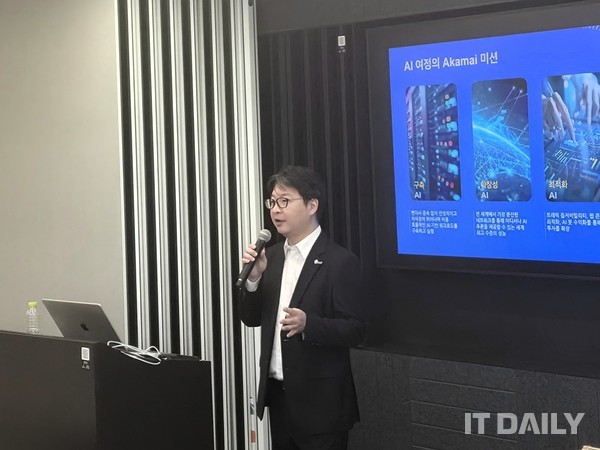
Akamai said that, because there is no single solution for security, a multi-layered defense is necessary. At a press briefing held on the 22nd at Akamai Korea’s headquarters in Gangnam-gu, Seoul, Han Jun-hyeong, managing director at Akamai Korea, said there is no silver bullet that can solve all AI-driven cyber threats. Han said Akamai stresses multi-layered defense because it links multiple solutions, and he emphasized the need for such a defense at the briefing.
Han also said Akamai has completed preparations to respond to vulnerabilities, has completed preparations to respond to data leaks caused by AI, and has also completed preparations for Micro-segmentation for zero trust.
Akamai launched in 1998 as a CDN company and later expanded into cybersecurity and cloud businesses. It also established its Korean subsidiary in 2008 and has secured more than 280 domestic clients. Akamai has strengthened its position in the local market.
Akamai identified AI as a key technology to watch. Lee Kyung-joon, CEO of Akamai Korea, said the shift to agentic AI is changing enterprise applications, work environments, and IT infrastructure. He said AI competitiveness is not secured by a single superior model alone, adding that factors ranging from speed and performance to security and data control are all intertwined.
Akamai cited simplicity, scalability, cost optimization, and cybersecurity as the keywords of the AI era. Regarding this, Han said security is the core that underpins every element.
Akamai said that as IT systems change with the AI transition, external connection points are increasing. It also said attacks are intensifying in both speed and scale because of AI. Han said that after the emergence of cutting-edge AI earlier this year, "Machine Speed" has come to the fore, adding that the challenge for defense is to keep pace with AI-based attacks.
Han pointed out that a strategy centered on vulnerability detection and patching has limitations. He said that, accordingly, a response based on the assumption that IT assets may be breached is necessary.
Akamai proposed a multi-layered defense framework as a way to address new security threats. It blocks risky elements first at the web browser, which is the user touchpoint, and even if an external hack succeeds, it prevents damage from spreading through Micro-segmentation. On top of that, it responds by applying ZTNA and MFA as means to protect the network domain.
Regarding the need for this kind of structure, Han cited the IT industry maxim, "There is No Silver Bullet." The saying means there is no one-size-fits-all technology that can solve a problem at once.
Han said Akamai provides a wide range of security solutions. He also said that because various attacks are flowing into IT systems, a single defense framework cannot block all of the many threats.
Akamai is accelerating its cloud business. The company acquired U.S. cloud computing services company Linode in 2022 and, with that as a springboard, entered the public cloud business.
Akamai is building business results in South Korea, centered on the gaming industry. Devsisters and SmartBig were cited as examples of domestic achievements.
The company highlighted the network and data center resources it has accumulated through its CDN and security businesses as strengths. Managing Director Kang Seong-jin said the company provides services with low costs and minimal latency based on its own network.
Akamai is focusing on the use of AI inference capabilities as companies move to integrate AI models into service chatbots and game services. Accordingly, it presented a direction for responding to related corporate demand.
Akamai plans to support ultra-low-latency services by linking its edge computing and AI data centers (AIDC). The photo shows a press Q&A session with Akamai Korea officials, with Lee Kyung-joon, CEO of Akamai Korea, and managing directors Han Jun-hyeong, Kang Seong-jin, Cho Sang-won, and Jang Seong-min seated. Photo by Kim Ho-jun.
Kang said that in AI inference environments, the distance between users and the AIDC can be more than 200 kilometers. He said Akamai has built a service that communicates with the AIDC through edge servers near users, and that the entity performing the computation is the GPU. He added that the network segment responsible for transmission can improve speed by passing through edge servers.
Kang said that in the long term, as the processing specifications of edge servers become more advanced, the company is aiming to directly equip them with GPUs. However, he said direct GPU installation is currently physically difficult. Accordingly, the company is now using the two domains in parallel, and its main tasks are minimizing latency and maximizing inference performance.
He then introduced Devsisters and SmartBig as domestic client examples. Devsisters is using Akamai cloud and GPU resources and applying AI functions such as recommendations and image processing to the CookieRun series. SmartBig is using Akamai Cloud to reduce data transfer costs for its global game infrastructure.
In the domestic market, the power and cooling conditions needed to operate AI data centers, as well as data sovereignty and sovereign AI requirements, are presented as constraints. Domestic variables cited include a shortage of power for AI data centers, a lack of cooling facilities, and demands for data sovereignty and sovereign AI. Kang said it is difficult to secure AI data centers with sufficient power and cooling facilities, and that domestic demands for data sovereignty are also strong.
Kang assessed that, because of these conditions, the Korean market cannot be approached in the same way as other countries, while also suggesting the possibility of expanding domestic infrastructure. He added that the company is preparing market-specific measures for South Korea and said related details are expected to be announced at a global event in the coming months.
Source: IT DAILY · Kim Ho-jun
Original: https://www.itdaily.kr/news/articleView.html?idxno=241799
References
This article was produced with the help of an automated content generation algorithm.
Source: IT DAILY
View originalThis article was summarized and organized by BizCrush based on the original article from IT DAILY. For exact quotations and full details, please refer to the original article.