[AI Brief] LG Expands AI Strategic Cooperation With MS... Pushing Ahead on AIDC, Physical AI, and AX Across the Board
IT DAILY ·
✦ AI Summary
LG held a top management meeting (TMM) at Microsoft headquarters in Redmond, Washington state, U.S. on the 21st and signed a strategic partnership.
The two companies will cooperate across the broader AI business, including AIDC, physical AI, and AX, and discussed three major areas: AI data center infrastructure, AI transformation, and physical AI.
Xenon has passed the preliminary KOSDAQ listing review and is moving ahead with its IPO process, while Liner has signed an MOU with KAIST on policy research AI cooperation, and PCN is pursuing the development of distributed data federated computing technology.
The "AI Brief" section is a daily feature introducing key AI news from Korea and abroad. As AI technology increasingly transforms industry and everyday life, this brief focuses on LG's expanded AI strategic cooperation with MS.
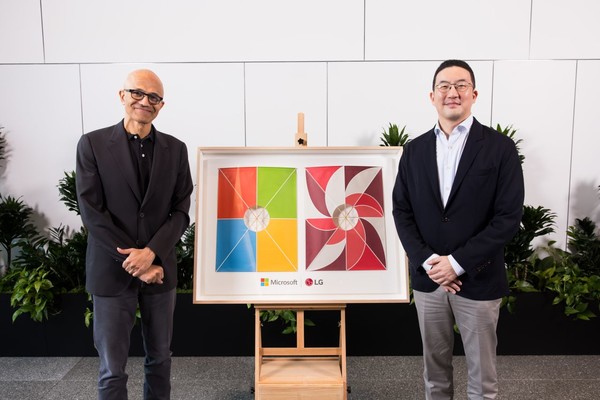
LG announced on the 21st (local time) that it had held a top management meeting (TMM) at Microsoft headquarters in Redmond, Washington state, U.S. The meeting was attended by LG Chairman Koo Kwang-mo and Microsoft CEO Satya Nadella.
As a result of the meeting, the two companies signed a strategic partnership. However, LG's relationship with MS was not a new build but an expansion of their strategic partnership, and it took place as an extension of LG's expanded AI strategic cooperation with MS.
The scope of cooperation covers the entire AI business, including AIDC, physical AI, and AX. The two companies discussed three major areas of cooperation to expand the AI ecosystem, and that cooperation will be pushed ahead with around those three areas.
The photo shows Microsoft CEO Satya Nadella and LG Group Chairman Koo Kwang-mo. The photo source is LG Electronics' LinkedIn.
LG will pursue collaboration across the range from AI data center infrastructure to AI transformation and physical AI. In the AI data center infrastructure segment, it will seek business opportunities and push ahead with plans to supply LG's cooling, power, and IT infrastructure solutions in connection with MS's global data center expansion. LG aims to stably supply key AI data center solutions and to establish itself as a practical supply partner in MS's global AI infrastructure expansion.
In the AI transformation segment, LG will pursue a transformation into an "AI-native" company. To this end, it plans to introduce MS AI and cloud platforms, including Copilot and "Microsoft 365 E7: Frontier Suite," for office workers across the company.
In the physical AI segment, cooperation will be expanded. LG plans to use MS cloud infrastructure for model development and training in real-world domains such as manufacturing, logistics, and mobility. In addition, it plans to build a "data flywheel," meaning a repetitive structure of accumulating data from manufacturing sites and training models, and the two companies will jointly use their infrastructure and platforms in that process.
Xenon has passed the preliminary review for a KOSDAQ listing, moving its IPO process into full swing. Xenon announced on the 22nd that it had received approval from the Korea Exchange on the 21st for its preliminary KOSDAQ listing review.
Xenon submitted its preliminary listing review application in July, and it took about 2 months from submission to approval. Samsung Securities is the lead underwriter, and Xenon plans to enter KOSDAQ through a general listing.
Xenon was founded in 2017. The company has its own enterprise AX platform, "Xenos," and supports the entire process of corporate AI strategy planning, development, introduction, and operations.
Xenon has accumulated project experience in finance, the public sector, and power generation. Recently, it has diversified its customer base and areas of application into manufacturing and pharmaceuticals.
Based on the growth of its enterprise AX business, Xenon plans to advance its AI infrastructure, agent, and physical AI technologies. It also plans to expand its global business.
Xenon has received approval for its preliminary listing review. As follow-up steps, it plans to sequentially file a securities registration statement, conduct demand forecasting, and carry out a general subscription.
Xenon plans to invest the funds raised through the listing in expanding its AI infrastructure. The funds will be used to secure computing resources such as graphics processing units (GPUs), advance its proprietary AI platform technology, advance AI agent technology, and advance physical AI technology. Xenon also plans to use the funds to secure top talent and pursue global business.
The people in the photo are KAIST Professor Park Kyung-ryul and Liner AI strategy head Kang Jeong-gu, and the photo source is Liner. Liner has joined KAIST in AI-based policy research cooperation and has begun developing AI-based policy research methodologies.
This cooperation starts with a proof of concept for a research workflow using AI agents in academic research. The two sides plan to jointly develop a knowledge graph specialized for the policy field, a verification agent, and a policy simulation environment.
On the 22nd, Liner announced that Liner and Professor Park Kyung-ryul's di-Lab (Digital Innovation and International Development Lab) at the Graduate School of Science and Technology Policy, Korea Advanced Institute of Science and Technology (KAIST), had signed a memorandum of understanding (MOU) for research cooperation in the "policy research AI" segment. The agreement aims to jointly develop a knowledge graph specialized for the fields of international development and science and technology policy based on the use of the academic research AI agent "Liner Scholar," jointly develop AI agents specialized for the fields of international development and science and technology policy, and demonstrate and analyze the effects of AI on policy research productivity and on access to policy research knowledge.
To this end, the two sides will pursue three core tasks: proof-of-concept research on the Liner Scholar-based research workflow, development of a domain knowledge graph and verification agent, and research on policy simulation based on the knowledge graph.
Under the division of roles, Liner will be responsible for AI agent technology support and support for systems development capabilities, while di-Lab will provide domain expertise, set the application context, handle verification, and conduct academic research.
PCN announced on the 22nd that it will pursue advancing core technologies for the project "Development and Demonstration of Distributed Data Federated Computing Technology to Strengthen Data Utilization."
The goal of this technology research is to develop secure federated computing technology. The purpose is to use distributed data analysis and AI training while protecting personal information and corporate secrets.
Secure federated computing is a technology that uses distributed data produced and collected by large-scale local terminals and institutions without moving it to a central location. This technology performs federated analysis and AI training without leaking personal information or corporate secrets.
The development targets are a hierarchical federated computing platform, multi-layer federated analysis, and multi-model split federated learning technology. PCN explained that once federated computing technology is advanced, collaborative analysis and AI training will be possible without directly moving or integrating data, even in environments where sharing raw data between institutions is difficult because of personal information and corporate secrets.
As a follow-up step, demonstration of application services using real data will be carried out.
Lee Geum-tak, executive vice president of PCN's R&D headquarters, said the company is presenting a direction that supports the use of data distributed across multiple institutions for AI training and analysis on the premise of protecting personal information and data sovereignty, and that to this end it aims to create a data and AI cooperation environment for various industries such as healthcare, finance, and education by continuously advancing related technologies.
Source: IT DAILY · Yang Seung-gap
Original: https://www.itdaily.kr/news/articleView.html?idxno=241797
References
This article was produced with the help of an automated content generation algorithm.
Source: IT DAILY
View originalThis article was summarized and organized by BizCrush based on the original article from IT DAILY. For exact quotations and full details, please refer to the original article.