LG Energy Solution Expands AI Across Battery R&D, Advances Materials, Design, and Life Prediction
TECHWORLD ·
✦ AI Summary
LG Energy Solution is expanding the use of AI across battery research and development.
The scope of application covers battery materials discovery, cell design, performance and life prediction, and smart factories.
The company aims to combine more than 30 years of accumulated research data and expert domain knowledge with AI to improve development speed and accuracy.
LG Energy Solution is expanding the use of artificial intelligence (AI) across battery research and development. The scope of application covers battery materials discovery, cell design, performance prediction, and life prediction. The company aims to use this to speed up development and improve accuracy.
LG Energy Solution plans to combine more than 30 years of accumulated research data and expert domain knowledge with AI. Based on this foundation, the company intends to broadly apply AI across multiple stages of battery research and development.
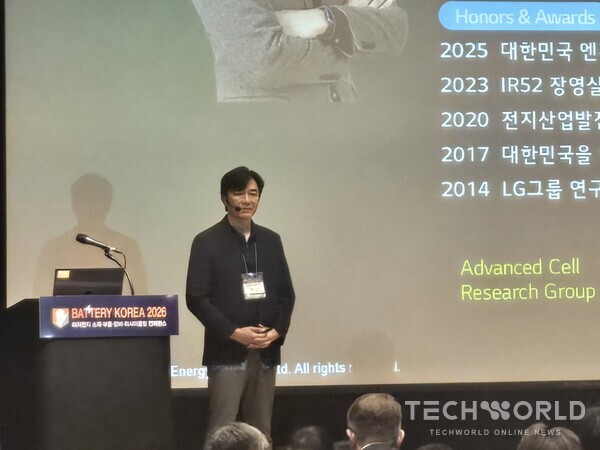
This strategy was introduced by Executive Vice President Lee Jae-heon of LG Energy Solution at 'Battery Korea 2026,' held on the 21st at COEX in Seoul. The presentation topic was 'LG Energy Solution's AI Transformation Strategy for Cell R&D.'
Lee has continued battery cell research since joining LG Chem in 1999. He currently leads the advanced development organization, which is responsible for battery materials, new processes, and core technologies for cell development.
LG Energy Solution sees EVs and ESS as the key sources of demand in the current battery market. It also expects the battery market to expand once autonomous vehicles, humanoid robots, and UAM become commercialized.
As battery market expansion continues and technology competition with Chinese companies intensifies, Chinese firms are also expanding their production capacity. They are likewise continuing large-scale investments in research manpower and patents, sharpening competition.
In this situation, LG Energy Solution has presented a response strategy centered on combining AI with long-accumulated research assets rather than competing only on the scale of investment. The company has highlighted a method that does not rely on generic data as its differentiating approach.
LG Energy Solution is using in-house experimental data and battery experts' judgment as resources. Lee explained that because Chinese companies are making significant investments in AI personnel and resources, simply introducing AI alone would make it difficult to secure an advantage.
Lee pointed to more than 30 years of accumulated data and expert domain knowledge as LG Energy Solution's key differentiators. Based on this, the company is broadening the areas where it is pushing forward with the transformation of battery R&D.
LG Energy Solution's areas for pushing forward with the transformation of battery R&D are materials discovery, cell design, performance and life prediction, and smart factories. Lee introduced AI applications in research and development, excluding the production segment, on this day.
In AI-based materials discovery, the company is using not only publicly available information but also experimental data accumulated by the company and the specialized knowledge of its researchers. By combining internal data with expert judgment, it is searching for the necessary materials, compositions, and application methods.
A representative example of this approach is battery material surface coating technology. In the past, researchers individually reviewed candidate materials, but moving forward, the development process is set to shift based on AI suggesting suitable coating materials and experimental directions.
The company is also applying AI to cell design. Whereas the existing cell design method involved designing a specific structure and then calculating the expected performance, the future approach will first input the performance required by customers and then reverse-engineer the materials and cell structure needed to achieve it.
To support this, the company is building a battery development agent. This agent will handle tasks such as setting the direction for materials development, exploring cell designs that meet customer requirements, and organizing battery testing schedules.
Lee said that while performance prediction by design was the focus in the past, the company is now developing an agent that finds design methods capable of meeting target performance. He explained that the focus of design work is shifting from performance prediction to exploring designs that satisfy target performance.
In this process, AI is being used for battery performance and life prediction. This also includes estimating battery health status (SOH) and detecting unusual behavior and abnormal degradation in advance.
AI is also being used to predict lithium plating during fast charging. In addition, analyses are being conducted on life by cell structure and charging conditions, as well as fast-charging performance by cell structure and charging conditions.
The results of these analyses are used to adjust designs from the early stages of development. Lee said the company preemptively predicts whether abnormal degradation will occur in life evaluations at the design stage or early evaluation stage, and then reflects the causes of degradation back into the design.
The company is also conducting research to optimize charging and discharging conditions by considering differences in the lifespan of the same battery depending on usage conditions. Simulation-based exploration of conditions that allow long-term use is also under way.
Lee explained that the company is reflecting the results of preemptive detection of unusual behavior and abnormal degradation in its designs. He added that the results of simulation-based exploration of conditions for long-term use are being provided to customers.
LG Energy Solution is pushing forward with plans to link AI and automated laboratories, aiming to improve research speed.
At its Gwacheon R&D campus, the company plans to sequentially build automated experimental facilities to create a research environment that connects battery manufacturing and evaluation. Coin-cell automated manufacturing equipment is already being used in research, and the scope of automation will be expanded to coin cells, mono cells, and pouch cells. The company also plans to connect the performance and life evaluation process for manufactured batteries into a single system.
In this system, data secured from the automated laboratory will be used to train AI models and support design work. AI will suggest experimental directions, automated facilities will carry out the proposed experiments, and the results will be reflected in the next design, creating an integrated structure.
Through this, LG Energy Solution expects to reduce repetitive work for researchers. It also expects to shorten the time required for materials discovery, cell design, testing, and evaluation.
As experimental data accumulates, the company also expects AI's accuracy in predicting performance and lifespan to improve.
Lee said that the standards for research competitiveness in the past were the scale of input resources, the depth of research, and the length of research periods. He added that going forward, the company must maintain its more than 30 years of accumulated research assets while combining them with AI to improve the speed and efficiency of innovation.
Following this direction, LG Energy Solution plans to combine battery research data and expert knowledge with AI and link the development process from materials discovery to experimentation and evaluation. Through this, the company expects to shorten research periods and respond to the investment and patent offensive by Chinese companies.
Source: TECHWORLD · Kim Seung-gi
Original: https://www.epnc.co.kr/news/articleView.html?idxno=407239
References
This article was produced with the help of an automated content generation algorithm.
Source: TECHWORLD
View originalThis article was summarized and organized by BizCrush based on the original article from TECHWORLD. For exact quotations and full details, please refer to the original article.