Acrylic to Join 65 Billion-Won Physical AI National Project... Developing an Execution Layer for Heterogeneous Robots
TECHWORLD ·
✦ AI Summary
Acrylic said on the 22nd that it will participate in a physical AI national project worth about KRW 65 billion.
Acrylic will join the Sungkyunkwan University Industry-Academic Cooperation Foundation-led project as a joint research and development institution, taking on the development of an execution layer that connects AI models with real robots.
Based on Jonathan PAI, Acrylic will pursue robot connectors, benchmarks, and verification, with the goal of integrating and controlling at least 7 types of robots through the standard interface by 2030.
Acrylic said on the 22nd that it will participate in a physical AI national project worth about KRW 65 billion. The project is the Ministry of Science and ICT and the National IT Industry Promotion Agency (NIPA)'s "Creating a Research and Development Ecosystem for SW Platforms Based on Collaborative Intelligence Physical AI" initiative.
The project Acrylic will join is "Research and Development of a Specialized Base Model for Heterogeneous Collaborative Physical AI SDF," led by the Industry-Academic Cooperation Foundation of Sungkyunkwan University. The project will run for 4 years and 5 months, from last August through December 2030, with a total budget of about KRW 65 billion and government funding of about KRW 45 billion.
A total of 18 industry-academia-research institutions will participate in the project. Participating organizations include KAIST, Seoul National University, Rainbow Robotics, and Hyundai Wia.
Acrylic will take part as a joint research and development institution and will be responsible for developing an execution layer that connects AI models with real robots. It will also join the steering committee, taking part in coordinating the project's budget, schedule, and performance goals. The institutional lead researcher is Lee Su-gi, head of Acrylic Research Institute.
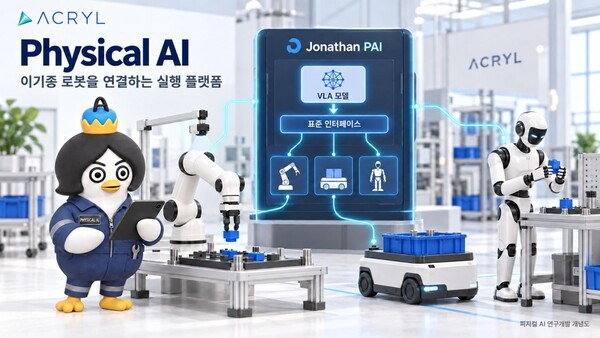
Acrylic will develop an execution layer that connects VLA models with real robots. The base platform is the physical AI integrated platform Jonathan PAI (Jonathan PAI), which supports the training, inference, and serving of VLA models. Based on this, Acrylic will build a standard interface for linking different robots.
Acrylic will develop a real-time robot communication gateway. It will also develop a pipeline for automatically collecting and managing robot operation data. Acrylic plans to secure robot connectors for linking industrial robotic arms, autonomous mobile robots (AMRs), and humanoids.
Acrylic will also establish a benchmark for evaluating the performance of heterogeneous robots. In addition, it will pursue verification to confirm whether the base model and platform operate properly in real manufacturing sites.
Jonathan will be used as a benchmark for measuring project performance. The research and development plan includes the number of robots that can be connected and controlled in practice through Jonathan as an indicator. The project target deadline is 2030, and the goal is to integrate and control at least 7 types of robots with different form factors, degrees of freedom, and sensor configurations into the Jonathan standard interface.
The company said it has made expanding the scope of physical AI platform applications a core task by building a structure that is not tied to specific AI models or robot types. Through this, it plans to create a structure that can connect and control various VLA models and robots within a single execution layer.
The technologies under development will be demonstrated at manufacturing sites such as food, automotive parts, commercial vehicles, and metal processing. In addition, the demonstration will also include sample and specimen handling in CAR-T cell therapy manufacturing processes and collaborative operation of heterogeneous robots, with the goal of expanding applicability to bio-manufacturing environments.
The company plans to commercialize the technologies secured through the project. Acrylic will develop "Jonathan PAI Robotics Edition," a robot connector library, and a third-party benchmark certification service, and it also plans to pursue a subscription-based licensing model linked to the number of deployed robots.
It also plans to hire 5 new researchers in robotics middleware, multimodal data platforms, and field demonstration. The company said this is to extend the heterogeneous resource management capabilities it has built in GPU infrastructure software to robot environments and strengthen the foundation for its physical AI business.
Acrylic CEO Park Oe-jin said the company's role is not to manufacture robots or robot brains, but to handle the execution layer that connects various AI models and robots. He added that, as Acrylic has accumulated experience in heterogeneous resource management based on GPU infrastructure software, it is pursuing the expansion of heterogeneous resource management capabilities into physical AI and aiming to advance Jonathan into a platform for connecting various AI models and robots.
Source: TECHWORLD · Kim Seung-gi
Original: https://www.epnc.co.kr/news/articleView.html?idxno=407309
References
This article was produced with the help of an automated content generation algorithm.
Source: TECHWORLD
View originalThis article was summarized and organized by BizCrush based on the original article from TECHWORLD. For exact quotations and full details, please refer to the original article.