[Interview] “The Key to AI Use Is Understanding Data and Integrated Governance”
IT DAILY ·
✦ AI Summary
Companies’ interest in adopting AI is shifting from comparing models themselves to how to use data.
Lim Jin-sik, head of solution engineering (SE) at Snowflake Korea, said that accurately understanding data meaning and business context is important to applying AI in practice.
Snowflake said it connects data collection, storage, analysis, and AI usage through a single platform and provides models from OpenAI, Anthropic, Google, and DeepSeek.
Companies’ interest in adopting AI is shifting from comparing models themselves to how to use data. In an interview with IT Daily at an office in Yeoksam-dong, Gangnam-gu, Seoul, Lim Jin-sik, head of solution engineering (SE) at Snowflake Korea, said that until last year, there were many questions about which model to choose and whether to switch to a better one. He added that now, concerns are growing over how well AI can understand corporate data and how useful information it can provide based on that data.
As it becomes more important for AI to accurately understand data meaning and business context in practical use, the role of an 'AI data platform' that connects data and AI in a single environment is also expanding. This platform is characterized by managing data and AI together while applying consistent governance.
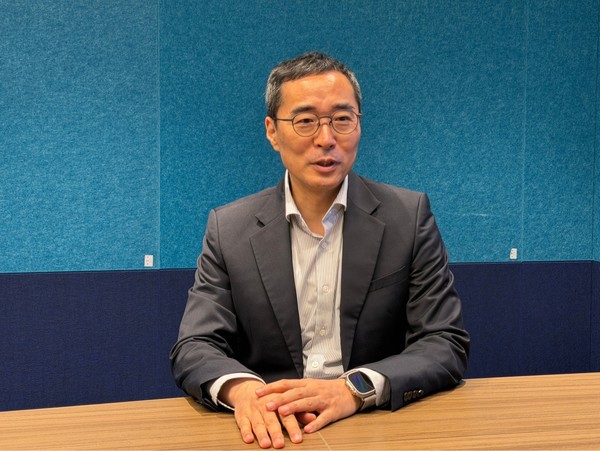
Lim Jin-sik, head of solution engineering (SE) at Snowflake Korea, offered an assessment of how companies’ use of AI is changing. Photo courtesy of Snowflake.
In the past, companies mainly reviewed ways to move corporate data into external AI model environments and use it there. But this process increased cost burdens and made data migration more difficult.
As a result, attention has shifted to keeping data in existing environments and connecting only the AI models needed. With this change, how accurately AI understands the meaning of corporate data and business context has become even more important.
Even with the same data, interpretation varies by company and organization. For example, the meaning of sales can differ depending on the aggregation scope and the calculation method. If these differences in aggregation scope and calculation method are not reflected, it is difficult to obtain the desired results in actual work.
Lim said that as concerns about AI increase, more companies are starting to look at AI from a data perspective more firmly than before. He explained that the prerequisite for conveying the meaning and context of data to AI accurately is organizing the data into a form that can actually be used.
However, the level of data readiness differs from site to site. Lim said the preparation of structured data is becoming more advanced, while the readiness of unstructured data remains low in some cases.
He also said that the degree to which unstructured data is linked with structured data so that AI can understand it well varies widely by customer. In other words, there are differences among customers in both the level of preparedness for structured and unstructured data and the way the two types of data are connected.
These differences become more pronounced in the operating stage. Even after confirming high accuracy in a PoC, the same performance may not continue once it is applied in the field.
In operations, it is necessary to reflect data context information and business workflows together. At the operating stage, not only the data itself but also context and business workflows must be incorporated together.
Lim said that high-quality data is important, but the key lies in linking data with the customer’s expected context level. He explained that context refers to the actual business meaning of data and how it connects with other information.
He also said that coordination at the organizational level is necessary. The background to this is the separation between the entity that manages the data and the department that actually uses it, and this was presented as a necessary process for deciding whether to use the data and who should bear operational responsibility.
Lim said there are differences in data readiness and large gaps between organizational responsibilities and the entities in charge of operational management. He also explained that because the data management entity differs, it takes a long time to decide whether to use the data.
In this situation, the introduction of AI agents is expanding the scope of management, and operational complexity is also increasing. The subject that accesses and judges data is expanding from humans to agents, and the scope of management is also broadening to include not only access permissions but also the actions they can perform.
Lim said that because AI agents have agency to access data on behalf of people, security and governance reinforcement for agents is needed at a level equal to or higher than that for people.
Accordingly, Lim identified the scope requiring tracking for agents as the commands received, the data accessed, and the subsequent actions performed. He also said that audits are needed to determine whether an agent had the proper permissions when accessing specific data, and whether the agent’s data access was based on a user’s intentional command.
Lim said that logging of the related processes is necessary, and he also said observability must be provided.
Lim said these changes are also altering the role of data platforms. He explained that the role of data platforms is expanding beyond collection, storage, and analysis to include supporting AI’s understanding and use of corporate data.
Lim explained that traditional data platforms focused on data collection, storage, and analysis, while the scope of an AI data platform includes support for trustworthy AI understanding and use of data.
In line with this, Snowflake proposed connecting data collection, storage, analysis, and AI usage through a single platform and applying the same governance framework. Snowflake presents this integrated data-and-AI environment as the 'Snowflake AI Data Cloud.' Lim presented the key challenge as whether the entire operational process from data collection and storage through application to AI work can be handled on a single platform, and whether it can be managed under a unified governance framework.
Lim said the role of an AI data platform is to create context between structured and unstructured data and provide a meaningful semantic layer, and he added that it should also comprehensively support context management, permissions and audits, observability, model selection, and cost management.
Snowflake presented Cortex Sense as an example of its AI use strategy. Cortex Sense automatically integrates data, business definitions, and operational knowledge to build a shared context. The shared context created in this way can be used immediately by AI agents. Lim said there is strong customer interest in generating context automatically instead of updating it manually.
Part of Snowflake’s strategy is connecting distributed data. The targets include external cloud, on-premises, and software as a service (SaaS) environments, and the connection method uses open formats. This supports use of the data without moving it to one place.
Lim said that gathering all data in one place is not always the best approach. He added that the company is moving toward greater openness and broader user choice.
Snowflake does not limit its AI model operations policy to a single model either. Snowflake offers models from OpenAI, Anthropic, Google, and DeepSeek, and supports model selection based on task difficulty and cost. Lim explained that customers can choose the model they need for each service, use high-performance models for deep analysis and research, and select relatively inexpensive models for simpler tasks.
Lim said he expects the future direction of AI data platforms to center on openness and integrated governance. He said AI services and the location of data will ultimately move toward openness, and that the field will evolve toward managing a comprehensive governance framework from a logical perspective rather than through physical centralization.
He also advised companies that, in AI use, data and organizational readiness to support actual deployment are more important than simply adopting technology. Lim recommended expanding consideration of context-building methods from an AI-ready data perspective, and said that reviewing organizational management systems and operating systems together can reduce the difficulties in building and adopting an AI data platform.
Source: IT DAILY · Yang Seung-gap
Original: https://www.itdaily.kr/news/articleView.html?idxno=241793
References
This article was produced with the help of an automated content generation algorithm.
Source: IT DAILY
View originalThis article was summarized and organized by BizCrush based on the original article from IT DAILY. For exact quotations and full details, please refer to the original article.