Government Shuts Down 66 Sex-Exploitation Sites, Expands CDN-Stage Blocking
IT DAILY ·
✦ AI Summary
The government held the third pan-government consultative body on digital sex crimes on the 22nd and reviewed its integrated response results against illegal sites.
It arrested 32 operators, shut down 66 sites, and reduced the number of active illegal pornography sites from 6,683 to 4,736, a 29% drop.
The government is moving beyond individual deletions to incapacitate sites themselves, expand CDN-stage access restrictions, introduce new blocking technology, and improve laws and institutions.
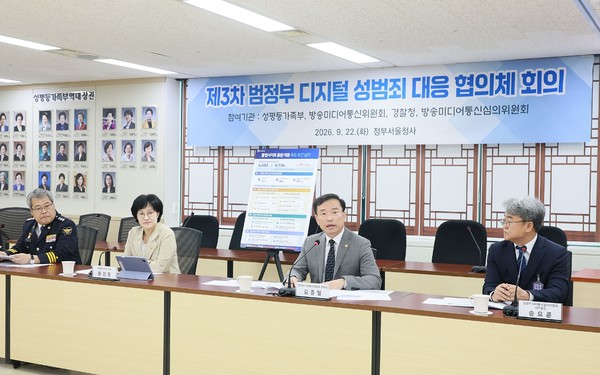
On the 22nd, the government held the third pan-government consultative body on digital sex crimes at the Government Seoul Office, with the Ministry of Gender Equality and Family, the Korea Communications Commission, the National Police Agency and the Korea Communications Standards Commission participating, and reviewed its integrated response results against illegal sites. The government checked progress after shifting the focus of its response to digital sexual exploitation materials from removing individual posts to incapacitating illegal sites themselves, and confirmed achievements of 32 arrests of operators and 66 sites shut down.
The government is responding by expanding existing access blocking to CDN-stage access restrictions for sites that bypass blocking by using CDN. Related agencies are continuing their integrated response to illegal sites by widening the scope of access restrictions to the CDN stage in response to cases that evade existing blocking.
At the consultative body meeting, Kim Jong-cheol, chairman of the Korea Communications Commission, gave opening remarks. Those in the photo are Hong Seok-gi, head of the National Investigation Headquarters of the National Police Agency; Won Min-kyung, minister of Gender Equality and Family; Kim Jong-cheol, chairman of the Korea Communications Commission; and Song Yo-hoon, secretary general of the Korea Communications Standards Commission.
The government said there were limits to supporting the removal of individual sex-exploitation materials alone, and on August 20 it announced an "integrated response plan to illegal sites." The number of active illegal pornography sites identified by the government fell 29% from 6,683 to 4,736. The plan focused not only on expanding support for the removal of individual sex-exploitation materials, but also on blocking the operating base of sites and channels for re-distribution.
Police arrested 32 site operators who used overseas servers or CDN, ignored removal requests, and repeatedly distributed illegally filmed material, and ordered 66 sites to suspend operations. Among them, developers were also arrested in 16 sites, and the illegally filmed material on those 16 sites was remotely seized and deleted. Criminal proceeds of KRW 2.7 billion were confiscated and collected before indictment. Police expanded the scope of their investigation, reviewing 300 illegal sites operated in Korean and 1,353 sites that had been supported for deletion by the Central Digital Sex Crime Victim Support Center from June to August, and as a result selected 170 sites as investigation targets. There are currently 76 sites under investigation, and the current targets also include sites referred for investigation by the Ministry of Gender Equality and Family. Four dedicated special investigation teams of 20 members each have been newly established at the Seoul, Busan, Gyeonggi Nambu and Jeonnam provincial police agencies.
However, new sites continue to appear by changing domains or impersonating existing sites. The government is continuing to track those sites.
Authorities are pushing access blocking for illegal sites together with review and corrective requests. As of August 20, the Korea Communications Standards Commission had identified 6,683 active illegal sites, completed corrective requests for blocking on 5,077 of them, and was reviewing 1,606 others. It also shortened the electronic review processing period for pornographic sites distributing illegal filmed material, reducing the time from the previous 1 to 2 weeks to an average of within 24 hours.
Authorities are also applying network-stage access restrictions to CDN that bypass existing blocking. The Korea Communications Commission conducted on-site inspections of 15 CDN providers, and the Korea Communications Standards Commission reviewed and decided on 443 digital sex crime illegal sites from April 28 to August 11. Of those, CDN providers identified 380 sites, and the Korea Communications Standards Commission completed access restrictions for all 380.
Authorities are also preparing new access-blocking technology to respond to the spread of encrypted communication protocols such as QUIC and encrypted client hello (ECH). The Korea Communications Commission and the Korea Communications Standards Commission are conducting live network verification with 8 internet service providers (ISPs), and the verification covers interoperability with existing blocking systems, the ability to handle large traffic volumes, and service stability. The government plans to introduce the new technology in the first half of 2027.
In responding to illegal sites, the government is working to advance detection and tracking technologies and improve the system, based on the use of artificial intelligence (AI). First, related ministries are pursuing the development of automatic illegal-site detection technology, as well as site-to-site relationship analysis technology and revenue-linked information extraction technology.
Then, from 2027 to 2030, under its plan to use agentic AI, it will pursue plans to develop source technologies for agentic AI-based detection and tracking automation, agentic AI-based evidence collection automation, agentic AI-based diffusion forecasting, and agentic AI-based preemptive blocking.
At the same time, legal and institutional reforms are also under way. A bill reflecting measures announced in August was introduced on August 31, and it includes criminalizing the act of opening illegal sites as an independent offense, blocking advertising revenue, and granting the right to request emergency blocking for sites that continuously ignore deletion requests. The government has determined that if the original server remains even after the operator is arrested, re-distribution of damaging videos is still possible, and is also pursuing the introduction of an active defense system that would allow direct access to overseas original-server sites for evidence collection and allow original content on overseas original-server sites to be deleted.
Won Min-kyung, minister of Gender Equality and Family, said this achievement is significant because it demonstrated the practical feasibility of incapacitating illegal sites with overseas servers, even amid the prevailing view that such sites are difficult to address. She added that the government will continue tracking them regardless of whether they are hidden overseas, and will root out illegal sites by relentlessly tracing domain changes and impersonation sites as well.
Source: IT DAILY · Kim Byung-ju
Original: https://www.itdaily.kr/news/articleView.html?idxno=241794
References
This article was produced with the help of an automated content generation algorithm.
Source: IT DAILY
View originalThis article was summarized and organized by BizCrush based on the original article from IT DAILY. For exact quotations and full details, please refer to the original article.