Liner, KAIST Apply AI Agents to Science and Technology Policy Research
TECHWORLD ·
✦ AI Summary
Liner and KAIST researchers signed an MOU for collaboration to apply AI agents to science and technology policy and global development research.
The collaboration focuses on applying Liner Scholar, an AI agent for academic research, to research settings to validate research workflows and analyze the impact of AI on research productivity and knowledge accessibility.
The two sides will move forward step by step with building a domain knowledge graph, developing a verification agent, and designing a policy simulation environment.
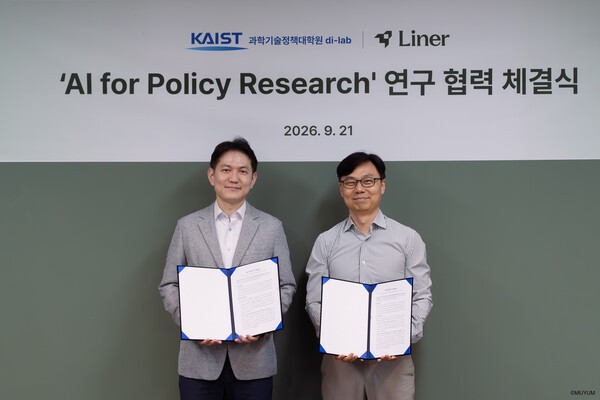
Liner and researchers at KAIST will apply AI agents to their science and technology policy and global development research. On the 21st, Liner announced that it had signed an MOU for research collaboration on "AI for Policy Research" with the di-Lab led by Professor Park Kyung-ryeol at the KAIST Graduate School of Science and Technology Policy and the Center for Science, Technology and Global Development Research, G-CODEs.
The collaboration focuses on using Liner Scholar, an AI agent for academic research. The two sides plan to apply it in research settings to validate research workflows in international development and science and technology policy, and to analyze how AI affects research productivity and knowledge accessibility.
To that end, the two sides will move forward step by step with validating research workflows based on Liner Scholar, building a domain knowledge graph, developing a verification agent, and designing a policy simulation environment.
The division of roles will see Liner take charge of developing AI agent technology and systems, while KAIST's di-Lab will provide expertise in policy and international development, define the application context, conduct verification, and carry out academic research.
The collaboration will first proceed with di-Lab researchers using Liner Scholar throughout the research process, including data collection, policy analysis, and paper writing, and then jointly analyzing the data generated in the process. The purpose of the joint analysis is to examine the impact of AI research tools on research productivity, check gaps in research capabilities between countries and regions, and assess disparities in AI use between countries and regions.
At the same time, the two sides will build a domain knowledge graph that structures complex entities and relationships involving institutions, programs, policies, and funding in the fields of international development and science and technology policy. They will also jointly develop a verification agent to check whether each piece of information is backed by its original source, with the aim of improving the reliability of research results.
The collaboration will then expand into policy simulation research. The two sides are considering ways to implement various stakeholders, including donor agencies, recipient country governments, and implementing organizations on the ground, as agents, and are also designing an environment that would allow them to analyze the ripple effects of policy interventions in advance based on the knowledge graph.
Professor Park Kyung-ryeol of KAIST said that while AI offers opportunities for innovation, it also has the potential to widen global gaps, and that through this collaboration, he will precisely analyze the ripple effects of global technological change and academically clarify the significance of applying AI to policy research.
Kang Jeong-gu, head of AI strategy at Liner, said the company aims to improve policy research productivity by combining Liner's AI technology with the domain expertise of di-Lab, and expressed its intention to build an AI-based policy research case that seeks to narrow global knowledge gaps.
Source: TECHWORLD · Kim Seung-gi
Original: https://www.epnc.co.kr/news/articleView.html?idxno=407295
References
This article was produced with the help of an automated content generation algorithm.
Source: TECHWORLD
View originalThis article was summarized and organized by BizCrush based on the original article from TECHWORLD. For exact quotations and full details, please refer to the original article.