Alibaba Unveils AI Full-Stack Roadmap From Chips to Agents, Sets Qwen 4 and 20 GW Data Center Plan
TECHWORLD · · 2 views
✦ AI Summary
Alibaba unveiled an AI full-stack roadmap and major new technologies at the Apsara Conference.
The announcements included the Qwen 4 training plan, development of the Qwen 4.5 and Qwen 5 series, and the Qwen-Image 3.1 and HappyOyster 2.0 Preview.
It also introduced the Zhenwu V900 AI chip, Agentic Cloud, and the Qwen Intelligence smartphone agent platform, while setting a goal of expanding data center capacity to more than 20 GW by 2032.
Alibaba said on the 22nd that it unveiled an AI full-stack roadmap and major new technologies at its annual technology event, the Apsara Conference. Rather than presenting AI-related elements as separate product units, Alibaba framed them as an interconnected system and unveiled a full-stack AI strategy linking AI chips, cloud infrastructure, foundation models, and agents. It also signaled a direction of expanding its technology scope across chips, infrastructure, models, and agents.
The announcement included model-related updates involving Qwen foundation and multimodal models. Alibaba presented its next-generation Qwen 4 training plan and also outlined a follow-up large-model roadmap. As presented in the headline, the items included a Qwen 4 and 20 GW data center roadmap.
Alibaba also unveiled its own AI chip. The announcement included an in-house AI chip and presented a configuration that extends into the hardware area. This was positioned as one pillar of the event, which focused on making models, infrastructure, and hardware into a single AI execution environment.
In the cloud and agent areas, Alibaba unveiled cloud infrastructure specialized for agent execution and Agentic Cloud, and also unveiled an AI agent platform for smartphones. The scope of the announcement extended from models to chips, cloud, and smartphone agent platforms. Through this, Alibaba signaled a direction of building an integrated AI environment that includes agent execution.
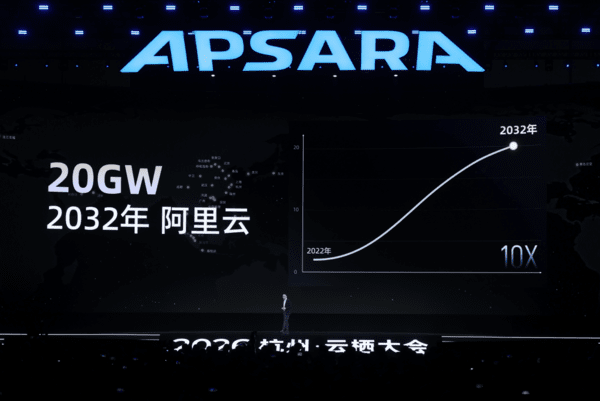
Eddie Wu, CEO of Alibaba Group, said the company plans to sharply expand its computing infrastructure in response to the spread of machine intelligence. To address rising AI demand, Alibaba set a goal of expanding the global data center capacity operated by Alibaba Cloud to more than 20 GW by 2032.
Wu said that as machines increasingly become the central subject of thought, large-scale supply of intelligence is becoming commoditized. He added that Alibaba plans to respond to new AI demand by expanding models and computing infrastructure at the same time.
On the model side, next-generation Qwen 4 is currently being trained. For follow-up development, the company plans to sequentially develop the Qwen 4.5 and Qwen 5 series, and Alibaba expects future model scale to expand to the 5 trillion to 10 trillion parameter range.
Automation is being expanded in the model development process. Qwen 3.8-Max automatically handled pipeline design, data validation, iterative experiments, and error diagnosis for a month and carried out 33 improvement cycles. The company said the Artificial Analysis score rose from 40 to 45 during that process.
The same performance-improvement approach has been extended to chip design experiments. The company said Qwen 3.8-Max carried out more than 60 hours of self-improvement and called EDA tools more than 10,000 times. As a result, it said it reduced the chip bus module area by 42% without performance degradation.
It then strengthened multimodal models across the board. Qwen 3.8-LiveTranslate cut real-time interpretation latency from 2.8 seconds to 2.3 seconds. Qwen-Audio-3.1-TTS-Next was developed as an audio model that generates dialogue and ambient sound at the same time, and the Qwen-Audio series models that support speech recognition and real-time interaction were also updated.
The unveiling also extended to the image and world model segments. The company unveiled Qwen-Image 3.1 in the image and world model area and also unveiled HappyOyster 2.0 Preview. Qwen-Image 3.1 is an image generation and editing model for e-commerce and design tasks, while HappyOyster 2.0 is a world model designed to enable continuous interaction in virtual environments.
Alibaba also rolled out new products and plans on both the software and hardware sides. First, it unveiled Qwen Intelligence, a corporate agent platform for smartphones. Qwen Intelligence is a full-stack agentic solution for smartphone makers and supports multi-app integration and complex task execution through Qwen-based agent functions.
In hardware, Alibaba semiconductor design unit T-Head unveiled Zhenwu V900, a processor for AI training and inference. Zhenwu V900 has 216 GB of memory and 1200 GB per second of inter-chip bandwidth. It supports FP8 and FP4 operations.
Alibaba also unveiled a next-generation supernode server combining Zhenwu V900 with its own networking chip and storage chip. Alibaba said the server was designed to support clusters capable of connecting up to 500,000 accelerator cards. Mass production and commercial release of Zhenwu V900 are scheduled for the first quarter of 2027.
Alibaba also presented a CPU roadmap that includes schedules for future generations of CPUs. It is developing Yitian 720 and Yitian 730 with a target launch in 2027, and plans to unveil Yitian 750 in 2029, directly connected to the Zhenwu AI chip.
To strengthen cloud capabilities, Alibaba positioned Agentic Cloud as the strategic centerpiece of its cloud business and divided the architecture into model, agent execution environment, and context data layers. Among these, the AI-native cloud handles large-scale training and inference, while the agent-native cloud handles agent deployment, operations, and security. The context engine provides real-time data and long-term memory.
On this structure, AgentCore, the enterprise agent platform, supports the full lifecycle from agent building to execution and management. Agent Security Center is designed to manage security and compliance issues during large-scale agent operations. Agent Context, a component of the context layer, connects enterprise documents, business systems, chat logs, and multimodal data.
Agent Context provides long-term memory and real-time context information. Alibaba said this can reduce token usage by up to 67% in some tasks.
Joe Tsai, chairman of Alibaba Group, said AI should be defined not merely as a technological innovation but as something that must generate productivity and value in real-world settings. He also stressed the importance of expanding the scale of AI use across industries.
Source: TECHWORLD · Kim Seung-gi
Original: https://www.epnc.co.kr/news/articleView.html?idxno=407297
References
This article was produced with the help of an automated content generation algorithm.
Source: TECHWORLD
View originalThis article was summarized and organized by BizCrush based on the original article from TECHWORLD. For exact quotations and full details, please refer to the original article.