Nota Unveils 3x Faster Robot AI on Qualcomm NPU, Validates Physical AI Optimization
TECHWORLD ·
✦ AI Summary
Nota said on the 22nd that it has lightweighted a vision-language-action (VLA) model on an edge AI board based on Qualcomm Dragonwing IQ-9075.
It directly ran a robot AI model on Qualcomm's industrial NPU and carried out NPU computation optimization, runtime optimization, and robot motion optimization.
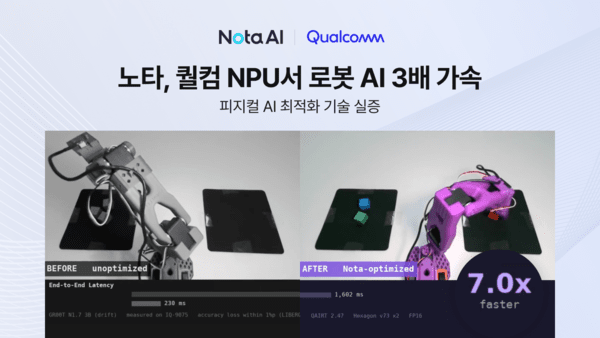
As a result, VLA inference speed increased by up to 7x, actual robot arm task speed improved by 3x, and object-moving time was reduced from 36 seconds to 12 seconds.
Nota said on the 22nd that it has lightweighted a vision-language-action (VLA) model on an edge AI board based on Qualcomm Technologies' industrial SoC, the Qualcomm Dragonwing IQ-9075. Nota said it optimized VLA on the board.
Nota directly ran the robot AI model on Qualcomm's industrial NPU, while carrying out NPU computation optimization, runtime optimization, and robot motion optimization at the same time.
As a result, robot arm task performance improved. After optimization, VLA inference speed increased by up to 7x, while actual robot arm task speed improved by 3x. The time required to move an object was reduced from 36 seconds to 12 seconds.
The demonstration was carried out by having a robot arm receive a spoken command, pick up a cube, and move it to a mat on the opposite side. Through this, Nota verified the potential for deployment in a physical AI environment.
Nota said it raised speed while keeping the task success rate at 92%, with an accuracy loss of about 1 percentage point from the original model's 93% success rate. The company said this allowed it to improve inference speed and actual task speed while preserving most of the model's performance.
The key point of this effort lies in optimizing existing robot AI models that depended on GPU and external servers so they can run directly on the NPU connected to the robot. The implementation links camera image recognition, language command understanding, action generation, and execution inside the robot.
To that end, Nota applied VLA lightweighting, NPU computation graph optimization, multi-NPU runtime deployment, and action generation acceleration. It also focused not just on reducing the amount of model computation, but on linking faster AI decision-making to better real-world robot movement.
This approach is aimed at the characteristics of robot environments, where inference latency can directly affect actual task performance. If the time required to determine the next action after camera images and language commands are input becomes too long, the surrounding environment can change while the robot is moving, creating a gap between the time of judgment and the time of execution.
Training data for robot foundation models consists of continuous action trajectories collected through Teleoperation and other methods. For that reason, there is a need to reduce actual execution latency, and lowering latency has the effect of narrowing the time gap between the learned action flow and the robot's actual movement. Accordingly, an important premise is that the key factor is the simultaneous optimization of hardware and the execution environment, not the model alone.
Nota unveiled the technology at Korea Real-World AI Network (KRAIN) 2026. At the event, it demonstrated robot arm tasks before and after optimization and compared measured results, saying the purpose was to verify how improvements in inference speed affect actual task speed and success rates.
These results show that the scope of Nota's AI optimization technology has expanded from mobile and edge devices into robotics. Nota's core technology is an optimization layer that connects a wide range of AI models and semiconductor environments. Based on this, Nota plans to expand its business into physical AI areas such as robots and humanoids.
Nota is participating with LG Electronics and Mobilint in a government-led project for humanoid development under the K-On-Device AI Semiconductor Technology Development Program, and it is in charge of the lead organization for the AI model optimization subtask in that project. In this process, it is optimizing VLA for domestic NPU hardware and real robot environments.
Chae Myung-soo, CEO of Nota, said the achievement shows that AI optimization technology can go beyond improving model size and inference speed to enhance the responsiveness and task performance of actual robots. He added that the company plans to advance the optimization layer covering a variety of AI models and hardware, and expand its application area across physical AI, including robots and humanoids.
Source: TECHWORLD · Kim Seung-gi
Original: https://www.epnc.co.kr/news/articleView.html?idxno=407294
References
This article was produced with the help of an automated content generation algorithm.
Source: TECHWORLD
View originalThis article was summarized and organized by BizCrush based on the original article from TECHWORLD. For exact quotations and full details, please refer to the original article.