Boston Dynamics Launches 'Robotics Learning Center' at Hyundai Motor's U.S. Plant, Preparing Atlas for Manufacturing Deployment
TECHWORLD ·
✦ AI Summary
Boston Dynamics said it opened RMAC at HMGMA in Georgia on the 21st, local time, and has begun full operations.
RMAC is a testbed for Atlas to undergo learning and performance verification before being deployed to Hyundai Motor Group's automotive manufacturing sites, and the initial learning tasks are logistics, parts placement, and Sequencing.
Boston Dynamics plans to expand applications to parts assembly by 2030 and also establish a separate facility at the HMGMA site in 2027 that will be about 10 times larger than RMAC.
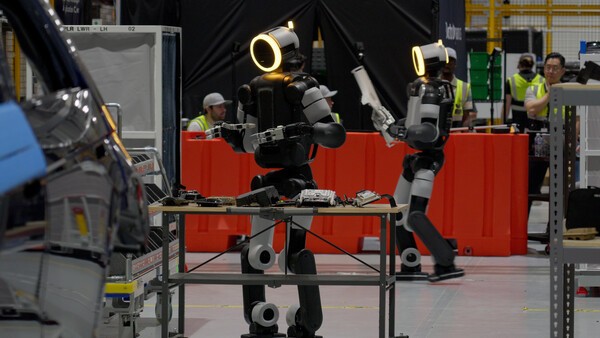
Boston Dynamics said it has established a learning hub for deploying humanoid robots to manufacturing sites at Hyundai Motor Group's U.S. plant and officially began operations after opening the Robotics Metaplant Application Center (RMAC) at HMGMA in Georgia on the 21st, local time.
The target robot is Atlas, and RMAC serves as a testbed for learning and performance verification before Atlas is deployed to Hyundai Motor Group's automotive manufacturing sites.
RMAC's environment closely resembles actual production processes, and the learning environment was also set up to mirror real automotive manufacturing conditions. Boston Dynamics said it began operating RMAC so Atlas can first learn logistics and parts placement work and verify performance under conditions similar to actual production.
The initial learning tasks are logistics and parts placement, and the plan is to expand applications to parts assembly in the future. RMAC moved into full operation after a pilot run in June.
At RMAC, Atlas learns by repeatedly performing manufacturing process tasks under conditions close to an actual production environment. Atlas's training tasks at RMAC include logistics preparation and Sequencing work for automotive parts. Sequencing involves placing parts in the order required for assembly. The goal is to accumulate data for on-site application.
Based on these learning results, Boston Dynamics plans to expand Atlas's work scope to parts assembly by 2030. It also plans to expand into tasks with many repetitive motions, and further into high-intensity work that requires heavy lifting.
In line with this, Hyundai Motor Group is preparing to scale up Atlas production and expand Atlas deployment. As part of its deployment plan, it aims to sequentially place 25,000 Atlas units at Hyundai Motor and Kia global sites over the next several years. In the U.S., it is also pushing ahead with the establishment of a new facility capable of producing 30,000 robots annually.
It also plans to expand robot learning facilities. Boston Dynamics plans to build a separate facility on the HMGMA site in 2027. The facility will be built at roughly 10 times the scale of RMAC, with the aim of expanding both data collection and the scope of training tasks.
The scope under review for RMAC includes learning for application at automotive manufacturing sites as well as the potential for expansion into other industries. Boston Dynamics is discussing deployment plans with customers in manufacturing, aerospace, semiconductors, logistics, food and beverage, and life sciences, focusing on industries that already use Spot and Stretch.
Zack Jackowski, Boston Dynamics' CPTO, said the company is optimizing supply chain, production, testing, and deployment capabilities for Atlas with Hyundai Motor Group. He said the goal is to create a physical AI environment through RMAC that can improve robot safety and productivity.
Source: TECHWORLD · Kim Seung-ki
Original: https://www.epnc.co.kr/news/articleView.html?idxno=407274
References
This article was produced with the help of an automated content generation algorithm.
Source: TECHWORLD
View originalThis article was summarized and organized by BizCrush based on the original article from TECHWORLD. For exact quotations and full details, please refer to the original article.