KEIT, KOAT, KCA, and KAPE Hold Joint Briefing on 2026 Public Data Utilization Promotion
IT DAILY ·
✦ AI Summary
Four public institutions — KEIT, KOAT, KCA, and KAPE — held the "2026 Joint Briefing on Promoting the Use of Public Data" at Mokwon University on September 17.
The briefing was for college students and private companies, introducing each institution's public data and use cases while sharing private-sector outcomes and new data demand and suggestions for improvement.
In the morning, the event focused on education to improve college students' understanding of public data and utilization capabilities, while the afternoon featured the sharing of utilization outcomes and new data demand from companies using public data and AI companies.
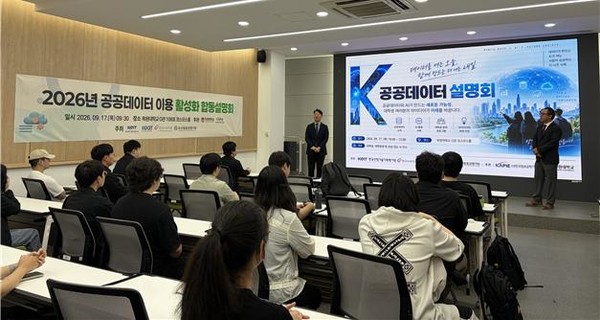
Four public institutions — the Korea Evaluation Institute of Industrial Technology (KEIT), the Korea Agricultural Technology Promotion Agency (KOAT), the Korea Consumer Agency (KCA), and the Korea Institute for Animal Products Quality Evaluation (KAPE) — held the "2026 Joint Briefing on Promoting the Use of Public Data" at Mokwon University on September 17. The event was co-hosted by the four institutions and co-organized by the regional integration exchange team of the Korea Information Engineering and Technology Society and Mokwon University.
The briefing was aimed at college students and private companies, with the goal of introducing the public data held and opened by each institution, as well as practical use cases, to the public and businesses.
It was also designed as a venue to share actual private-sector outcomes and identify new data demand and suggestions for improvement from users.
The briefing expanded the data-opening model centered on individual institutions, with the four organizations, which hold public data in the areas of industrial technology R&D, agricultural technology, consumer life, and livestock, taking part together. They shared private-sector outcomes from the use of each institution's public data, and the event was meaningful in that institutions holding public data in different fields participated together and shared their achievements jointly.
The program was divided into morning and afternoon sessions. In the morning, the event focused on helping college students better understand public data and strengthen their data utilization capabilities. In the afternoon, companies using public data and AI companies took part and shared their achievements and new data demand.
At the joint briefing, each institution mainly introduced private-sector utilization outcomes and real service cases identified and supported to promote the use of public data. The sharing participants were users and companies, who presented concrete results from public data use.
The public data utilization outcomes introduced at the event spanned academic research, public service applications, industrial services, and AI-based work support services. This showed that the role of public data is expanding beyond simple information provision to a range of services and research.
At the event, the public data identified, opened, and supported for use by the four institutions illustrated a usage flow in which public data moves from opening to private-sector use, then to research and service development, and on to new value creation.
The event also detailed the outcomes of public data use through that flow and introduced actual cases of public data application.
Along with this, a special lecture by an on-site expert was held on the specialized capabilities needed in the AI and data era, with Park Chang-hee, chairman of the Korea Information Engineering and Technology Society and director at Interweb, delivering the lecture.
Park Chang-hee introduced the AI capabilities needed for the use and analysis of public data and explained that, to increase the value of public data use, data analysis skills matter beyond simple searching. He then emphasized the importance of the ability to solve new problems through the combination of AI technologies and introduced the need to obtain the AICE (AI Certificate for Everyone) qualification as a way to systematically learn and verify AI and data utilization capabilities, along with the AICE qualification itself.
Kim Chung-il, vice chairman of the Korea Information Engineering and Technology Society, delivered a special lecture. The lecture topic was the specialized capabilities ICT experts need to respond to changes in the future era, the acquisition of engineer licenses, and the value of using engineer licenses. Kim said that, amid rapidly changing ICT conditions including AI, data, information security, and digital transformation, specialized capabilities that can comprehensively analyze and solve on-site problems are important.
Kim Chung-il explained how engineer licenses can be used in the process of students growing into future technical professionals, and he also explained how engineer licenses can be used in the process of ICT workers growing into future technical professionals. Through this, he linked the capabilities needed to respond to the rapidly changing ICT environment with the meaning and use of engineer licenses to the career paths of students and ICT workers.
A representative of the co-hosting institutions said that the criterion for judging the value of public data is not the number of items opened, but the creation of new value through use by the public and businesses. The representative added that, based on the outcomes shared at the briefing, the institutions plan to continue identifying and spreading private-sector utilization results in areas such as papers, agricultural services, livestock services, and R&D AI services, and that they will actively connect new data demand raised on site to the institutions' data opening and quality improvement efforts.
The event was co-organized by the Korea Information Engineering and Technology Society and Mokwon University, and the two institutions said they plan to connect the four public institutions, college students, and private companies based on ICT expertise and the university's education and research capabilities. On that basis, the Korea Information Engineering and Technology Society and Mokwon University said they will continue to support the discovery of public data and AI convergence use cases and also continue supporting the cultivation of data specialists.
Source: IT DAILY · Kim Ho
Original: https://www.itdaily.kr/news/articleView.html?idxno=241776
References
This article was produced with the help of an automated content generation algorithm.
Source: IT DAILY
View originalThis article was summarized and organized by BizCrush based on the original article from IT DAILY. For exact quotations and full details, please refer to the original article.