Siemens Unveils a Way to Expand Industrial AI From Talking to Working
IT DAILY ·
✦ AI Summary
Siemens said the standard for expanding industrial AI is execution capability, not model performance.
It said the scope of AI use will expand to participation in design, production, operations, and service tasks, as well as execution on industrial sites.
Siemens will hold "Agentic Enterprise Connect (AEC) 2026" next month on the 13th at Josun Palace Gangnam in Gangnam-gu, Seoul, and introduce its ICX- and Human-in-the-loop-based strategy.
Siemens laid out a direction for expanding competitiveness in industrial AI. It set the standard for expansion not as model performance but as execution capability, and outlined a vision that goes beyond internal data analysis and answer generation.
Siemens said it will not limit AI's role to information analysis and response generation, but will support AI agents in participating in design, production, operations, and service tasks. Through this, it presented a direction to broaden AI's use to actual work on industrial sites.
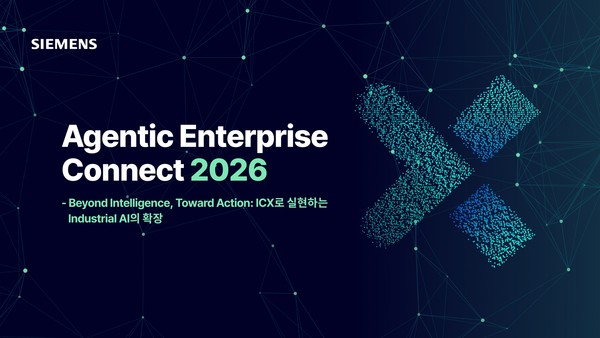
On the 22nd, Siemens announced plans to hold "Agentic Enterprise Connect (AEC) 2026." The event will take place next month on the 13th at Josun Palace Gangnam in Gangnam-gu, Seoul, under the theme "Beyond Intelligence, Toward Action: Scaling Industrial AI with Intelligence Center X."
At this event, Siemens plans to introduce a way to move beyond the PoC stage that industrial-site AI often gets stuck in. The presentation will focus on its "agentic enterprise" strategy for applying and scaling AI in real workflows.
Siemens' concept of an agentic enterprise does not mean a fully autonomous AI enterprise. It assumes a structure in which AI agents search for the data they need and propose execution plans within goals and guidelines set by people, while humans remain involved in major decisions. Siemens described this operating model as Human-in-the-loop.
The key is to move AI beyond simply searching corporate data. To do that, AI needs to understand the meaning of data and the context of work. Industrial-site data is scattered across fragmented repositories such as PLM, ERP, MES, and equipment operation systems. Even data about the same product or equipment can differ by system in format, naming, and relationships.
This is also why the focus is on "connection and execution" rather than new AI models. Generative AI can produce plausible answers even when it uses only part of disconnected data. But it has difficulty making reliable judgments in real work such as changes to production schedules or equipment maintenance.
Accordingly, Siemens is pursuing a strategy that uses industrial ontologies and knowledge graphs. Siemens said the point is to give AI the meaning of data from different systems and how those data are connected.
Siemens described the enterprise knowledge graph as representing the relationships among data distributed across multiple business systems. It also said the role of the enterprise knowledge graph is to go beyond simple retrieval for AI agents and support context-based reasoning.
The implementation platform is Intelligence Center X (ICX). Siemens said ICX is less a product for providing a new LLM than an industrial AI orchestration platform that connects and governs corporate data, AI models, and real business applications.
ICX integrates Graph Studio, which structures relationships and context in corporate data; AI Studio, which develops and operates AI and machine learning models; and Mendix, a low-code platform for building AI agents and business applications. Its operating structure consists of Graph Studio connecting to enterprise-data knowledge graphs, AI Studio providing analytics and prediction models, and Mendix implementing user-facing business applications and workflows.
Siemens said it designed these three components to be placed under a single management framework. It explained that this makes it possible to trace the basis for AI decisions and also trace the execution process.
This approach targets the industry's "AI pilot trap." Companies have succeeded in testing AI models at the individual department level, but enterprise-wide expansion has been hindered by data fragmentation and differing governance standards. The goal, therefore, is to remove the obstacles to scaling AI trials across the entire enterprise.
AI agents are also expected to take part in core work such as design changes and production operations. However, Siemens said the prerequisites for that participation are establishing data accuracy, access control, and responsibility boundaries for execution results. It also cited the need to make the human review and approval stages for AI proposals more specific by industry, and stressed Human-in-the-loop alongside autonomous execution.
Based on these assumptions, AEC 2026 will connect ICX with industrial ontologies and enterprise data. At AEC 2026, Siemens also plans to demonstrate in real time how AI agents support engineering, operations, and service tasks.
At the event, partner companies including Megazone, Data Solution, and Cadianth Systems will participate to share ICX-based intelligent workflows and introduce industrial AI use cases. A key point of interest will be the tasks that can be performed after AI is linked to real business systems, moving beyond question-and-answer AI.
Kim Dae-sik, a professor in the Department of Electrical Engineering and Computer Science at KAIST, will then give a special lecture. The lecture topic is "Survival Strategies in the Age of Agentic AI: The Potential and Risks of Agent AI in the Era of AGI."
Oh Byung-joon, head of Siemens Digital Industries Software Korea, said many industrial companies have data systems and AI pilots but still show limits in expanding them into actual workflows. He then presented an agentic enterprise innovation model that operates data, insights, and practical workflows across the full business lifecycle under a single governance framework.
Source: IT DAILY · Lee Jaeyoung
Original: https://www.itdaily.kr/news/articleView.html?idxno=241773
References
This article was produced with the help of an automated content generation algorithm.
Source: IT DAILY
View originalThis article was summarized and organized by BizCrush based on the original article from IT DAILY. For exact quotations and full details, please refer to the original article.