Beware of New Fraud Targeting Chuseok Holiday Travelers... Eastsecurity Says Families Should Prepare Anti-Scam Safeguards, Including Code Words
TECHWORLD ·
✦ AI Summary
Eastsecurity said that ahead of the Chuseok holiday, people need to watch out for new scams exploiting AI.
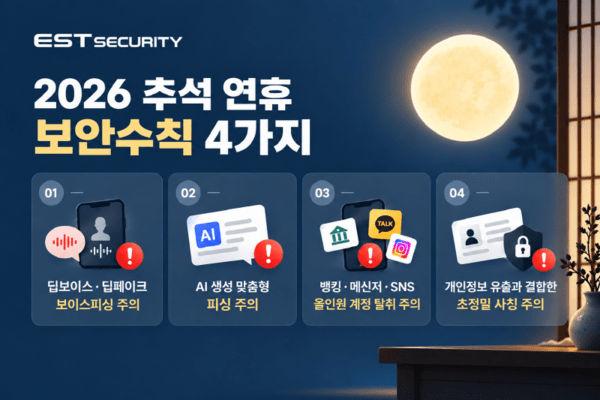
The four types it disclosed are deepvoice scams, deepfake video call scams, AI-generated personalized phishing, 'all-in-one account hijacking,' and highly precise impersonation.
It recommended setting up advance verification methods such as family code words, blocking the installation of apps from unclear sources, and reporting suspicious activity to 112 or 1332.
Ahead of the Chuseok holiday, concerns have been raised that new types of scams exploiting AI are on the rise. On the 22nd, Eastsecurity disclosed four major types of holiday scams and urged caution.
The four types identified by Eastsecurity include voice-based deepvoice scams that can be pulled off with just a few seconds of audio, deepfake video call scams, AI-generated personalized phishing with no grammatical errors, 'all-in-one account hijacking' targeting banking, messengers, and SNS at the same time, and highly precise impersonation combined with personal data leak incidents. The company said the common thread among these scams is that they exploit victims' trust.
Industry observers say technological advances such as AI and deepvoice have made it difficult to detect fraud by relying on human senses alone. They note that even a few seconds of voice samples can be used to synthesize a familiar person's voice and face in real time, while generative AI can send customized scam messages based on personal information without grammatical errors.
Eastsecurity said that because it has become difficult to distinguish these scams based on intuition alone, families need separate preventive measures. It added that families should prepare anti-scam safeguards such as code words.
Eastsecurity recommended that families set up advance verification methods to prepare for requests impersonating relatives or acquaintances. It suggested code words as one example. It also said that when an urgent request for money is received, a response is needed in which the recipient calls back using a number they already know to verify the request.
As a way to prevent secondary phishing damage, Eastsecurity stressed that apps of unclear origin must be blocked from being installed in the first place. An Eastsecurity official explained that human-sense-based detection methods, such as natural-sounding sentences and a familiar person's voice, are themselves becoming targets of AI attacks. The official added that ahead of this year's Chuseok holiday, verification procedures need to be thoroughly overhauled.
An Eastsecurity official recommended checking before the holiday whether personal information has been leaked and taking preventive steps such as updating passwords. The official also said that if anything suspicious is detected, people should immediately report it to the Korean National Police Agency (112) or the Financial Supervisory Service (1332) to prevent the damage from spreading.
Source: TECHWORLD · Kim Hye-jin
Original: https://www.epnc.co.kr/news/articleView.html?idxno=407262
References
This article was produced with the help of an automated content generation algorithm.
Source: TECHWORLD
View originalThis article was summarized and organized by BizCrush based on the original article from TECHWORLD. For exact quotations and full details, please refer to the original article.