SKT-KISTI Develop ‘Digital Twin’ Technology for Quantum Cryptographic Networks
IT DAILY ·
✦ AI Summary
SK Telecom and KISTI said on the 22nd that they have developed digital twin technology for quantum cryptographic networks.
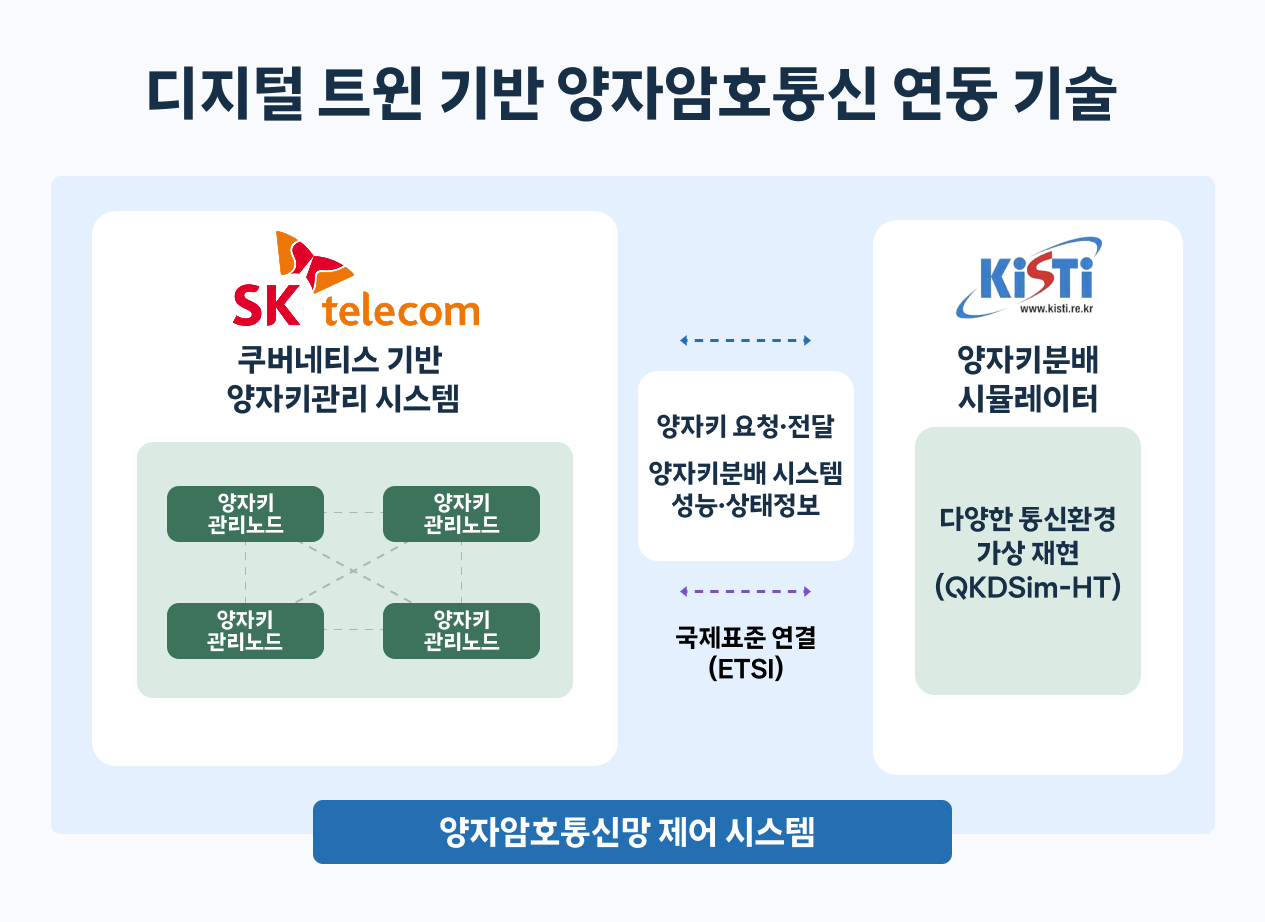
The technology links SKT's quantum key management system with KISTI's quantum key distribution simulator in real time through an ETSI international standard-compatible interface.
This makes it possible to test the entire process of generating, transmitting, and managing quantum keys in a virtual environment even without an actual network.
SK Telecom (SKT) and the Korea Institute of Science and Technology Information (KISTI) said on the 22nd that they have developed digital twin technology for quantum cryptographic networks. The technology is designed to pre-verify the performance and operational feasibility of quantum cryptographic networks before they are actually deployed.
A digital twin is a technology that performs simulation, analysis, and prediction based on a virtual replica of a physical asset, process, or system. Quantum key distribution (QKD) is a technology that securely generates and transmits encryption keys based on the principles of quantum mechanics.
At the core of the new technology is real-time integration between SKT's quantum key management system (Key Manager) and KISTI's quantum key distribution simulator. The integration uses an ETSI international standard-compatible interface.
In terms of how it works, when the key management system requests a quantum key, the KISTI simulator implements various quantum key distribution communication environments. The simulator then delivers the quantum keys and the performance and status information of the quantum key distribution system in real time.
As a result, it is now possible to test the entire process of generating, transmitting, and managing quantum keys in a virtual environment even before an actual quantum key distribution network is deployed.
The virtual environment reflects surrounding communication conditions such as communication distance and optical loss, as well as equipment characteristics such as reception efficiency and post-processing algorithms, and is used to verify configurations and settings before operation. The items to be verified in this virtual environment are configurations and settings.
The equipment types, distances, and parameter settings confirmed in this virtual environment can be applied directly to the actual operating environment. The virtual environment plays a role similar to that of a digital twin.
SKT has also implemented the quantum key management system using a container-based architecture, and the system is not fixed to any specific hardware or virtual machine. SKT is deploying and operating the quantum key management system on Kubernetes, an open-source platform. Kubernetes supports automated deployment, scaling, and management of containerized applications distributed across multiple servers, enabling flexible scaling of the key management system. It also allows real-time verification based on the various network environments and key management scenarios generated by the simulator.
KISTI developed the quantum key distribution simulator. The simulator was designed to reproduce quantum key distribution environments according to virtual implementation conditions such as communication distance and optical loss.
KISTI also established the structure of a control system for quantum cryptographic networks. This system serves to control the integration of the key management system and the simulator.
If this structure is actually transferred, it will make it possible to implement a quantum cryptographic network that integrates with actual quantum key distribution equipment and an ETSI international standard-compatible interface. By applying the ETSI-compatible interface, it is possible to secure hardware independence from specific equipment and independence from proprietary interfaces. This will open the possibility of integration with quantum cryptographic equipment developed by other institutions and companies, while also securing scalability.
The technology was developed through two development projects by the Ministry of Science and ICT. The projects are the Ministry of Science and ICT's 'Element Technologies for Expanding the Efficiency and Optimizing Resources of QKD Networks' and the Ministry of Science and ICT's 'Development of Quantum Cryptographic Network Technology Based on National Research Infrastructure.'
Source: IT DAILY · Seong Won-young
Original: https://www.itdaily.kr/news/articleView.html?idxno=241772
References
This article was produced with the help of an automated content generation algorithm.
Source: IT DAILY
View originalThis article was summarized and organized by BizCrush based on the original article from IT DAILY. For exact quotations and full details, please refer to the original article.