SKT-KISTI Develop Quantum Cryptography Network Interconnection Technology
TECHWORLD · · 1 views
✦ AI Summary
SKT and KISTI announced on the 22nd the development of a joint quantum cryptography network interconnection technology.
The technology is a digital-twin-style system that verifies performance and operability in a virtual environment before a quantum cryptography network is built.
Using an international standard-compatible interface, it linked SKT's key management system with KISTI's Quantum Key Distribution simulator in real time.
As the importance of quantum cryptography grows amid advances in AI and quantum computing, SKT and the Korea Institute of Science and Technology Information (KISTI) announced on the 22nd the development of a joint quantum cryptography network interconnection technology. The technology developed this time is a digital-twin-style system designed to preverify performance and operability before building a quantum cryptography network.
Quantum cryptography networks are difficult to modify after deployment, particularly when it comes to conditions such as optical cable length and optical loss. In addition, because testing under various conditions is difficult with expensive equipment, this technology is notable for moving the entire test process into a virtual environment for verification.
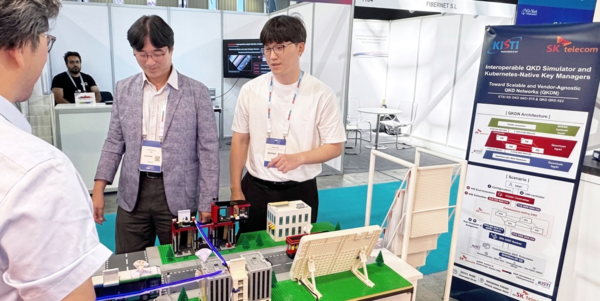
At the core of the technology is the real-time linkage between SKT's Key Manager, its quantum key management system, and KISTI's Quantum Key Distribution (QKD) simulator. The linkage applies an ETSI international standard-compatible interface, and through industry-academia-research collaboration, a quantum cryptography network interoperable with actual Quantum Key Distribution equipment and an international standard-compatible interface has been implemented.
The technology is structured so that when the key management system requests a quantum key, it reproduces a variety of Quantum Key Distribution communication environments in the KISTI simulator. Quantum keys generated in the simulated environment are delivered in real time, and the performance and status information of the Quantum Key Distribution system are also transmitted in real time. Through this, a virtual environment has been established that makes it possible to verify the entire chain from quantum key generation to management and supply.
In this virtual environment, the operation of Quantum Key Distribution equipment is reflected, as is the communication distance when connected to actual equipment. Optical loss, reception efficiency, post-processing algorithms, and equipment characteristics are also reflected. The verification configuration and settings of this virtual environment can be applied to actual operating environments, including the target configuration and settings for what equipment should be placed at what distance and with what values.
The technology applies an international standard-compatible interface and is independent of specific equipment and dedicated interfaces. As a result, it will be possible to interconnect with quantum cryptography equipment developed by other institutions and companies in the future. It is also expected to enhance interoperability between different quantum cryptography systems and contribute to the expansion of quantum cryptography communication services.
The quantum cryptography network interconnection technology was unveiled at ECOC 2026, which opened on the 21st in Malaga, Spain. ECOC 2026 is Europe's largest international optical communications event.
SKT said it connected its Kubernetes-based key management system with the Quantum Key Distribution simulator. Ryu Tak-ki, head of network technology at SKT, said this makes it possible to flexibly verify a range of network environments and key management functions. He added that, based on this, the company will pursue the establishment of a highly scalable quantum cryptography network operating environment.
KISTI said the linkage has laid the foundation for implementing a variety of quantum cryptography communication environments. Song Joong-seok, head of KISTI's Network Future Technology Research Division, said the groundwork has also been laid for verifying integration with actual key management systems, and added that the institute will pursue ways to develop the technology into a core tool for improving the interoperability and scalability of quantum cryptography networks in the future.
Source: TECHWORLD · Kim Hye-jin
Original: https://www.epnc.co.kr/news/articleView.html?idxno=407248
References
This article was produced with the help of an automated content generation algorithm.
Source: TECHWORLD
View originalThis article was summarized and organized by BizCrush based on the original article from TECHWORLD. For exact quotations and full details, please refer to the original article.