Vector Unveils 'vSECC.InPlug,' Extending Charger-to-Vehicle Distance to Up to 100 m
TECHWORLD ·
✦ AI Summary
Vector Korea unveiled a new communication controller board, 'vSECC.InPlug,' for commercial vehicle electrification.
The product moved charging communication functions into the DC charging connector to ease distance constraints in the existing DC charging architecture, enabling the distance between the vehicle and the charger to be extended to up to 100 m.
Vector first unveiled it at 'IAA Transportation 2026' in Hanover, Germany, from September 15 to 20, and plans to apply it in cooperation with LAPP Mobility GmbH.
Vector Korea unveiled a new communication controller board for commercial vehicle electrification, called 'vSECC.InPlug.' Vector announced the details on the 22nd, saying the product is designed to ease installation distance constraints for charging infrastructure.
Vector Korea pointed to the limitations of existing DC charging architectures as the reason placement constraints arise for chargers and related equipment at commercial vehicle depots. In the existing setup, the distance between the charging communication controller and the vehicle was limited to about 7.5 m. As a result, bus and truck depots with large vehicles moving around and wide parking areas faced constraints in deciding where to place chargers and power and cooling equipment.
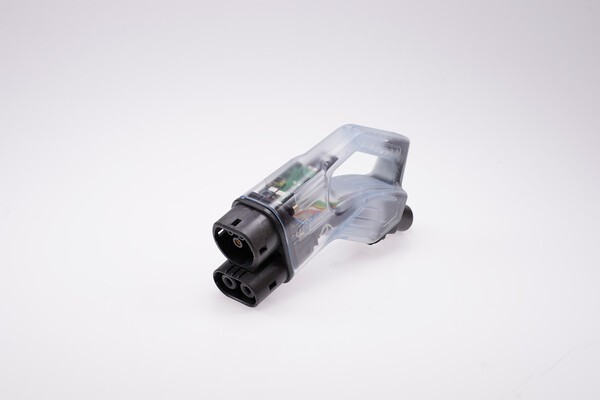
Accordingly, 'vSECC.InPlug' is characterized by moving the charging communication function, which had previously been installed in a separate space, into the DC charging connector itself. This allows the distance between the vehicle and the charger to be extended to up to 100 m.
Vector said this design can increase flexibility in charging infrastructure layout at bus and truck depots. 'vSECC.InPlug' was first unveiled at 'IAA Transportation 2026' in Hanover, Germany, from September 15 to 20.
Vector changed the existing architecture with vSECC.InPlug. By embedding the communication controller inside the charging connector, the connector directly handles PLC between the vehicle and the charger, while a separate vSECC is centrally placed in the control cabinet. The vSECC is responsible for the charging process, communication protocols, power electronics devices, and backend integration.
With this restructuring, communication functions have been split between the connector and the central control area. As a result, the distance between the central power conversion unit and the actual charging point can be greatly extended, while charging equipment can also be concentrated in one place and connectors distributed across a large site. This makes the infrastructure architecture possible.
Peter Guse, senior director in charge of business development at Vector, said bus and truck depots determine charger installation locations based on parking positions, vehicle size, and traffic flow. He said vSECC.InPlug allows flexible placement of charging points across large sites while maintaining centralized power electronics, and added that infrastructure scalability is greatly improved.
Vector is working with LAPP Mobility GmbH to bring vSECC.InPlug into actual use. The two companies integrate the communication controller board directly into the DC charging connector. Charging connector solutions equipped with vSECC.InPlug are supplied through LAPP.
Charging infrastructure manufacturers can also apply vSECC.InPlug directly to their own connector and system designs. Accordingly, a variety of integration methods are supported depending on system architecture and charging point layout.
Vector and LAPP will demonstrate how vSECC.InPlug works at IAA Transportation 2026. The demonstration setup uses a transparent charging connector, a control panel, and a small truck model. The demonstration will present the full communication path from vehicle to charging connector to centralized charging infrastructure, and real exhibits of the system architecture will also be on display.
vSECC.InPlug supports IEC 61851, DIN SPEC 70121, ISO 15118-2, and ISO 15118-20. The main targets for the product are bus and truck depot operators and charging infrastructure manufacturers that need to separate charging points from power electronics locations.
Vector also unveiled additional depot operation solutions to prepare for the transition to electric buses, beyond charging infrastructure. Among them, vCharM.DMS is a depot management system for small and medium-sized bus depots.
vCharM.DMS integrates telematics data, original equipment manufacturer backend information, maintenance data, and operation data. This supports real-time sharing of the same data among dispatchers, control centers, and maintenance teams.
Depot operators can check each vehicle's parking area, current status, and next departure time through map and list screens. The system also helps them determine in advance whether each vehicle is ready for operation by reflecting maintenance history, fault reports, washing tasks, and driver shift information.
vCharM.DMS can be used even before electric buses are introduced, and can be applied first to depots operating internal combustion engine buses. After the transition to electric buses, it can be linked with Vector's vCharM charging and energy management system.
After the transition to electric buses, charging schedules can be optimized based on scheduled departure times and required state of charge (SoC). This links vehicle operation information with charging demand and enables a method that connects depot operations and charging management into a single flow.
Vector unveiled these solutions at IAA Transportation 2026. The announcement included expanded charging connector communication distance and solutions covering vehicle management and charging operations at commercial vehicle depots, and Vector has begun targeting the electrification infrastructure market.
Source: TECHWORLD · Park Gyu-chan
Original: https://www.epnc.co.kr/news/articleView.html?idxno=407246
References
This article was produced with the help of an automated content generation algorithm.
Source: TECHWORLD
View originalThis article was summarized and organized by BizCrush based on the original article from TECHWORLD. For exact quotations and full details, please refer to the original article.