Mobilint's MLA100 Becomes First AI Accelerator to Receive TTA Verified Certification
TECHWORLD ·
✦ AI Summary
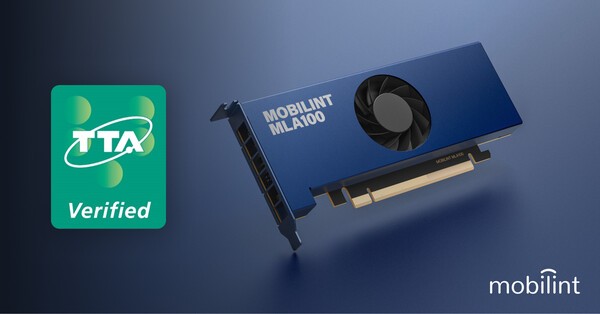
Mobilint announced that it has obtained the Korea Telecommunications Technology Association (TTA)'s "AI Accelerator TTA Verified" certification for its AI accelerator, the MLA100.
The MLA100 is a PCIe-based AI accelerator equipped with Mobilint's in-house NPU, ARIES, and delivers up to 80TOPS and 25W performance.
The certification verified factors needed for actual adoption and operation, including system compatibility, operational stability, the software environment, and AI model execution.
On the 22nd, Mobilint said it had obtained the Korea Telecommunications Technology Association (TTA)'s "AI Accelerator TTA Verified" certification for its AI accelerator, the MLA100. The NPU installed in the MLA100 is "ARIES," which Mobilint developed in-house. With this, the MLA100 became the first product in the AI accelerator category to receive the "AI Accelerator TTA Verified" certification. Through the certification, Mobilint has received official recognition of the MLA100's real-world applicability and operational stability as an AI accelerator equipped with an in-house NPU.
The scope of the certification review went beyond computing performance to include system compatibility, operational stability, the software environment, and AI model execution. The certification means that the key factors related to actual AI system adoption were evaluated in a comprehensive way.
The MLA100 is a PCIe-based AI accelerator. It is designed to be installed in existing industrial servers and edge devices. It can also connect with existing systems based on a standard PCIe interface.
The MLA100 performs AI inference tasks such as video analysis, vision inspection, and equipment anomaly detection. It delivers up to 80TOPS of performance and operates at 25W.
In industrial settings, computing performance alone is not enough as a criterion for deciding whether to adopt AI semiconductors. When adopting them, companies must also check whether they can be stably connected to existing servers, whether they can operate for long periods, whether actual AI models can run, and whether a software environment for development and operations is in place.
Mobilint said it has obtained this TTA certification. The certification means that key requirements in the actual system adoption process were verified by a third-party specialist organization.
In control systems that require 24-hour video analysis, compatibility and operational stability of AI accelerator systems are important. Compatibility and operational stability are also important in vision inspection and equipment anomaly detection at manufacturing sites. They are also important in public infrastructure areas such as transportation, safety, and facility management.
In defense and military systems, reducing dependence on external cloud services is necessary. In defense and military systems, AI inference must be performed directly on site. In on-premise AI environments, verifying whether the system can actually be operated is important.
With its PCIe-based design, the MLA100 is installed in existing servers and equipment, with the aim of adding AI inference capabilities. Its main targets are companies and institutions seeking to build edge AI using existing infrastructure, as well as companies and institutions seeking to build on-premise AI environments using existing infrastructure. It is aimed at demand from those who want to introduce AI without replacing their entire system.
In this context, the "AI Accelerator TTA Verified" is TTA's in-house certification program, designed to objectively verify the quality and performance required for the actual adoption and operation of AI accelerators. The certification organizes the verification process for AI accelerators from the perspective of real-world deployment.
The evaluation items include hardware physical stability, hardware electrical stability, PCIe interface compatibility, system integration with various servers and platforms, operational stability under changing environments, SDK verification, software environment verification, actual AI model operation, and computing performance. In other words, the structure checks everything from hardware stability to interfaces, system integration, software, actual AI model execution, and performance.
Mobilint conducted the MLA100 evaluation for about 3 months starting in June this year and received final certification last August. The evaluation confirmed stable operation in various system and operating environments, and also confirmed that the MLA100 met items related to existing system integration, AI model execution, and other requirements needed for real-world application.
With this certification, conditions for companies and institutions considering NPU adoption, as well as server, SI, and AI solution partners, to review the applicability of the MLA100 have expanded. As a result, the basis for reviewing the MLA100 has widened to include third-party verification results in addition to product specifications provided by the manufacturer.
Based on this certification, Mobilint plans to expand the MLA100's deployment to industrial sites that require real-time AI inference. The expansion targets include video surveillance, smart manufacturing, public safety, defense, and military. It also plans to strengthen cooperation with server, SI, and AI solution partners and secure real-world deployment cases to expand the MLA100's use in the edge and on-premise AI markets.
Source: TECHWORLD · Park Gyu-chan
Original: https://www.epnc.co.kr/news/articleView.html?idxno=407253
References
This article was produced with the help of an automated content generation algorithm.
Source: TECHWORLD
View originalThis article was summarized and organized by BizCrush based on the original article from TECHWORLD. For exact quotations and full details, please refer to the original article.