RealWorld, CJ Logistics Expand Physical AI Collaboration for Logistics
IT DAILY ·
✦ AI Summary
RealWorld and CJ Logistics signed an MOU on the 21st and agreed to cooperate on developing physical AI technologies specialized for the logistics industry.
The two companies plan to jointly develop an RFM for use in logistics operations, carry out PoC and actual logistics process applications, and then expand cooperation into global commercialization.
The collaboration focuses on combining RealWorld's RFM and physical AI software capabilities with CJ Logistics' logistics field operations infrastructure and commercialization capabilities.
RealWorld and CJ Logistics are expanding their collaboration on logistics-focused physical AI.
RealWorld will work with CJ Logistics to develop physical AI technologies tailored to the logistics industry. The two companies also plan to jointly develop a robotics foundation model (RFM) for use in logistics operations.
After the joint development, the two companies also plan to carry out technology verification. They then plan to expand cooperation into global commercialization.
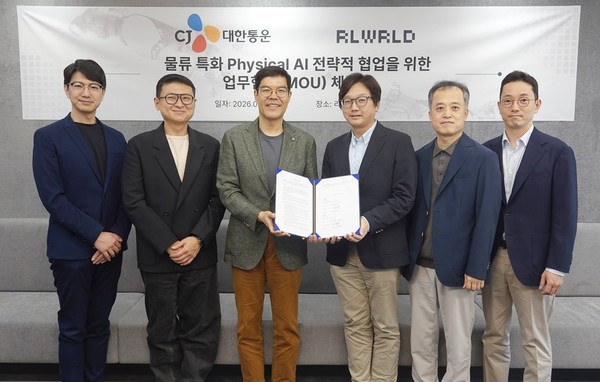
Officials who attended the ceremony for signing the business agreement for strategic collaboration on logistics-focused physical AI pose for a commemorative photo. The photo is courtesy of RealWorld.
RealWorld and CJ Logistics signed a memorandum of understanding (MOU) on the 21st. The MOU covers combining the two companies' AI technologies with logistics field capabilities, jointly developing an RFM solution specialized for logistics, and cooperating to apply it to actual logistics processes. The scope of cooperation will also be expanded to global commercialization.
The core of the agreement lies in combining RealWorld's RFM and physical AI software capabilities with CJ Logistics' logistics field operations infrastructure and commercialization capabilities. Through this, the two companies aim to develop and advance physical AI technologies that can be used in real logistics environments. They plan to jointly select logistics processes where the RFM will be applied first and carry out a proof of concept (PoC) to verify key operations. Based on the PoC results, they plan to gradually expand the scope of applicable processes and improve the technology step by step.
As verification results accumulate, the two companies plan to jointly push ahead with the commercialization of logistics-focused physical AI-based LaaS (Logistics as a Service). LaaS is a concept in which companies use logistics centers, transport networks, and automation equipment without directly building or owning them. It includes functions such as order processing, storage, picking, packing, delivery, returns, and data analysis in service form.
FourtyTwoMaru said on the 21st that it had filed a patent application in South Korea and the United States for a 'method and system for generating data representations based on a large language model.' The purpose of the filing is to secure global rights to foundational ultra-large AI technology. Through this filing in South Korea and the United States, FourtyTwoMaru aims to broaden the scope of rights for its core ultra-large AI technologies.
The patent describes a technology in which an LLM interprets unstructured document information inside a company and then organizes and presents answers to user requests in tables or charts. A key feature of the patent is the procedure for verifying answer figures against actual company data. This is expected to improve response accuracy for enterprise lightweight models (sLLM), curb hallucinations, and secure answer reliability.
FourtyTwoMaru has accumulated 122 patents filed and secured in South Korea and overseas. That includes 63 in South Korea, 39 in the United States, 18 in Europe, and 2 PCT international applications. Overseas filings account for half of the total, and the patents cover the entire solution and service lineup. The transition to generative AI has accelerated in earnest since 2023, and 50 applications have been filed since then.
FourtyTwoMaru plans to sequentially apply this patented technology to its enterprise LLM solutions. It also plans to expand supply to major domestic and overseas companies and public institutions.
Kim Dong-hwan, CEO of FourtyTwoMaru, said that patents are an objective indicator of an AI company's technological strength and a means of protecting its business in the global market. He explained that he sees the present, when the agentic AI market is entering full bloom, as a decisive time for building up technological assets.
Kim said the company plans to continue expanding domestic and overseas patent filings for core LLM and agentic AI technologies. He also said the company intends to push ahead with building a strong patent barrier for the global market.
Meanwhile, ITcenCore said on the 21st that it held a seminar on the theme of 'Efficient Internal Control Operations Using AI.' Photos from the seminar were provided by ITcenCore.
ITcenCore held the seminar on the 15th in the committee meeting room of the Korea Chamber of Commerce and Industry in Seoul. At the event, it presented ways to automate corporate internal control work and improve risk management efficiency using AI and data analysis.
The seminar went beyond introducing AI technology and also included specific examples of AI use in corporate internal control work and system demonstrations. Through real-world use cases and demonstrations, it presented the potential to improve automation and risk management efficiency.
ITcenCore demonstrated its self-developed 'AI-based risk monitoring system.' Based on a company's various business data, the system detects abnormal transactions and risk signals, and it is equipped with AI-based automated explanation request drafting, compliance score calculation based on OCR analysis of supporting documents, and scenario risk prediction through multidimensional analysis. ITcenCore carried out the demonstration by revealing actual system screens.
ITcenCore also presented automated collection of supporting files, preprocessing of supporting files, evaluation results and accuracy improvement (RAG), AI model and version designation, API integration management, token usage monitoring, and security management through its in-house AI agent, 'AgentGo ICM.' Security management items included data encryption and blocking of sensitive information. Through this, the company presented review points for applying AI evaluation functions in enterprises.
At the end of the article, it was noted that CrowdWorks and MobiLus won a contract for an 'agricultural autonomous driving data' project.
CrowdWorks announced on the 21st that it had won MobiLus' 'agricultural autonomous driving data annotation' project. MobiLus is a company specializing in physical AI.
The contract is based on the premise that data annotation for agricultural autonomous driving is more difficult than annotation for autonomous driving on public roads. The reasons cited were that cultivated fields have no fixed lane markings or signs, field boundaries are unclear, seasonal and weather changes are significant, dust and vibration occur during driving, and there are many complex noise factors.
CrowdWorks established guidelines that reflect the actual physical characteristics of farmland and began advanced data construction with the goal of implementing a precise decision-making system for autonomous driving agents. In the process, it aims to secure a high level of boundary recognition accuracy in unstructured farmland by applying pixel-level masking using semantic segmentation to cultivated fields, shrubs, farm roads, and dirt roads.
In addition, CrowdWorks is also carrying out precise object labeling for emergency stop and slow-down situations. This is intended to support AI's real-time judgment of dangerous situations by reflecting the size, location, and distance of obstacles.
It presented a strategy to complete high-quality AI training datasets that allow autonomous robots and agricultural machinery to travel safely without deviating from their routes even under poor or hard-to-identify field conditions.
Playtag announced on the 21st that it has officially launched 'MonoXYZ (Mono),' a conversational video behavior analysis AI solution.
Mono is a conversational behavior analysis solution that uses video from mobile phones and CCTV as input. The solution analyzes what people in the video are doing and how they are doing it.
Mono presents its analysis results as quantitative data. Playtag explained that conventional video analysis solutions focused on detecting predefined simple rules such as intrusion and collapse.
Playtag said Mono analyzes the continuous behavioral context and intent of people in video without any separate preconfiguration and provides the analysis results as data.
Mono is currently running pilot programs at 5 organizations and workplaces, where it is being used for detection, verification, analysis, and validation depending on site characteristics. At senior care sites, it is being applied to fall detection and care routine verification. At early childhood sports facilities, it is being used for education participation analysis and activity volume analysis, with the aim of securing evidence for activity improvement and linking to recommended activities. At construction and manufacturing sites, it is being applied to worker movement path analysis and verification of compliance with safety rules.
Based on these operational experiences, Playtag plans to gradually expand the scope of Mono's application. The expansion targets include customer movement analysis in retail stores, human-robot collaboration safety in smart factories, and monitoring of developmental and cognitive changes in care settings.
Source: IT DAILY · Yang Seung-gap
Original: https://www.itdaily.kr/news/articleView.html?idxno=241763
References
This article was produced with the help of an automated content generation algorithm.
Source: IT DAILY
View originalThis article was summarized and organized by BizCrush based on the original article from IT DAILY. For exact quotations and full details, please refer to the original article.