MaumAI Demonstrates 'NAVICOM' Autonomous Driving at Gongju Baekje Marathon... Verifies Outdoor Physical AI
TECHWORLD ·
✦ AI Summary
MaumAI said it applied its autonomous driving solution, NAVICOM, to the Gongju Baekje Marathon site to verify the localization and mobility performance of an autonomous robot.
NAVICOM is a solution that combines GPS, LiDAR SLAM, and an inertial measurement unit (IMU), and supports indoor and outdoor localization and autonomous driving.
The demonstration was carried out in connection with the Software (SW) Centered University Project Group at Kongju National University, and it also confirmed driving feasibility in spaces shared by people and obstacles.
MaumAI announced that it applied its autonomous driving solution, NAVICOM, to the Gongju Baekje Marathon site to verify the localization and mobility performance of an autonomous robot in a complex outdoor environment. NAVICOM is a solution that combines GPS, LiDAR, SLAM, and an inertial measurement unit (IMU).
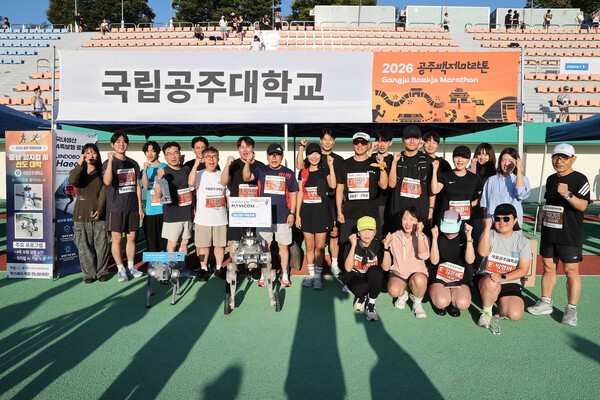
On the 20th in Gongju, South Chungcheong Province, at the 2026 Gongju Baekje Marathon, MaumAI operated a robot equipped with NAVICOM and demonstrated its autonomous driving technology. Through this, it tested the localization and mobility performance of the autonomous robot in a real outdoor environment.
The demonstration was carried out in connection with the Software (SW) Centered University Project Group at Kongju National University. The project group participated in the event with support from the Ministry of Science and ICT and the Institute for Information & Communications Technology Planning & Evaluation (IITP)'s SW Centered University Project.
In this demonstration, MaumAI focused less on driving speed and more on environmental awareness and stable mobility in real-world spaces. It also confirmed driving feasibility in spaces shared by people and obstacles.
The reason MaumAI directly operated the robot at the marathon site rather than in a controlled laboratory or exhibition hall was to verify performance in real-world spaces. The focus of the demonstration was also on confirming whether stable driving was possible in real-world spaces rather than on a speed competition.
The company described NAVICOM as a navigation and communication platform. NAVICOM incorporates sensor fusion based on GPS, LiDAR SLAM, and IMU. NAVICOM supports indoor and outdoor localization and autonomous driving.
GPS is used for outdoor localization. LiDAR SLAM is used for position estimation in indoor areas and sections where GPS signals are limited. IMU data is combined to correct the robot's posture and movement state. The design objective is to maintain localization and ensure driving continuity even during environment transitions.
NAVICOM uses a Zero Modification structure. It is mounted externally without changing existing robot hardware. As a result, NAVICOM can be applied to different robot platforms instead of developing a new autonomous driving system for each robot.
MaumAI links autonomous driving functions with RMS (Robot Management System). RMS handles integrated management of robot status, missions, and control information. RMS supports remote control, status monitoring, mission planning, route setting, and patrol schedule management.
The system provides robot, sensor, and network status monitoring functions, as well as 2D and 3D map creation and editing functions, and supports the driving of individual robots. It is also configured to support integrated control for on-site operation and management of multiple robots, thereby expanding the scope of support.
Based on this foundation, MaumAI is planning to expand the range of NAVICOM applications. The expansion targets include sports events, festivals, public events, and park and urban patrols, as well as inspections of industrial facilities. Accordingly, NAVICOM Advanced, a model designed with outdoor and industrial environments in mind, has been equipped with IP67-rated water and dust resistance.
Son Byung-hee, head of MaumAI's Defense AI & Robotics division, said the demonstration was an opportunity to show the robot's environmental awareness and stable mobility in real-world spaces. He also said the company plans to advance its physical AI platform to support the on-site missions of a variety of robots.
Source: TECHWORLD · Kim Seung-gi
Original: https://www.epnc.co.kr/news/articleView.html?idxno=407226
References
This article was produced with the help of an automated content generation algorithm.
Source: TECHWORLD
View originalThis article was summarized and organized by BizCrush based on the original article from TECHWORLD. For exact quotations and full details, please refer to the original article.