Which Books to Read During the Chuseok Holiday? SK Telecom Executives Recommend Them Directly
TECHWORLD ·
✦ AI Summary
SK Telecom executives introduced 8 recommended books for Chuseok holiday reading as September-October titles in the in-house T Library.
The recommendations span a wide range of themes, including AI and humaneness, the international order after the AI era, human civilization, life and death, and inner reflection.
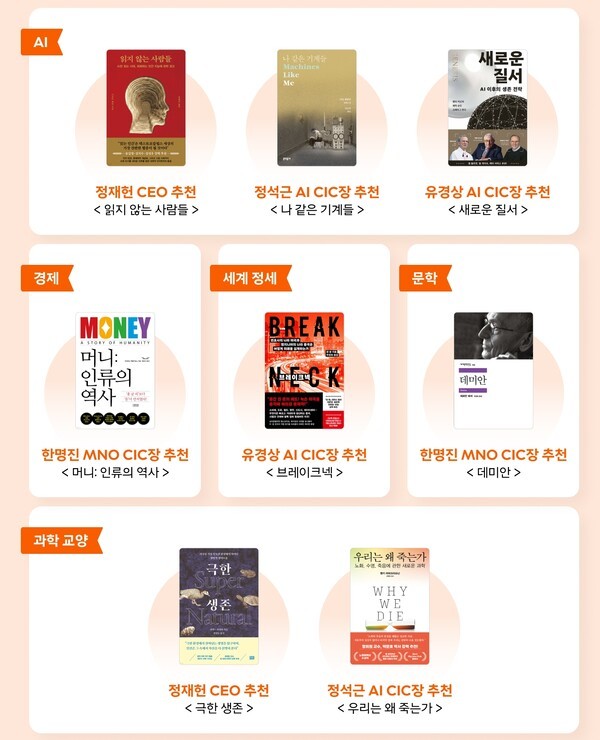
CEO Jae-heon Jeong, MNO CIC Head Myeong-jin Han, AI CIC Head Seok-geun Jeong, and AI CIC Head Gyeong-sang Yoo recommended “Who Wrote This?”, “Machines Like Me,” “The New Order,” “Money: The True Story of a Made-Up Thing,” “Breakneck,” “Extreme Survival,” “Why We Die,” and “Demian.”
A reading list recommended by SK Telecom executives has been presented as a way to make use of the free time during the Chuseok holiday. The article’s theme is an introduction to SK Telecom executives’ recommended books for Chuseok holiday reading.
The recommendations were made by SK Telecom executives, and the total comes to 8 books. These titles were introduced as the 9-10 month books for the in-house T Library.
SKT said the range of themes covered by the recommended books is broad. The selections span topics such as humaneness in an era when AI reads and thinks in place of people, the international order after the AI era, understanding human civilization, the power of life to survive extreme environments, reflections on death and life, and classics that explore one’s inner self.
This round of recommendations reflects a wide-ranging sense of concern, from AI and the international order to life, death, and inner reflection. Through them, readers are prompted to consider their place in a rapidly changing world and their direction going forward.
The list also offers the suggestion that readers use the free time during the Chuseok holiday to read and expand the breadth of their thinking over the long break. The purpose of the recommendations is to present a reading list that invites readers to think about a changing era.
Among the books selected by CEO Jae-heon Jeong, MNO CIC Head Han Myeong-jin, AI CIC Head Jeong Seok-geun, and AI CIC Head Yoo Gyeong-sang, the theme this time was presented as something humans must preserve in the AI era. As AI is depicted as summarizing long documents in seconds and searching for the information needed, the question was also raised of whether direct human reading is still necessary in the AI era.
The starting point for this question was the issue of why humans should read for themselves. In response, CEO Jae-heon Jeong recommended Naomi Baron’s “Who Wrote This?”
The book explores the history of reading intelligence. The author argues that human reading ability was acquired over a long period of time.
The author also says reading has contributed to the evolution of the human brain and thought, and has played an important role in understanding others. At the same time, the author warns that if AI increasingly takes over reading, human ability in this area could weaken.
The book’s concern lies in reflecting on what humans may lose when they let AI handle reading and distance themselves from it. From there, the question continues of what humans must preserve in the AI era.
AI CIC Head Jeong Seok-geun recommended the SF novel “Machines Like Me.” Set in a fictional past where science and technology have advanced, the novel follows Charlie and Adam, the first artificial human in history. Along with Charlie’s lover Miranda, Charlie and Miranda set Adam’s personality, and the relationship among the three takes an unexpected turn.
Through the situation in which Adam, a nonhuman being, comes to love a human lover, the novel narratively examines the problems that arise when machines touch the realm of human emotion and ethics. In the process, it takes love, responsibility, and moral judgment as subjects of exploration and continues its fictional inquiry into the boundary between what is uniquely human and what belongs to machines.
AI CIC Head Yoo Gyeong-sang recommended “The New Order.” This book is a co-authored work exploring the future in the AI era, written by former U.S. Secretary of State Henry Kissinger, former Google CEO Eric Schmidt, and former Microsoft research chief Craig Mundie. The authors are organized around politics, economics, and science.
Taking AI’s impact as its subject of analysis, the book looks at how it affects eight areas of thought and activity, including the human brain and perception of reality, politics and security, and science and strategy, through the authors’ perspectives. Through this, figures from politics, economics, and science examine how AI affects human perception and various sectors of society across multiple categories, offering a view of the future in the AI era.
A book that first mentioned dangerous future scenarios such as the misuse of AI by powerful organizations and threats to human free will, while also presenting strategies to overcome those risks, was introduced first. The article then moved on to books that ask what forces move the world.
MNO CIC Head Han Myeong-jin recommended “Money: The True Story of a Made-Up Thing.” The book reexamines roughly 5,000 years of human history through the lens of money.
The book covers ancient currency and religion, war and finance, industrialization, and the modern digital economy. It also traces how money has transformed civilization.
Han said the book would be a good recommendation for readers who want to understand finance and the economy from a broader historical perspective. It was also presented as a book that examines changes in human civilization over the long term with money at its center.
The relationship between the United States and China was then introduced as the fiercest competition over technological supremacy, and AI CIC Head Yoo Gyeong-sang recommended Dan Wang’s “Breakneck.” Wang looks at U.S.-China competition beyond technology companies and economic indicators, and analyzes the differences in how the two countries solve problems.
The concern with comparing how the two countries operate and analyzing their strengths and weaknesses continues into a question about how nations develop technology and industry. The subtopic is how to live, beyond mere survival.
This concern expands into books in the life sciences. “Extreme Survival,” recommended by CEO Jae-heon Jeong, is a book that explores the possibility of life surviving in environments lacking water, oxygen, and food, tracks organisms adapted to the harshest environments on Earth, and highlights the unique adaptive strategies of different life forms.
The author, Alex Riley, is a science journalist who focuses the narrative on life’s adaptability and resilience through survival strategies. The examples of organisms living in extreme environments show a variety of ways to adapt to different conditions.
Next, “Why We Die,” recommended by AI CIC Head Jeong Seok-geun, is a book that summarizes modern life science research on aging and lifespan. The author is molecular biologist Venki Ramakrishnan, a Nobel Prize winner in Chemistry.
The book reviews the biological mechanisms related to aging and introduces scientists’ research aimed at delaying aging. Through this, the article connects the theme to questions of life and death beyond survival.
Questions about survival and death ultimately lead to the question of how to live. MNO CIC Head Han Myeong-jin presented the classic Hermann Hesse novel “Demian” as a recommended book that speaks to this question.
The work depicts the process by which a person breaks through their own wall and arrives at their true self. More than a century after its publication, “Demian” continues to be widely read because of the enduring relevance of its question: “Who am I, and how should I live?”
Source: TECHWORLD · Lee Gwang-jae
Original: https://www.epnc.co.kr/news/articleView.html?idxno=407220
References
This article was produced with the help of an automated content generation algorithm.
Source: TECHWORLD
View originalThis article was summarized and organized by BizCrush based on the original article from TECHWORLD. For exact quotations and full details, please refer to the original article.