Public AI Moves Beyond Chatbots to Administrative Decision Support... SKT Wraps Up 'GranData Public Day 2026'
IT DAILY ·
✦ AI Summary
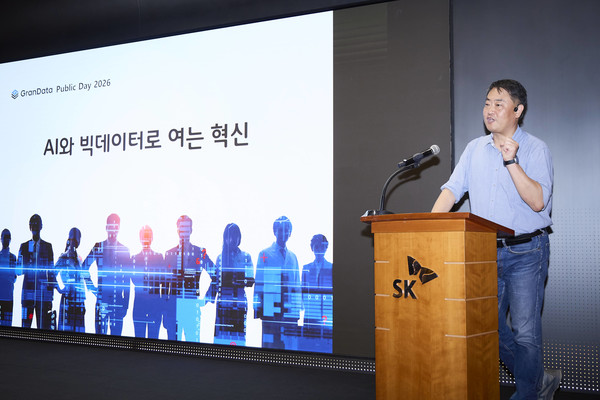
SK Telecom held the seminar 'GranData Public Day 2026' at SKT Tower in Euljiro, Jung-gu, Seoul on the 18th and announced it on the 21st.
More than 250 officials involved in public-sector data from the government, local governments, and public corporations attended.
The seminar covered cases linking private-sector data and AI to public administration, examples from local governments, and ways to use synthetic data.
SK Telecom held the seminar 'GranData Public Day 2026' at SKT Tower in Euljiro, Jung-gu, Seoul on the 18th to introduce public AI and big data use cases. SK Telecom announced the event on the 21st.
More than 250 people attended the event. Attendees included data-related officials from the public sector, such as those from the government, local governments, and public corporations.
'GranData' is a data business consortium operated by SK Telecom, Shinhan Card, Korea Credit Bureau (KCB), Kakao Mobility, and SK Broadband. GranData launched in 2021 with SK Telecom, Shinhan Card, and KCB aiming to support data-driven decision-making in the public and private sectors, and since then participating companies and the scope of data used have expanded.
The seminar focused on real-world cases of linking private-sector data to administrative work, showing how telecommunications, card, and mobility data can complement visitor movement, consumption, and regional population characteristics that are difficult to identify using only administrative data from public institutions, and connect them to policy and administrative decisions.
In the first part of the seminar, methods for analyzing visitor data for cultural, sports, and tourism events were introduced. The approach aimed to identify the success factors of similar events and also included content for proposing customized event programs based on the findings. It also presented a way to go beyond simply counting visitors after an event and instead further analyze visitor characteristics and movement patterns to reflect them in planning the next event.
Next, Seoul Songpa-gu Office shared examples of applying AI and data. The application target was a review of land-use options for donated sites owned by local governments, and the analysis incorporated characteristics of existing public facilities, usage volume, the demographic makeup of nearby residents, and location information. It was presented as a reference for determining what kind of facility would be appropriate.
The role of public AI is expanding beyond chatbot-based question-and-answer services for residents to a tool that supports the judgment of policymakers. Changes in data open portals operated by many local governments were also introduced. The existing portal model required users to search for and download datasets directly.
By contrast, portal functions that apply conversational prompts are evolving in a direction that allows users to query and analyze public data and receive policy information guidance based on natural-language questions. However, the function of AI is not to automatically determine a development direction; rather, it is focused on synthesizing multiple data sources and providing policymakers with grounds for review.
In the second part, technical and operational measures for putting internal AI and data in public institutions to practical use were presented as the topic of discussion. As a case study, Jeonnam-Gwangju Integrated Special City was introduced, and it is using no-code and vibe coding. The targets are working-level departments such as tourism and transportation, and telecom and card big data analysis is being used as applied data.
The operating model is structured so that frontline staff use the data directly instead of repeatedly requesting it from data experts. However, direct use takes place under the condition that authorization and procedures are observed. The goal is to improve access to the data needed.
As privacy issues were repeatedly raised in the process of using public data, pseudonymized information and AI-based synthetic data were presented as ways to ease the problem. Synthetic data was described as artificially generated data that reflects the statistical characteristics of real data and helps reduce the burden of directly sharing source data that includes personal information.
Next, based on a case from Busan Metropolitan City, the seminar introduced a direction for applying synthetic data when sharing and analyzing data that requires privacy-related review, and also presented technical and operational considerations for applying synthetic data. In this process, synthetic data was described as something that requires review of its similarity to the original, the possibility of re-identification, and the reliability of analysis results.
Kim Myeong-guk, head of Industrial AI at SKT, said that AI agents using AI such as A.Dot and private data from GranData are being applied to field operations at public institutions, and conveyed his intention to continue proposing ways to support data use and work innovation in the public sector.
Source: IT DAILY · Lee Jae-young
Original: https://www.itdaily.kr/news/articleView.html?idxno=241746
References
This article was produced with the help of an automated content generation algorithm.
Source: IT DAILY
View originalThis article was summarized and organized by BizCrush based on the original article from IT DAILY. For exact quotations and full details, please refer to the original article.