Rebellions NPU Expands to 4 SKT AI Services, Processing 14 Million Cases a Day
TECHWORLD ·
✦ AI Summary
Rebellions said on the 21st that deployment to SK Telecom's commercial AI services has expanded to four core functions.
The first commercial deployment began in December last year with the relationship inference function in A.Dot Call Summary, and later expanded to voice synthesis, AI customer service, and security services.
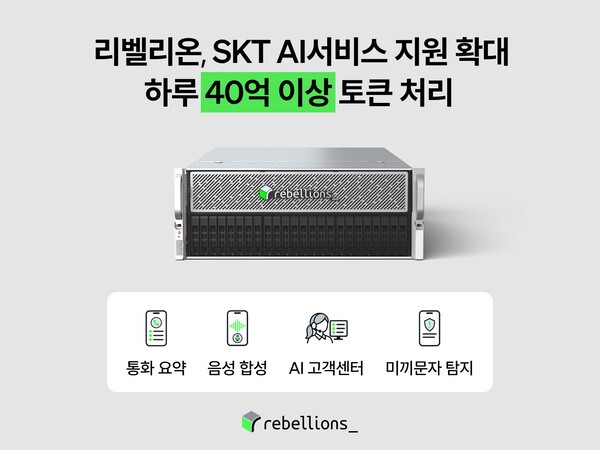
The services currently using the technology are A.Dot Call Summary, A.Dot Voice Synthesis (streaming TTS), AI Customer Service (AICC), and ScamVanguard.
Rebellions said on the 21st that the deployment of the Rebellion NPU to SK Telecom's commercial AI services has expanded to four core functions. The two companies began testing the application of a domestic NPU to major SK Telecom AI services in June last year.
The first commercial deployment came in December last year. At the time, the Rebellion NPU was first applied commercially to the relationship inference function in A.Dot Call Summary.
Since then, the scope of deployment has expanded to voice synthesis, AI customer service, and security services. The four services now using the technology are A.Dot Call Summary, A.Dot Voice Synthesis (streaming TTS), AI Customer Service (AICC), and ScamVanguard.
These services are running on servers based on Rebellion's ATOM-Max AI semiconductor. Rebellion's infrastructure is currently handling about 14 million real-time AI requests a day, which exceeds 4 billion tokens when converted. The services have been operating stably for more than half a year in services used by the public.
Since June this year, Rebellions has been gradually expanding NPU deployment across major SK Telecom AI services. The NPU applications now include the one-line summary function in A.Dot Call Summary, A.Dot's voice synthesis function (streaming TTS), the post-call processing and search systems of AICC, and ScamVanguard's bait-message detection function.
Streaming TTS is a real-time service that requires sentence-level voice synthesis at the same time text is generated. Rebellions said the function runs stably based on the NPU's low-latency, high-performance computing. ScamVanguard is using NPU infrastructure that supports a global-standard AI development and deployment environment, allowing it to immediately apply new and variant fraud-message detection models without service interruption.
SK Telecom said it is improving enterprise-wide computing resource efficiency by selectively using GPUs and NPUs depending on the size and performance characteristics of AI models. To that end, SK Telecom has built an NPU farm made up of dozens of NPUs and hundreds of cards. It is also operating its infrastructure in a pool model in which multiple internal services share the same NPU resources.
Rebellions said the expanded deployment has confirmed the commercial infrastructure use of a domestic NPU. It added that the use cases for domestic NPUs have expanded beyond laboratory and test environments to large-scale real-time traffic processing.
Rebellion CEO Park Seong-hyeon said that over the past year, the status of domestic NPUs has changed, moving from the stage of possibility to a proven infrastructure stage. He cited the fact that four services used by the public every day are operating stably on Rebellion's infrastructure as key evidence of that shift.
Park said Rebellions will seek to broaden the base of AI services at home and abroad based on its large-scale commercial operations record. He added that the company is using those operational achievements to underscore the commercial viability of domestic NPUs.
Park Byung-kwan, head of the Core Platform division at SK Telecom, said AI computing demand is increasing. In response, he explained, SK Telecom is actively introducing and using Rebellion's NPU alongside GPUs, and is selectively using and reallocating GPUs and NPUs by task characteristics in AI services to improve the efficiency of enterprise-wide AI resource utilization.
He said SK Telecom plans to expand its NPU farm in the future and outlined a policy of maximizing synergies from the use of domestic NPU semiconductors. He also said the company plans to respond swiftly to AI computing demand both inside and outside the company.
Rebellions is working to run SK Telecom's AI foundation model 'A.X K1' and is also expanding commercial AI services. Through this, it is increasing real-world service deployment cases for domestic NPUs and has experience processing large-scale traffic. Rebellions plans to expand NPU infrastructure supply to a range of industries, including finance, telecommunications, and the public sector, based on efficiency.
Source: TECHWORLD · Park Kyu-chan
Original: https://www.epnc.co.kr/news/articleView.html?idxno=407181
References
This article was produced with the help of an automated content generation algorithm.
Source: TECHWORLD
View originalThis article was summarized and organized by BizCrush based on the original article from TECHWORLD. For exact quotations and full details, please refer to the original article.