“AI Alone Has Limits”: GTONE Presents “Application Governance” That Combines Specialized Analysis Engines
IT DAILY ·
✦ AI Summary
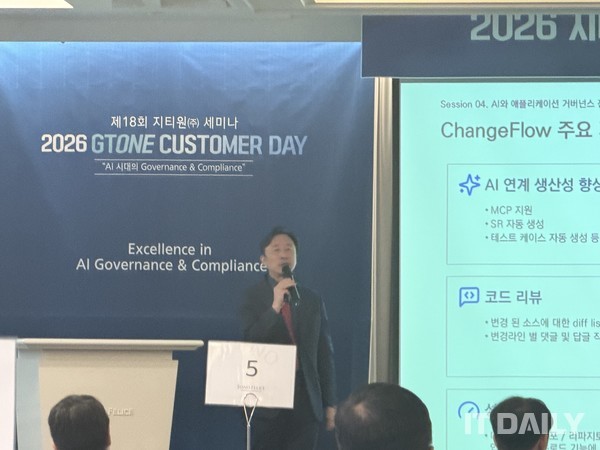
GTONE held the "2026 GTONE Customer Day Technical Seminar" at Sono Felice Convention in the COEX Airport Terminal in Gangnam-gu, Seoul, on the 17th and explained the management direction for application development and operations environments where AI use is expanding.
GTONE Executive Vice President Baek Woon-gi introduced new governance strategies and the need for a hybrid model in environments using generative AI and AI agents in his presentation, "AI and Application Governance Strategy."
GTONE said it provides configuration and change management, analysis, and security functions through ChangeFlow (ChangeFlow), ChangeMiner (ChangeMiner), CodePrism (CodePrism), and SecurityPrism (SecurityPrism).
On the 17th, GTONE held the "2026 GTONE Customer Day Technical Seminar" at Sono Felice Convention in the COEX Airport Terminal in Gangnam-gu, Seoul, and explained the management direction needed in application development and operations environments where AI use is expanding. GTONE presented the details at the event.
At the same event, GTONE Executive Vice President Baek Woon-gi delivered a presentation on the theme of "AI and Application Governance Strategy." He introduced a new governance strategy needed for application development and operations environments that use generative AI and AI agents.
The core of the presentation was a proposal for ways to stably manage complex enterprise application environments. It also argued for the need for "application governance" that combines AI with specialized analysis tools.
Executive Vice President Baek said that the expanded use of AI improves application development productivity. However, he pointed out that this also creates challenges in source code quality management, security management, change management, and controlling development and operations environments.
Baek said that even if AI is applied across the development process, it cannot fully replace existing specialized analysis tools. He said that while high productivity gains can be expected in small, independent code areas, the likelihood of inconsistent analysis results increases as the codebase grows, and the likelihood of inconsistent analysis results also increases as the complexity of relationships between systems grows. He also explained that as the codebase expands and the complexity of inter-system relationships increases, the risk of hallucinations and token costs may also rise.
Baek said the effect of coding automation is clear and that the effect is concentrated in small, independent areas. Accordingly, he conveyed the gist of his remarks as saying that a hybrid model combining specialized analysis engines and LLMs is currently the more appropriate direction.
Baek suggested not limiting AI to individual tasks at development sites, but connecting it to a management framework that spans configuration management, change management, application maintenance, and DevOps environments. He said the scope of AI should be expanded, but not limited to individual development tasks.
GTONE explained that it is implementing this direction through its application change management solution, "ChangeFlow (ChangeFlow)." ChangeFlow (ChangeFlow) is based on configuration and change management and includes AI integration features.
ChangeFlow (ChangeFlow) supports automatic SR (Service Request) creation, automatic test case generation, and DevOps environment integration. Baek said this can ease the difficulty business users face in writing SRs, and that AI-linked automatic SR generation can standardize quality. He also said it can automatically generate test case descriptions and expected results, which can also improve productivity.
GTONE also offers "ChangeMiner (ChangeMiner)," a change impact analysis solution, "CodePrism (CodePrism)," a source code quality analysis solution, and "SecurityPrism (SecurityPrism)," a security vulnerability analysis solution.
ChangeMiner analyzes program-database relationships and change impact data. Using ChangeMiner's analysis results, AI identifies affected programs, identifies affected tables, and identifies affected columns.
CodePrism and SecurityPrism are specialized static analysis engines. These engines perform quality defect analysis and security vulnerability analysis, and AI supports code modification based on the static analysis results.
Baek said this structure is a hybrid form that combines the strengths of LLMs and specialized analysis engines. He went on to explain that when a developer issues commands in natural language, the system can analyze source code defects and security vulnerabilities, and AI can automatically modify the source code.
Baek predicted that the scope of application governance management may in the future expand to include relationships between AI agents and legacy systems. He explained that agents can call server APIs based on the Model Context Protocol (MCP), and that it is possible to check whether those APIs route through program methods in legacy areas and whether they connect to database tables. He added that this makes it possible to visualize AI agent flows at a physical level.
Source: IT DAILY · Yang Seung-gab
Original: https://www.itdaily.kr/news/articleView.html?idxno=241736
References
This article was produced with the help of an automated content generation algorithm.
Source: IT DAILY
View originalThis article was summarized and organized by BizCrush based on the original article from IT DAILY. For exact quotations and full details, please refer to the original article.