“As AI Spreads, Compliance Becomes More Sophisticated”: GTOne Presents Response Strategy for the Financial Sector
IT DAILY ·
✦ AI Summary
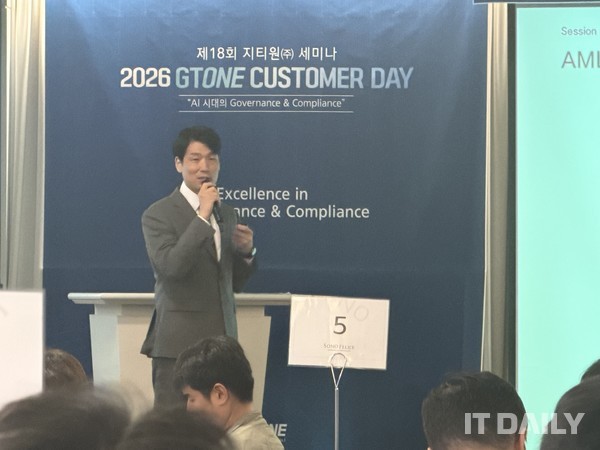
GTOne held the “2026 GTOne Customer Day Technical Seminar” at Sono Felice Convention in the COEX Intercontinental Airport Terminal in Gangnam-gu, Seoul on the 17th and presented “AI and Financial Compliance Strategy.”
Lee Yeon-geun, director at GTOne, explained that as AI use expands in the financial sector and work productivity and service sophistication advance, regulatory response and internal control requirements must also be considered.
GTOne is expanding its use of AI by applying “AMLXpress,” “WatchXpress,” and “FATCA/CRSXpress” to anti-money laundering, watchlist filtering, and exchange of information on overseas financial accounts.
As AI adoption expands across the financial sector, improvements in work productivity and more advanced services are being made through the use of AI. Accordingly, there are calls for more advanced financial compliance operations.
On the 17th, GTOne held the “2026 GTOne Customer Day Technical Seminar” at Sono Felice Convention in the COEX Intercontinental Airport Terminal in Gangnam-gu, Seoul. GTOne presented related content at the event.
The presentation was given by Lee Yeon-geun, director at GTOne, under the title “AI and Financial Compliance Strategy.” Lee presented regulatory response strategies and compliance response strategies in line with the expansion of AI use in the financial sector.
At the event on the 17th, Lee Yeon-geun, director at GTOne, emphasized financial compliance response. He said that as AI adoption expands in the financial sector and AI-driven productivity gains and service upgrades continue, related regulations and internal control requirements also need to be considered together.
Anti-money laundering work is a particularly burdensome area because, given its nature, it requires assessing customer risk and determining suspicious transactions based on large volumes of transaction data. GTOne is expanding the use of AI around “AMLXpress” to improve the efficiency of anti-money laundering work.
The scope of “AMLXpress” includes customer risk assessment, suspicious transaction monitoring, and suspicious transaction reporting (STR). GTOne is calculating risk scores using existing customer risk assessment models and AI training models, and has applied explainable AI (XAI) so that variables affecting risk levels can be identified. In addition, AI models are operated on an MLOps basis, with continuous performance monitoring and management.
GTOne is also expanding the use of AI in suspicious transaction reporting. AI provides evidence needed for risk judgment, such as changes in transaction patterns, whether transactions are split, and the concentration of transactions with specific counterparties, while large language models (LLM) are used to draft comprehensive opinions.
Lee explained that the task of drafting comprehensive opinions for STR is highly time-consuming because it requires reviewing multiple transactions and deciding whether to report them to the Financial Intelligence Unit. He added that it is possible for an LLM to draft a preliminary version of the comprehensive opinion, after which the person in charge reviews it, revises it if necessary, and then finalizes the STR report.
Lee said the scope of sanctions-related response is also expanding. He noted that entities and subsidiaries in which sanctioned parties hold at least a 50% stake are also included among sanctioned targets, and that related rules will be applied domestically starting this year. He also said many clients are requesting improvements to watchlist filtering.
In response, GTOne is enhancing its watchlist filtering solution, “WatchXpress.” A watchlist is a list used to check whether a transaction is subject to sanctions before it takes place. “WatchXpress” has functions that check whether a customer appears on the watchlist and support approval or rejection decisions during the know-your-customer (KYC) process.
One burden factor in the exchange of information on overseas financial accounts is the large-scale annual regular review conducted once a year. Because the review cycle is long, there is the possibility of data changes between reviews and structural changes in front-end systems during the interim. There is also the possibility of reprocessing the entire task if an error occurs during a long batch job. Lee explained that in practice, batch jobs can continue for several days or longer.
To address this, GTOne provides “FATCA/CRSXpress.” “FATCA/CRSXpress” supports extracting review targets, assigning personnel, requesting additional information, and preparing reporting data. It also includes a data quality verification function before batch execution.
Lee explained that because the regular review is conducted only once a year, incorrect data frequently enters the system in the meantime, and front-end structural changes also occur frequently during that period. Accordingly, he said the company has applied task segmentation and allocation, as well as detailed item-by-item queries, so that when a problem occurs, only the relevant part can be processed and work can resume immediately.
Source: IT DAILY · Yang Seung-gap
Original: https://www.itdaily.kr/news/articleView.html?idxno=241737
References
This article was produced with the help of an automated content generation algorithm.
Source: IT DAILY
View originalThis article was summarized and organized by BizCrush based on the original article from IT DAILY. For exact quotations and full details, please refer to the original article.