Data Consumers Shift From Humans to AI Agents...GTOne Emphasizes
IT DAILY ·
✦ AI Summary
Executive Director Jang Hee-cheol of GTOne gave a presentation on the topic of "AI and Data Governance Strategy" at the 2026 GTOne Customer Day Technology Seminar on the 17th.
He explained that in the AI era, the main consumers of data are shifting from humans to AI agents.
Accordingly, he said that existing control- and regulation-centered governance needs to shift to an active guardrails-centered approach built around quality, context, identification, and traceability.
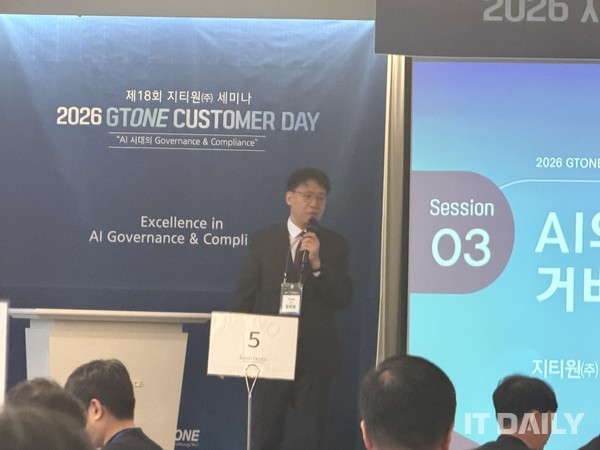
GTOne Executive Director Jang Hee-cheol gave a presentation on the topic of "AI and Data Governance Strategy" at the 2026 GTOne Customer Day Technology Seminar held on the 17th at Sono Felice Convention at the City Airport Terminal in Gangnam-gu, Seoul. The photo shows Executive Director Jang speaking, and it was provided by reporter Yang Seung-gap.
At the technology seminar that day, Executive Director Jang explained that the subjects consuming data are changing in the AI era. He said that while humans used to be the data consumers, data consumers are recently shifting to AI agents.
Using that as a starting point, Executive Director Jang explained the direction of data governance development in the AI era. The main point of the presentation was that GTOne is emphasizing "active guardrails" in line with the shift in data consumers from humans to AI agents.
He said that despite rapid improvements in AI performance, difficulties continue in the process of applying it to actual corporate work. As a response, he proposed managing structured and unstructured data, and said it is necessary to build a data environment that AI can use for search and reasoning.
Executive Director Jang explained that as AI spreads, the main users of data are changing from people to AI agents. He said that whereas people used to directly query and analyze structured data, the current shift is toward AI agents using both structured and unstructured data. He also said that the current approach involves natural-language queries and reasoning and execution based on contextual connections.
He noted that with this change, AI's judgment and execution are directly linked to actual business operations, expanding the real-world business impact of AI misjudgment and misexecution. He explained that whereas past AI problems were limited to simple wrong answers, current AI problems are developing into business disruptions. As examples, he cited payment mishandling and purchase-order mishandling.
Against this backdrop, the main problems with introducing AI agents in companies were identified as data quality, the semantic gap caused by a lack of understanding of a company’s unique business context, excessive data access privileges, and uncertainty in decision-making paths. Executive Director Jang said that if source data is contaminated, an agent’s autonomous execution could produce incorrect business outcomes.
Executive Director Jang emphasized that the role of data quality is the criterion that gives legitimacy to agentic AI behavior. He added that efforts to improve data quality are necessary.
Because control- and regulation-centered data governance makes it difficult to sufficiently address problems that arise during AI data use and task execution, the response highlighted was a shift in existing data governance toward "active guardrails." It was explained that the existing management approach was centered on control and regulation, and that the reason for the shift is to preemptively manage problems in AI data use and task execution.
Executive Director Jang said the existing nature of data governance is control-based, passive, and regulation-centered. He then said a shift to data governance based on active guardrails that ensure safe driving is necessary.
The guardrails presented are quality, context, identification, and traceability. The quality guardrail is responsible for minimizing hallucinations, and the context guardrail helps prevent AI from arbitrarily interpreting a company’s unique terminology. The identification guardrail searches for and connects the actual data locations, such as tables and columns, that fit the business context, while controlling exposure of sensitive information. The traceability guardrail makes it possible to identify the source data behind AI results.
Executive Director Jang said the four guardrails should not be applied individually and that organic interlocking support is needed. He viewed guardrails not as separate devices but as a system that works together.
From this perspective, he said data management must be expanded to include unstructured data. As examples, he cited internal corporate documents such as PDF, Word, and Hangeul files, and proposed ways to link those internal documents with LLMs. He then explained that terms, classifications, summaries, and tables of contents should be extracted from internal documents, and that this extracted information needs to be turned into metadata. Mentioning the need to meta-ize unstructured data, Executive Director Jang proposed integrated management of unstructured and structured data as the goal.
Executive Director Jang emphasized the importance of "AI-ready data" and said the essential condition for AI-ready data is the application of guardrails. Based on such a system, he proposed supporting free data creation through self-service for business units, and supporting system intelligence through data utilization for IT.
Source: IT DAILY · Yang Seung-gap
Original: https://www.itdaily.kr/news/articleView.html?idxno=241731
References
This article was produced with the help of an automated content generation algorithm.
Source: IT DAILY
View originalThis article was summarized and organized by BizCrush based on the original article from IT DAILY. For exact quotations and full details, please refer to the original article.