AIM Intelligence Launches Global Consortium for Physical AI Safety Research
TECHWORLD ·
✦ AI Summary
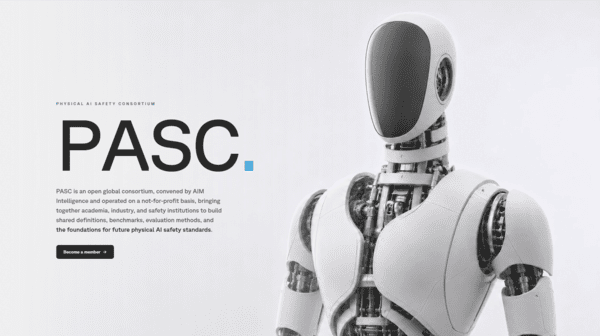
AIM Intelligence announced on the 17th the launch of the global Physical AI Safety Consortium (PASC).
PASC is a nonprofit global consortium established to study safety issues across physical AI, including robots and autonomous systems.
The first joint project of PASC is preparing a position paper on the definition of physical AI safety and directions for evaluation.
AIM Intelligence announced on the 17th the launch of the global physical AI safety consortium, the Physical AI Safety Consortium (PASC). PASC is a global consortium dedicated to studying safety issues across physical AI, including robots and autonomous systems.
AIM Intelligence convened PASC amid concerns that physical AI could pose threats to on-site safety as it operates in real-world environments. The purpose of establishing PASC is to identify, evaluate, and control related risks in advance.
The purpose of establishing PASC also includes defining physical AI safety and building a research foundation needed for evaluation methodologies, benchmarks, and future standardization. PASC operates on a nonprofit basis, and individuals and institutions can participate.
Participation takes the form of research, models, hardware, computing, and data. PASC currently includes more than 30 researchers and industry practitioners, and experts from organizations including Google, Microsoft, Oracle, and LG Electronics, as well as researchers from universities in South Korea and abroad and AI safety research institutions, are working together.
Key participants in PASC include Jenny Ni of Google; Adrian de Wynter of Microsoft and York University; Hitesh Laxmichand Patel of Oracle; Amit Agarwal of Oracle; Jang Ji-yong, executive director at LG Electronics; Kim Myung-joo, head of the Korea Institute for AI Safety; Professor Sicun Gao of UC San Diego; Professor Sharon Li of the University of Wisconsin; and Professor Yaqi Xie of the University of Illinois.
The first joint project they are pursuing through PASC is preparing a position paper on the definition of physical AI safety and directions for evaluation. After that, they plan to expand their activities to include the design of a joint evaluation framework and benchmarks, adversarial testing in operational environments, and verification research covering simulation and real robot environments.
PASC defined physical AI safety awareness as something to be continuously observed, updated, and intervened in, rather than judged in a one-time assessment. Accordingly, PASC identified as research tasks whether risks can be sufficiently defined, whether warning signs of risks that can be acted on can be detected, whether evaluation results hold even after changes in the environment or robot form, and how robust the safety system is against adaptive attacks.
Park Ha-eon, CTO of AIM Intelligence, said that as physical AI takes on a larger role in the real world, safety is a core foundation that must be designed and verified separately from model performance. He also said he wants to make PASC a forum that connects academic and industry expertise and serves as a venue for forming a common language and verification foundation for physical AI safety.
AIM Intelligence gave a session presentation at the AI Risk Conference on the 8th. The session was titled "The Front Line of AI Control: From Models to Agents to Physical AI," and in the presentation, AIM Intelligence highlighted the risks of physical AI and emphasized the need for red teaming and guardrails.
Source: TECHWORLD · Kim Hye-jin
Original: https://www.epnc.co.kr/news/articleView.html?idxno=407155
References
This article was produced with the help of an automated content generation algorithm.
Source: TECHWORLD
View originalThis article was summarized and organized by BizCrush based on the original article from TECHWORLD. For exact quotations and full details, please refer to the original article.