GT One Emphasizes Systematizing AI Governance: “Execution Requirements Need to Be Specified”
IT DAILY ·
✦ AI Summary
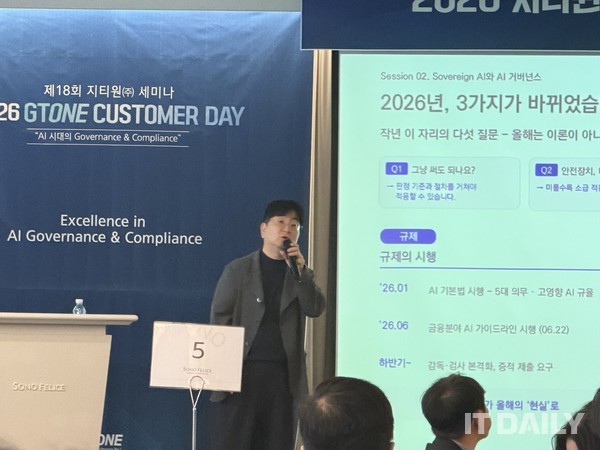
GT One held the "2026 GT One Customer Day Technical Seminar" on the 17th at Sono Felice Convention in the Seoul Gangnam District Urban Airport Terminal.
GT One Executive Director Kim Chan-su gave a presentation on "Sovereign AI and AI Governance," explaining the company’s AI control and management framework in the era of Sovereign AI and the role of the AI governance platform.
He identified tasks such as specifying execution requirements, determining AI service management units, defining the scope of linkage with related systems, and establishing metrics and data standards, while also introducing advances in AI Workbench functions and an expanded monitoring scope.
GT One held the "2026 GT One Customer Day Technical Seminar" on the 17th at Sono Felice Convention in the Seoul Gangnam District Urban Airport Terminal.
At the seminar, GT One Executive Director Kim Chan-su gave a presentation on "Sovereign AI and AI Governance," introducing the company’s AI control and management framework in the era of Sovereign AI. He also explained the role of an AI governance platform.
Kim said in his presentation that a governance consulting framework and a system cannot be directly connected. He added that a step to specify execution requirements is necessary.
Focusing on challenges identified in actual deployment sites, Kim shared the preparations needed to implement AI governance as a system. He also outlined the application direction for the integrated AI governance platform "AI Workbench."
Kim explained that the scope of governance management is expanding as regulations are enforced and AI agents proliferate. He said the existing focus had been on model performance and risk management, but as AI agents increasingly perform actual work and call external system functions, the objects of management are expanding to the entire execution process.
Kim said that in Sovereign AI, securing only models and infrastructure is not enough. He explained that, separate from whether openly available model files are provided, data curation and data alignment recipes remain confidential. He also emphasized that production sovereignty is necessary as a condition for complete AI sovereignty, and that control conditions such as explanatory grounds, execution records, and accountability frameworks must also be in place.
Based on this recognition, Kim set out the tasks needed to implement an actual operating framework for AI governance. Specifically, he identified specifying execution requirements, determining AI service management units, defining the scope of linkage with related systems, and establishing metrics and data standards as key tasks.
Building an AI governance system first requires specifying execution requirements to a level suitable for actual operations. Items included in this specification were breaking down the tasks defined during the consulting stage into process-based standards, reflecting execution, review, and approval units, determining the system-managed information fields, and deciding the responsible parties. Kim explained that to transfer consulting content into a system, execution rules and work units need to be specified to a level that can actually function.
He then said that how AI service management units are defined determines the scope of risk assessment and metric management. The AI service management unit is an important factor in setting risk assessment criteria and an important factor in setting metric management criteria. Whether an agent is treated as a single service can change the scope of management, and so can whether use-case units or business-domain units are bundled together. Kim said a clear definition of AI service units is needed, and explained that management metrics can be separated by service, agent, and model.
Finally, in terms of related-system integration, he said a key issue is how to connect the different management units of existing systems and the AI governance system. ITSM uses SRs and project codes as its management criteria, while the risk management unit for AI governance is the AI service. Accordingly, it is necessary to decide in advance which ITSM items should be linked to which AI services, and to coordinate the necessary integration scope, he said.
If each agent has a different data format, the burden of integration development for metric calculation can arise. There is also the possibility that a separate interface for metric calculation must be developed every time a new agent is added. Accordingly, the need to standardize metrics and data formats from the early stages of development was raised.
Kim said that metric standards should be finalized at the time agent and agent-platform development begins. He also explained that adding monitoring after development could force data formats to be rebuilt.
GT One advanced the functions of AI Workbench based on the challenges identified during the AI governance deployment process. AI Workbench is an AI governance platform that provides integrated support for governance standard information, AI lifecycle management, and monitoring.
Kim said that, in this process, the risk assessment function was embedded into the system. He also explained that a function was implemented to check the execution history of previous stages on a single screen during the review and approval process. He added that in the operations phase, a function was also added to manage recurring risk management processes by round.
The speaker explained that the scope of monitoring was broadened so it would not remain limited to traditional model-related metrics, expanding beyond existing model indicators to include agent indicators and performance indicators as well. He added that by using information entered into the system, report preparation for submission to the supervisory authority has also been automated, making it possible to automatically generate reports for submission to the supervisory authority based on system input information.
Source: IT DAILY · Yang Seung-gab
Original: https://www.itdaily.kr/news/articleView.html?idxno=241726
References
This article was produced with the help of an automated content generation algorithm.
Source: IT DAILY
View originalThis article was summarized and organized by BizCrush based on the original article from IT DAILY. For exact quotations and full details, please refer to the original article.