Naver Cloud Unveils Blueprint for “Defense Sovereign AI” to Rapidly Turn Commercial Tech Into Military Capability
IT DAILY ·
✦ AI Summary
Naver Cloud unveiled a cooperation model for “Defense Sovereign AI” that keeps the military in control of data and AI models while rapidly adopting and operationalizing advanced private-sector AI technologies inside a closed network.
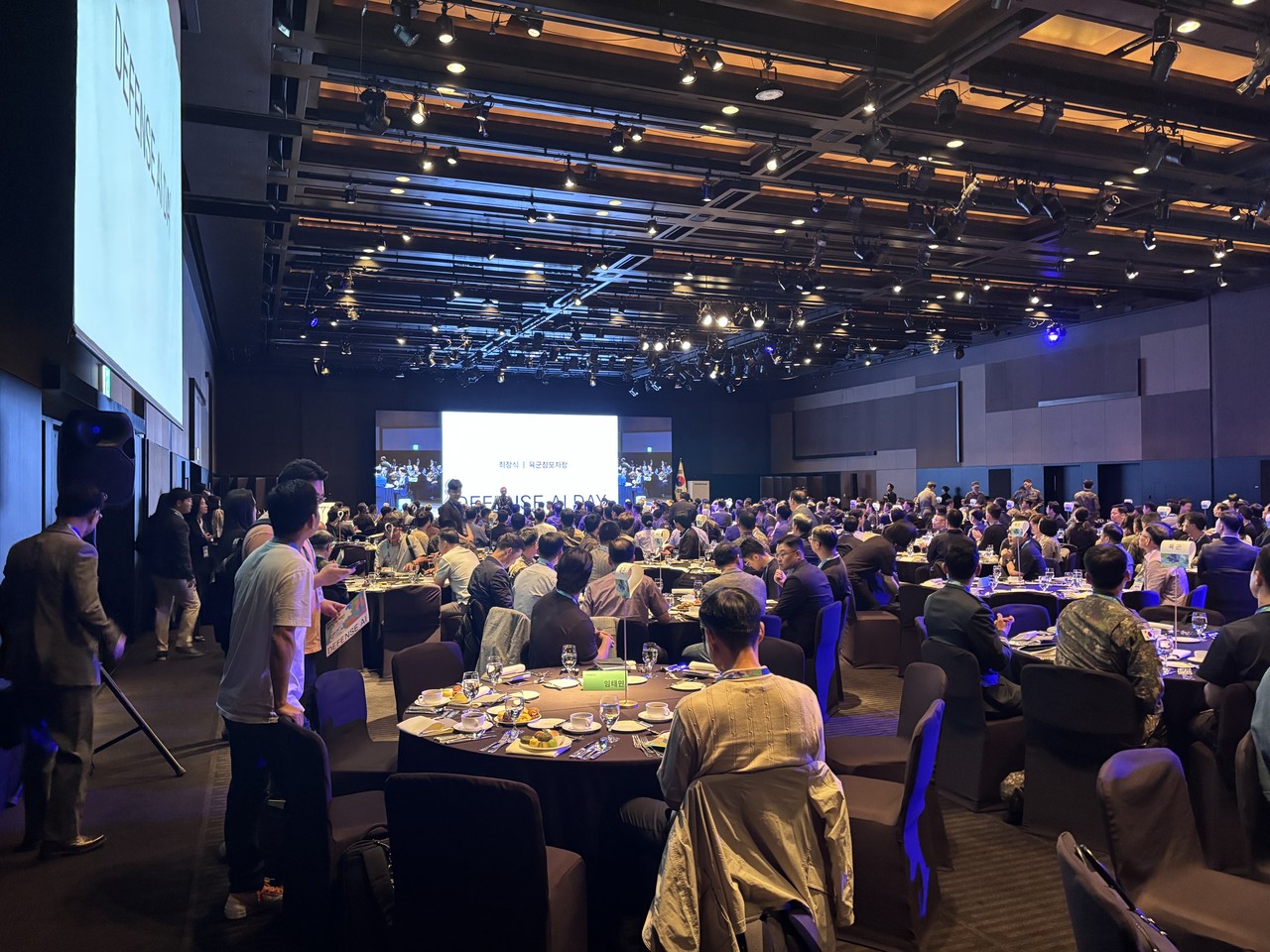
Naver Cloud held the Defense AI Day strategic seminar on the 18th, and more than 550 officials from the Ministry of National Defense, the Joint Chiefs of Staff, and the Army, Navy and Air Force attended.
The seminar introduced a common-criterion approach to battlefield interpretation, a three-stage decision support framework, three principles for defense cloud, and a demo presentation.
Naver Cloud unveiled a cooperation model for “Defense Sovereign AI” that would allow the military to rapidly adopt and operationalize advanced private-sector AI technologies within a closed network while directly retaining control over data and AI models. The purpose of this cooperation model is to enable the military to directly retain control over its data and AI models, while supporting the rapid adoption and operationalization of advanced private-sector AI technologies inside a closed network.
Naver Cloud held the Defense AI Day strategic seminar on the 18th. More than 550 people attended the seminar, including key officials from the Ministry of National Defense, the Joint Chiefs of Staff, and the Army, Navy and Air Force, and Naver Cloud presented the strategy there.
Kim Yoo-won, CEO of Naver Cloud, said the company’s role is not to get ahead of the military. He explained that what matters is providing the fastest and most accurate technical support in the areas the military needs.
Kim Yoo-won said Naver Cloud aims to be a key partner that thinks through and takes responsibility for the entire defense AI transition together with the military. He described the company’s role as technical support centered on military demand and sharing responsibility for the transition.
Kim Yoo-won, CEO of Naver Cloud, speaks at the event. The photo was taken by reporter Kwon Young-seok.
The keynote address was delivered by former Vice Minister of National Defense Kim Seon-ho, under the title, “The Essence of Defense AX from a Military Perspective.”
Former Vice Minister Kim warned of a rapid shift in the battlefield paradigm. Referring to battlefield cases such as the war in Ukraine and other recent conflicts, he said low-cost drones, the AI convergence of commercial sensors and networking are advancing.
He went on to say that a new combat concept in which large-scale troop deployments to the front line are no longer required is becoming a reality. He also said that while the military used to form the central structure for design and technical support, advanced systems built by the private sector are now being deployed directly to the battlefield, marking the arrival of an era of “private-sector technology first.”
Former Vice Minister Kim reportedly said that the introduction of defense AI should not be seen as simply adding equipment within the existing procurement framework. He stressed the need for a shift in mindset that changes the very way wars are fought and operations are conducted.
Kim presented the principle that human roles must be clearly defined amid AI development. He said AI can provide data fusion, multiple courses of action and simulation results. However, he said the final decisions, orders and responsibility remain with human commanders.
Yoo Kyung-beom, executive vice president of Naver Cloud, gave a presentation at the event. The topic was “A Changing Battlefield Environment and Proposals to Accelerate Defense Sovereign AI.” He said sovereignty in defense is not a choice but a condition for survival.
Yoo pointed to data fragmentation, a rigid weapons acquisition system and closed-network security regulations as practical limitations facing the South Korean military. He then presented four execution strategies to overcome these limits: convergence, deployment, demonstration and evolution.
Yoo explained that the United States is also concentrating on a small number of big tech companies, such as JWCC, to concentrate capital-intensive AI infrastructure capabilities. He said the role of big tech is to converge hyperscale infrastructure and foundation models.
He then said the role of startups is to add specialized solutions, while the role of system integrators is to link existing weapons and C4I systems. He added that to accelerate Defense Sovereign AI, a “civil-military convergence ecosystem” connecting big tech, startups and system integrators is essential.
As an alternative to address possible delays in AI adoption caused by the restrictions of military closed networks, the FDE model was proposed. Yoo said building an internal military data center requires enormous budgets and a long time. He therefore proposed a method that does not wait for an internal military data center.
Yoo proposed first producing a high-performance “semi-finished model” pre-trained in a public environment using nonclassified and public data. He then explained a process in which tools and FDEs enter the closed network, fine-tuning is carried out based on military classified data, and the system is ultimately operationalized. He described the approach as the fastest and most practical.
Sung Nak-ho, head of Naver Cloud, spoke at the event on the theme of a foundation for autonomous intelligent weapons systems. The photo was taken by reporter Kwon Young-seok. Sung defined intelligence as “an artificial resource that can become infinitely inexpensive.”
Sung raised the idea of building an Intelligence Network for military operations. He explained that small edge platforms such as drones have hardware limitations that make it difficult to host large-scale intelligence on board. Instead, he said they can be fused into collective intelligence if connected through a network.
Sung also explained that each platform must be able to survive independently at the local level even when communications are cut off. He said this requirement structure is an organic, composite intelligence structure. Based on the computational limits of individual small platforms, it was presented as a way to connect them through a network to form overall intelligence, while allowing each platform to operate autonomously even if communications are severed.
In the earlier part of the seminar, the need for a “common semantic framework” was emphasized so that different sensors and platforms can recognize the same battlefield situation. The issue raised was that heterogeneous sensors and platforms must interpret the same battlefield situation according to a common criterion.
As the technology to implement this, Sung presented “spatial intelligence” for the real-time restoration of a 3D digital twin operational map using data from heterogeneous sensors such as radar, thermal imaging (TOD) and optical cameras. He also presented a World Model that simulates behavioral outcomes in a virtual battlefield environment, much like AlphaGo Zero’s self-play example.
Sung said spatial intelligence and the World Model will become the core engines of autonomous weapons systems and intelligent command systems. He explained that the earlier issue of interpreting the battlefield using a common criterion is linked to these two technologies.
In the latter part of the seminar, Lee So-eun, director at Naver Cloud, gave a presentation. The session introduced infrastructure and platform architectures for real-time defense data utilization and decision support for commanders, and Lee defined the key to battlefield initiative as speed of understanding that outpaces the volume of information.
Lee then presented Naver Cloud’s three-stage decision support framework for commanders. The framework consists of a data fabric, a defense ontology and decision support for commanders.
Lee explained virtualization-based real-time connectivity without replication or transfer of unit-specific distributed data, pre-structuring of military doctrine and operational concepts based on a knowledge data graph, and the incorporation of a “Korean-standard ontology.” Through this, he said, it would be possible to provide comprehensive situational analysis during target identification and instantly present commanders with simulations of multiple courses of action.
A demo was then shown on site. The demonstration showed the real-time detection of an unidentified vessel, the real-time detection of signs of a shelling provocation, and the derivation of response measures accordingly.
Park Jong-geon, an executive at Naver Cloud, speaks at the event. Park, the final presenter, spoke on the theme, “A Defense-Specialized Cloud Strategy That Protects AI and Data Control Rights.” At the session, he proposed a cloud deployment model that meets military security and operational continuity requirements.
Park also presented three principles for defense cloud. Principle 1, Control, means the military retains final control over data policy and model approval. Principle 2, Continue, means missions continue without interruption using local field data and pre-approved models even if communications networks are cut off. Principle 3, Evolve, means models continue to evolve under military control based on field experience data when connectivity is restored.
Naver Cloud plans to use this seminar as a starting point to accelerate collaboration with the military and the defense industry ecosystem, and to work with that ecosystem so it can meet military operational environments and security requirements while enabling the continuous absorption of the latest private-sector AI technologies into military capabilities.
Source: IT DAILY · Kwon Young-seok
Original: https://www.itdaily.kr/news/articleView.html?idxno=241721
References
This article was produced with the help of an automated content generation algorithm.
Source: IT DAILY
View originalThis article was summarized and organized by BizCrush based on the original article from IT DAILY. For exact quotations and full details, please refer to the original article.