SelectStar Wraps Seminar on Responding to AI Basic Act, Says Continuous Verification Is Needed to Operate AI Services
TECHWORLD ·
✦ AI Summary
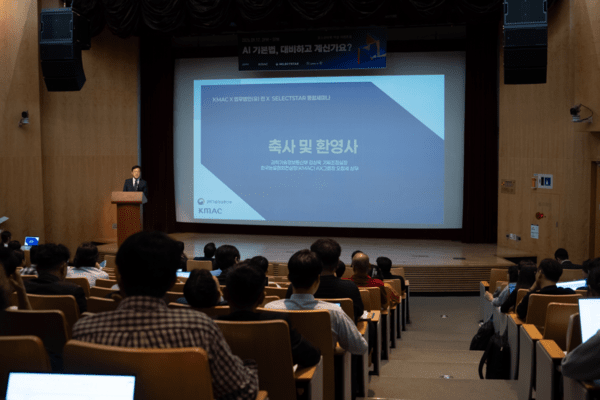
SelectStar held a seminar on the 17th titled "Practical Responses After the AI Basic Act: Responsibility, Governance, and Verification," and reviewed response measures for companies and public institutions after the AI Basic Act took effect.
The seminar covered legal and regulatory interpretation, organizational governance, and technical verification of actual AI services, while sessions were held on AI public procurement, changes in security regulations, governance frameworks for responsible AI operations, and strategies for confirming AI safety and reliability.
Lee Hyun-taek stressed that responding to the AI Basic Act requires transparency review, safety verification, support for classification of high-impact and high-risk systems, fulfillment and documentation of operator responsibilities, and support for impact assessments, and that a continuous evaluation and verification system should be established rather than relying on a one-time assessment before launch.
As the AI era enters full swing, companies and public institutions are actively using AI to improve work efficiency. Against this backdrop, industry officials stressed the need to continuously verify risks in the process of operating AI services after the AI Basic Act.
To that end, SelectStar held a seminar on the 17th titled "Practical Responses After the AI Basic Act: Responsibility, Governance, and Verification." On the 18th, SelectStar said the seminar was organized to review response measures for companies and public institutions after the law took effect, and was conducted through joint discussions with experts.
The seminar covered legal and regulatory interpretation, organizational governance, and technical verification of actual AI services as areas for discussion. Response measures were examined by linking legal and regulatory interpretation with organizational governance and technical verification of actual AI services.
The event featured several sessions, including AI public procurement, changes in security regulations, governance frameworks for responsible AI operations, and technical implementation strategies for confirming AI safety and reliability. In one session, titled "Technical Implementation Strategies That Prove Reliability Beyond Governance," SelectStar stressed that, to respond to the AI Basic Act, companies need a technical evaluation and verification framework that can objectively confirm whether policy and management systems actually function in real services.
Lee Hyun-taek, head of SelectStar's Global Business Development Team, who delivered the presentation, explained that legal and institutional requirements need to be translated into concrete measurement and verification criteria, along with supporting evidence, for actual AI services. He presented five technical review areas for this purpose: transparency review, safety verification, support for classification of high-impact and high-risk systems, fulfillment and documentation of operator responsibilities, and support for impact assessments.
The presentation cited finance, healthcare, and agentic AI as examples of field risks by industry. Based on this, it said evaluation items and verification standards need to be designed differently by service purpose and application area.
It was also explained that AI evaluation cannot be limited to a single test just before launch, and that a system for ongoing reevaluation is needed even after actual operation, as models, data, and services change. Lee said AI governance means an organization sets acceptable risks and management standards. He also explained that technical verification is the process of presenting, with objective evidence, whether AI meets the required standards.
Lee said AI risks can change whenever the model, data, or service environment changes. He emphasized that it is important to establish a continuous evaluation and verification system rather than a one-time assessment before launch. In the latter half of the event, a panel discussion was held on hypothetical situations that could arise during actual AI service operations.
The discussion drew on AI cases from public institutions and finance. Participants said that when the scope of AI judgment and execution expands, accuracy, personal data, bias, and unauthorized execution should be seen as areas requiring continuous verification. They also discussed that reverification results when a model or data changes should be used as a basis for decisions on service launch and operation, and that as the scope of judgment and execution grows, continuous verification of major risks and reverification when changes occur are necessary.
Source: TECHWORLD · Kim Hye-jin
Original: https://www.epnc.co.kr/news/articleView.html?idxno=407132
References
This article was produced with the help of an automated content generation algorithm.
Source: TECHWORLD
View originalThis article was summarized and organized by BizCrush based on the original article from TECHWORLD. For exact quotations and full details, please refer to the original article.