Hanwha Systems Begins Developing AI Space Situational Awareness System to Protect Space Safety
TECHWORLD ·
✦ AI Summary
Hanwha Systems and the Korea Astronomy and Space Science Institute have signed a contract for the project to develop a space-based space surveillance satellite and a ground-linked space situational awareness (SSA) system.
This project is part of the national space situational awareness system (K-SSA) development initiative being pursued by the Korea AeroSpace Administration.
Hanwha Systems will be responsible for developing the space-based space surveillance satellite, building the ground-linked space situational awareness system, linking and integrating detailed subsystems, and conducting tests and verification.
Hanwha Systems and the Korea Astronomy and Space Science Institute have signed a contract for the project to develop a space-based space surveillance satellite and a ground-linked space situational awareness (SSA) system. Hanwha Systems said the deal will mark its full-scale participation in design and development as a private sector systems developer for the national space situational awareness system (K-SSA).
SSA is the activity of identifying and predicting risks in space, such as collisions and falls, based on observations and analysis of the position and orbit of space objects. The company said the recent surge in low Earth orbit satellites has increased the risk of collisions with artificial and natural space objects in orbit, while the need to protect national space assets has also grown. As a result, the importance of space situational awareness capabilities for preemptive responses to the risk of collisions between space objects and objects falling to the ground is rising.
This project is part of the national space situational awareness system (K-SSA) development initiative being pursued by the Korea AeroSpace Administration. The Korea Astronomy and Space Science Institute will serve as the lead research institution, defining the mission of the national space situational awareness system, establishing the concept of operations and system requirements, and overseeing detailed technical integration, system integration, and the overall technology management of the project.
Through this contract, Hanwha Systems will participate as the private sector systems developer for K-SSA, which is overseen by the Korea Astronomy and Space Science Institute. Accordingly, Hanwha Systems will carry out systems development work, including developing the space-based space surveillance satellite, building the ground-linked space situational awareness system, linking and integrating detailed subsystems, and conducting tests and verification.
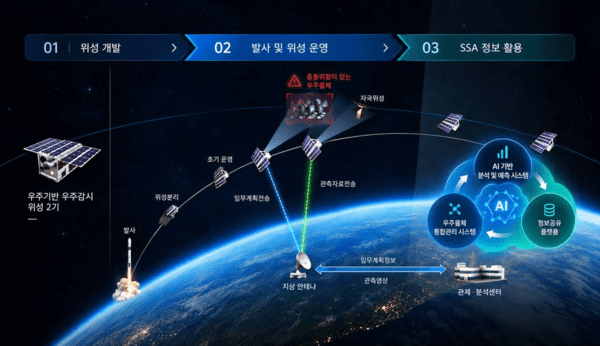
The space-based space surveillance satellite targeted for development is a microsatellite that will operate in low Earth orbit at an altitude of about 480 km. The satellite will carry an optical camera for space situational awareness (SSA), which will detect and track artificial and natural objects in space in real time. Through this, the space-based space surveillance satellite will collect core observation data for analyzing the risk of collisions and falls involving space objects.
The ground-linked space situational awareness system is a ground infrastructure that integrates and analyzes space object information secured based on various observation means and data, including the space surveillance satellite. Hanwha Systems will also be responsible for building this ground-linked space situational awareness system.
AI technology will be applied to this ground-linked space situational awareness system. This will enable precise prediction and analysis of the trajectories of space objects and the risks of collisions and falls, while sharing related information to support rapid situational assessment and action.
Song Seong-chan, head of Hanwha Systems' space business division, said the space industry is expanding beyond the traditional stages of satellite development and operation to include the safe use and management of space, and that the pace of this expansion is also rapid. He added that through this project, the company will secure core technological competitiveness in space situational awareness and space domain awareness (SDA) and contribute to strengthening South Korea's independent space security and response capabilities. He explained that SDA is a concept that comprehensively identifies and assesses the movement of space objects, as well as the intent and impact of various activities and threats in space.
Source: TECHWORLD · Lee Gwang-jae
Original: https://www.epnc.co.kr/news/articleView.html?idxno=407115
References
This article was produced with the help of an automated content generation algorithm.
Source: TECHWORLD
View originalThis article was summarized and organized by BizCrush based on the original article from TECHWORLD. For exact quotations and full details, please refer to the original article.