Will AIDC Power Rules Shift From How Much It Uses to How Much It Can Cut?
IT DAILY ·
✦ AI Summary
AIDC power procurement is shifting from a model centered on building out power plants and grid infrastructure to one centered on demand management.
Google, NVIDIA, and others have promoted the spread of 'flexible AI data centers' and the launch of AEMA, which aim to reduce AI computing or move it to other regions and time slots depending on power conditions.
In Korea, amid discussions over lower-level regulations under the AIDC special law and PIA exemptions, there are calls to include power flexibility in evaluation criteria.
A shift is emerging in how AIDC secures electricity, moving away from a model centered on expanding power supply and toward one focused on managing demand. Under the old approach, operators would first secure all the power needed by building out power plants and grid infrastructure, then run the data center.
At the same time, alternatives are gaining ground. One is to reduce AI computing when the grid is congested, and another is to move AI computing to other regions or time slots when the grid is congested.
Google and NVIDIA are pushing the spread of 'flexible AI data centers' that adjust power consumption according to power conditions. The idea focuses on using data centers not as fixed 24/7 demand centers with constant power consumption, but as resources whose usage can be adjusted depending on grid conditions.
If this change is applied domestically, the standards for AIDC power regulation could also shift. Criteria that have centered on total power usage could be replaced by ones focused on the speed and certainty of reducing consumption when power is scarce.
In Korea, work is under way to flesh out the scope of exemptions from the power system impact assessment, or PIA, for facilities outside the Seoul metropolitan area through lower-level regulations under the AIDC special law. However, if the discussion on exempting facilities from the PIA remains limited to facility size, it would be difficult to distinguish between AIDCs that can reduce power use and those that cannot.
Accordingly, there are calls for data center evaluation criteria to go beyond simply easing power thresholds and instead introduce 'power flexibility.' The core of power flexibility is to exclude the blanket suspension of all AI services when power is scarce. Tasks where real-time response and stability are critical would be protected first, while AI training and batch jobs that do not require immediate processing could be slowed down or rescheduled.
AI tasks can have their execution time and processing location adjusted. They can also use energy storage systems, or ESS, or on-site power sources, and doing so can reduce the power drawn from the grid.
Amid this trend, Google, NVIDIA, and Emerald AI launched the 'AI Energy Management Alliance,' or AEMA, on the 16th local time. AEMA aims to establish common technical and operational metrics for evaluating AIDC power flexibility and also seeks to accelerate the introduction of related policies.
As principles for applying to data centers, AEMA proposed evaluating actual reduction performance rather than specific hardware or software. The key is to verify performance based on how flexibly a data center can respond to requests for power reductions, rather than on the type of equipment it has. As evaluation metrics, it proposed response speed to power reduction requests, the scale of reductions, the duration of reductions, and whether systems operate as predicted in emergencies.
AEMA also proposed creating separate interconnection procedures for data centers that make verifiable commitments to power flexibility. The purpose of these separate procedures is faster and larger-scale grid connection than before. However, a system that would give priority to supply capacity on the grounds of power flexibility has not been finalized.
The operating model proposed along these lines is to maximize AI computing when the grid has spare capacity and delay some computations when power supply and demand become unstable due to heat waves or power plant outages. This idea has the advantage of making use of spare capacity in the existing grid without waiting for new power plants or transmission networks to be completed.
Examples showing how quickly data centers can reduce power use during emergencies or sudden spikes in demand have been presented one after another. According to AEMA, in a power flexibility demonstration, a case was confirmed in which data center consumption was cut by about one-third within 1 minute under an emergency scenario. NVIDIA and Emerald AI spent the past year testing technology that simultaneously adjusts AI computing and power consumption at 5 commercial data centers around the world. Google signed a demand response contract with Indiana Michigan Power, or I&M, and the Tennessee Valley Authority, or TVA, to adjust machine learning workloads.
These cases are in line with a method in which data centers reduce power use when demand surges by delaying or shifting to other time slots tasks that do not require immediate processing. A method of cutting data center power consumption by delaying or moving such non-urgent tasks to different time slots when demand spikes is being used.
Existing adjustment tools focused on improving the efficiency of cooling and power equipment and on controlling data center grid power use through ESS. But now AI computing itself is also becoming a target for power adjustments. In the past, power use was adjusted mainly through cooling and power equipment or ESS; now the scope has expanded to include adjusting the scheduling of computing tasks and AI workloads themselves.
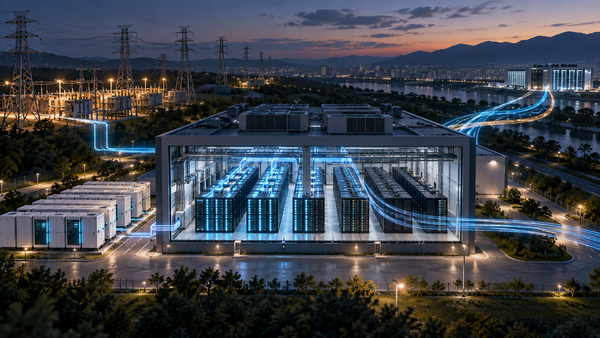
From a comparative perspective, the difference between highly efficient centers and centers capable of cutting power is highlighted. An image generated by AI was used in the article.
When evaluating data centers, general energy efficiency and power flexibility must be considered separately. The PUE standard compares IT equipment power use against total data center power use, and the meaning of PUE is to show the level of additional power consumed by cooling, power conversion, and related equipment. Power flexibility, by contrast, refers to how much actual consumption can be reduced when the grid requests it.
Accordingly, even a data center with a low PUE may be unable to reduce consumption if GPUs are run at maximum output at all times. In such cases, the data center functions as a fixed large load on the grid. Conversely, even a data center with high total power use may be able to shift some AI training to other time slots and use ESS or on-site power sources. In that case, it can ease pressure on the grid during peak demand.
From the perspective of power utilities, what matters is not only annual electricity consumption but also the amount used at the moment peak demand occurs. Power grids and generation facilities must be built based on the time periods when maximum power is needed. If power flexibility is low, it may be necessary to expand power plants and transmission and substation facilities in order to meet peak demand during limited time windows, and such expansion takes enormous cost and time.
If AIDC reduces power use during peak hours, room is created for additional facilities to connect to the existing grid. As a result, the role of data centers could shift from fixed loads that burden the grid to power resources that can help manage demand.
However, not all AI computing can be freely scaled down. Search, finance, healthcare, and security services require real-time response and stability, making it difficult to delay the operation of those services based solely on power conditions. As a result, data center operators face the task of distinguishing between critical services and adjustable workloads, while also having to ensure customer service quality even during power reductions.
For these reductions to actually help respond to a power supply crisis, a system is needed to verify whether the promised cuts are really carried out. If the reducible power of a data center is overestimated, the plan may fall short during a power supply crisis. In addition, prior agreement is needed on reduction speed, duration, recovery process, and standards for sharing operational data.
In Korea, AIDC power policy design is centered on power receiving capacity and location. In areas subject to the PIA, businesses seeking new power supply above a certain scale are reviewed through the PIA for power supply feasibility and grid impact. Accordingly, the variables that determine the pursuit of an AIDC project are whether it passes the PIA and when power can be brought in.
The law scheduled to take effect in March next year is the 'Special Act on the Promotion of the Artificial Intelligence Data Center Industry.' The special act includes a provision stating that among AIDCs built outside the Seoul metropolitan area, facilities with power supply capacity below the presidential decree standard may not be required to undergo the PIA.
However, the specific scale for applying the PIA exemption will be determined in lower-level regulations. A public discussion forum on those lower-level regulations was recently held. The main topics were the scope of AIDC recognition and power-related special provisions.
The current lower-level regulation discussions are not yet at the stage of adopting an official regulatory standard for AIDC power flexibility. At this stage, the discussions are about specifying eligible AIDC entities and the scope of PIA special treatment.
Even AIDCs with the same power receiving capacity can have different impacts on the grid. Some facilities maintain maximum output during peak hours, while others can cut usage by adjusting AI computing, ESS, or on-site power sources. There are concerns that evaluating these facilities under the same criteria could reduce incentives to invest in power flexibility.
Accordingly, the possibility of applying overseas power flexibility models domestically is being raised as an alternative. In PIA and grid interconnection reviews, both maximum usage and the amount of power that can be reduced can be assessed at the same time, and businesses can be required to present in advance their reducible capacity, response time, and duration. It could also be considered to reflect such proposals in grid connection procedures and special review processes after verifying them.
Another alternative is a conditional power supply model. Under this approach, initial connection is allowed, and then usage is reduced by the agreed amount when the grid becomes congested. However, if a conditional connection system is introduced, it will be necessary to confirm whether reduction commitments are being fulfilled, and the design must also include penalties for noncompliance and incentives for stable reductions.
As electricity demand rises along with AIDC expansion, meeting that demand solely by building power plants and transmission networks would take a considerable amount of time and cost a great deal. In response, the solution proposed by Google and NVIDIA focuses on the point that, along with generating new power, the timing and method of using existing secured power also matter.
Amid this trend, Korea's AIDC policy has so far taken an approach centered on the scale of PIA exemptions, but there are calls for further progress beyond simply deciding the size of the exemption. Going forward, AIDC evaluation factors are likely to include both power demand and the amount that can be reduced when the grid is under strain, and the ability to cut consumption during grid stress is increasingly likely to determine the speed of power procurement and business competitiveness.
Source: IT DAILY · Lee Jae-young 기자
Original: https://www.itdaily.kr/news/articleView.html?idxno=241692
References
This article was produced with the help of an automated content generation algorithm.
Source: IT DAILY
View originalThis article was summarized and organized by BizCrush based on the original article from IT DAILY. For exact quotations and full details, please refer to the original article.