[On Site] Quantum Moves Out of the Lab, Bringing Computing, Materials, and Security Together
IT DAILY ·
✦ AI Summary
The '2026 International Quantum Industry Expo,' held at COEX from the 9th to the 11th of this month, confirmed a new trend in the quantum industry.
At the event, Norma's industrial quantum computer 'Qrion' model, Dream Security's PQC-based key generation and supply solution 'Magic PQKMI,' ID Quantique's QKD system 'Clavis XG,' and XGate's QRNG chip were introduced.
The quantum computer and related materials, parts, and equipment sectors were centered on R&D and ecosystem building, while the security sector focused on market entry for products applying PQC, QKD, and QRNG.
In dictionary terms, a quantum is the smallest unit of energy that can no longer be divided. A quantum is also described by the property that particles can exist in multiple states at the same time and by the property of connections between particles that are far apart. Such quantum phenomena are drawing attention in industry as technologies that can overcome the limits of computation and measurement.
A representative example is the quantum computer, which performs operations based on the principles of quantum mechanics. As quantum computers emerge, security technologies aimed at protecting encryption are also rising. Alongside this, the materials, parts, and equipment industry related to quantum computer manufacturing is also gradually moving forward.
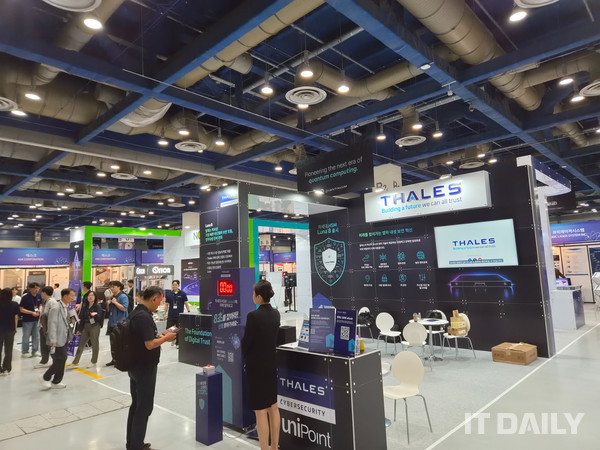
This new trend was confirmed on site at the '2026 International Quantum Industry Expo,' held at COEX from the 9th to the 11th of this month. The event was presented as a venue to spotlight the newly budding quantum industry. The photo was taken by reporter Kim Ho-jun.
The representative computing technology of the quantum industry is the quantum computer. A quantum computer is a new type of computer that uses 'Qubit.' The core technology of conventional computers is Bit, which represents either 0 or 1.
A qubit remains in a superposition of 0 and 1 until it is measured. Based on qubits, a quantum computer can perform computations in ways different from conventional computers.
A quantum computer is not a replacement for a conventional computer. It is a technology with new possibilities that works in a different way. Quantum computers are strong at calculations involving complex entanglement, multiple possibilities, or probabilities. They are well suited for simulations that model the movement of molecules and materials. They are expected to be used in battery development and drug discovery.
At the '2026 International Quantum Industry Expo,' Norma displayed its industrial quantum computer 'Qrion.' The exhibited 'Qrion' is not currently equipment that the company is developing or using. Photo by Kim Ho-jun.
At the front of the venue, Norma's industrial quantum computer 'Qrion (Qrion),' which is under development, was placed. The item on display that day was a Qrion model. The exhibited model was based on Norma's superconducting approach. The superconducting method cools metal circuits to an extremely low temperature, creating a superconducting state in which electrical resistance disappears, and then implements qubits in that state.
Superconducting quantum computers consist of cooling plates and wiring designed to reach cryogenic temperatures close to absolute zero (minus 273.15 degrees Celsius), and these components are installed in layers from top to bottom. The reason IBM's 'Quantum System One' has the appearance of a chandelier is also connected to this layered cooling-plate and wiring structure of superconducting quantum computers.
Today, quantum computers operate in conjunction with conventional computers. The setup connects them to a platform that uses programming languages such as Python and assigns only certain computations to the quantum computer. Norma also unveiled 'Q Platform MCP,' which links generative AI and a quantum program development and execution environment. The platform allows users to enter natural-language requests, build a quantum program, run it on a GPU-accelerated simulator, and then check the results.
Quantum computer components are difficult for a single company to manufacture on an all-in-one basis. As a result, if the quantum industry is to grow, the industrial ecosystem must expand in tandem.
In this regard, the Netherlands is fostering the quantum industry around five regional hubs. The country's hub cities are Delft, Eindhoven, Twente, Leiden, and Amsterdam. Of these, the Netherlands Organisation for Applied Scientific Research (TNO) is located in Delft, where quantum computing and quantum internet are being studied.
In the Eindhoven area, the focus is on linking the Brainport advanced manufacturing ecosystem, including ASML, with quantum-based technologies. Korea's quantum industry is only at the very beginning stage.
Against this backdrop, the Ministry of Science and ICT recently announced a policy to designate and foster Seoul, Jeonnam, Gwangju, Busan, Ulsan, and Gyeongnam (the southeastern region) as three major quantum clusters. The policy is expected to contribute to the formation of a domestic ecosystem for quantum research and related materials, parts, and equipment.
At the '2026 International Quantum Industry Expo,' several companies in the quantum-industry materials, parts, and equipment sector operated booths on the day of the event and showcased core components and equipment. The photo shows the setup of Sensorview's exhibition booth at the '2026 International Quantum Industry Expo,' and the photo credit reads Kim Ho-jun.
Sensorview is a specialist in high-frequency RF cables and connectors, and at its booth it exhibited long cables for quantum computers and cryogenic cables for quantum computers. These cryogenic cables are used to connect qubits in cryogenic environments with external control equipment at room temperature.
The brain of a quantum computer is the QPU, or Quantum Processing Unit, and the manufacturing method for a QPU varies by approach. Among them, a superconducting-based QPU can be made on a silicon wafer through semiconductor manufacturing processes, and Cubic Laser System displayed laser equipment for wafer manufacturing processes.
Cybersecurity was the most active field at this exhibition. The movement in the security sector was based on accumulated encryption and communication technologies. The goal in this field was to prepare in advance for the threat that quantum computers could pose to existing cryptographic systems. The emergence of quantum computers is increasing the possibility of a new security crisis.
At the root of this background is a problem with the foundation of public-key cryptography. Modern public-key cryptographic systems are based on the difficult problem of prime factorization. In 1994, Peter Shor developed Shor's Algorithm. Shor's Algorithm is a method for solving the prime factorization problem using a quantum computer.
For this reason, if quantum computers emerge, existing public-key cryptographic technologies may become ineffective. The security industry is therefore concerned about HNDL, or Harvest Now, Decrypt Later, attacks. An HNDL attack is the concept of collecting public keys now and decrypting them later.
Amid this trend, Dream Security had an exhibition at the '2026 International Quantum Industry Expo.' Dream Security's exhibit was 'Magic PQKMI,' a PQC-based key generation and supply solution. The photo credit is on the left. The photo source is Kim Ho-jun.
Technologies for responding to the quantum security crisis are divided into two categories. A representative technology is PQC, or Post-Quantum Cryptography. PQC is a technology that builds a public-key cryptographic system based on hard problems that are difficult to solve even with quantum computers. The security industry is promoting the transition of current public keys to PQC. Dream Security exhibited PQC-based key generation and supply 'Magic PQKMI (Magic PQKMI)' at the 2026 International Quantum Industry Expo.
Another technology is QKD, or Quantum Key Distribution. The difference between PQC and QKD is that PQC replaces public keys, while QKD exchanges secret keys through quantum communication. The implementation methods also differ: PQC is algorithm-based, while QKD requires separate equipment. However, QKD has the limitation of the distance over which quantum communication is possible. Even so, QKD is expected to contribute to quantum security in a way different from PQC.
At this event, ID Quantique (IDQ) introduced its QKD system 'Clavis XG.' ID Quantique was the exhibitor at the 2026 International Quantum Industry Expo. ID Quantique's exhibit was the QKD system 'Clavis XG,' and the equipment was located first from the right in the photo. Immediately to the left of Clavis XG was the PQC-based network equipment 'Solteris (Solteris).'
At the '2026 International Quantum Industry Expo,' a chip exhibit for XGate's QRNG was unveiled. The photo was provided by XGate. One way to improve the level of encryption is a technology that uses the principles of quantum mechanics. QRNG is a pure random number generator based on quantum properties, producing unpredictable, patternless, and irregular random numbers.
Today, the mainstream form of random numbers is pseudo random numbers implemented in software. Pseudo random numbers look random but are generated based on algorithms. For this reason, pseudo random numbers are not truly random.
XGate unveiled a chip-type QRNG on the day. This QRNG chip is intended to be mounted in XGate's VPN equipment and firewalls. An official said the QRNG could be installed in XGate's network security equipment.
The quantum-industry trends confirmed on site showed differences in pace by field. The quantum computer and related materials, parts, and equipment sectors were centered on research and development and ecosystem building. By contrast, in security, there were attempts to bring products applying PQC, QKD, and QRNG to market. On the exhibition floor, efforts to realize quantum computational capabilities coexisted with moves to prepare for a changing security environment.
In the quantum field, the transition of difficult scientific language into industrial technology has begun, but there are still high barriers before market adoption. In this situation, attention is being focused on the potential and practical realization of Korea's quantum industry.
In relation to this, the '2026 International Quantum Industry Expo' was held, sponsored by the Ministry of Science and ICT and the Seoul Metropolitan Government, and co-hosted by the Korea Quantum Industry Association, the Future Quantum Convergence Forum, and Jexpo. Side events included the Global Quantum Summit, the awards ceremony for the Global Quantum AI Competition, and the Quantum Tech IR Pitching Day.
Source: IT DAILY · Kim Ho-jun
Original: https://www.itdaily.kr/news/articleView.html?idxno=241634
References
This article was produced with the help of an automated content generation algorithm.
Source: IT DAILY
View originalThis article was summarized and organized by BizCrush based on the original article from IT DAILY. For exact quotations and full details, please refer to the original article.