From AI Cluster to an “AX Demonstration Valley”...Jeonnam-Gwangju Launches 26 Projects in the Second Half
TECHWORLD ·
✦ AI Summary
Jeonnam-Gwangju's AX Demonstration Valley, a second-phase project of the AI cluster, will launch 26 new projects in the second half of this year.
The scope of application was presented as civic participation, senior care, public administration, autonomous driving, manufacturing, power grids, and energy storage systems (ESS).
The Ministry of Science and ICT, the Ministry of Trade, Industry and Energy, the Ministry of Climate, Energy and Environment, and AICA held a briefing session and unveiled the technology development direction and demonstration conditions.
Jeonnam-Gwangju's “AX Demonstration Valley,” a second-phase project of the AI cluster, will gain momentum with the launch of 26 new projects in the second half of this year. The government plans to deploy AI technology in real urban and industrial settings, with the goal of confirming its usability.
The scope of application was presented as civic participation, senior care, public administration, autonomous driving, manufacturing, power grids, and energy storage systems (ESS). The concept was designed around linking R&D results with local industries and commercialization.
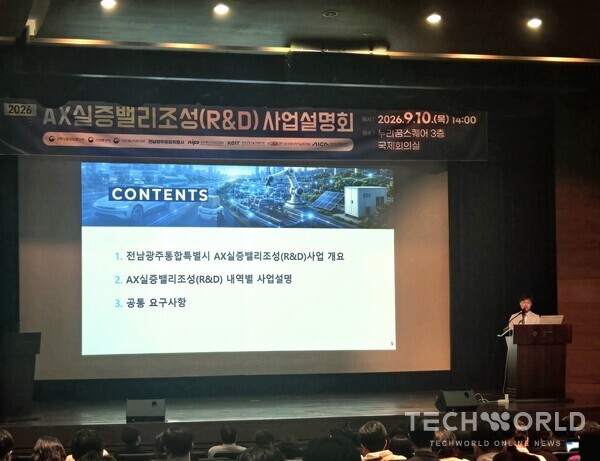
The Ministry of Science and ICT, the Ministry of Trade, Industry and Energy, the Ministry of Climate, Energy and Environment, and the AI Industry Convergence Agency (AICA) held the first briefing session for Jeonnam-Gwangju on the 8th, and a second session at Nuri Dream Square in Sangam, Seoul, on the 10th. The second session unveiled the technology development direction and demonstration conditions for the new projects.
The new projects for the second half of this year consist of 8 designated calls, 13 item-specific calls, and 5 open calls, for a total of 26. The target areas are AI for Everyone, urban and daily-life innovation, future mobility AX, and AI-based optimization and safety management for energy operations.
“AI for Everyone” focuses on applying AI in areas closely tied to daily life, such as civic participation, senior care, content production, and public administration. Among them, PM Hwang Jun-cheol presented direct participation-type democracy, senior mind care, and video generation AI as showcase items.
First, the AI-based direct participation-type democracy platform is equipped with functions to collect and analyze citizen opinions, identify policy demand, and support civil servants' policy decisions. PM Hwang Jun-cheol explained that it can aggregate and analyze opinions to determine the majority view.
The application then expanded into senior care. The method of using senior care data combines not only medical information generated at hospitals but also everyday data.
The “multimodal senior mind care technology for realizing AI for Everyone” is intended to identify changes in seniors' conditions by combining heterogeneous data and to provide individualized services.
PM Hwang said the direction of senior services is to use not only hospital information but also data accumulated in daily life. He explained that the goal is to synthesize multiple data sources to understand seniors' conditions and provide the services they need.
He also introduced efforts in the content sector to develop video generation AI that reflects the characteristics of Korean culture and content. The focus is on securing a model and usage base suited to domestic content production environments rather than simply using overseas generative AI.
Projects are also being pursued to apply AI agents to internal work at public institutions. The project, titled “Development of Technology for an AI-based Integrated Innovative Organization Operation Platform,” will enable AI to pre-identify document and work data dispersed across departments and individual PCs, while allowing employees to search for the information they need in natural language.
The project will also support employees' work processing. PM Hwang said that documents by department and materials stored on individual PCs are scattered, making it difficult to search for needed information, and explained that the project involves conversational document search and linking to agents that perform actual work based on AI's prior understanding.
The autonomous driving sector is shifting from conventional rule-based methods to learning-based AI models. As a result, the main projects have been set as the development of next-generation autonomous driving architecture and space-specific mobility.
PM Bang Won-chan explained that the dominant approach in domestic autonomous driving systems had been rule-based. He added that the goal of this project is to shift toward an AI model that learns from driving data.
The next-generation autonomous driving architecture is about reorganizing the existing step-by-step structure of sensor information processing around AI. The existing structure has processed sensor information by dividing it into perception, judgment, and control stages. In parallel, efforts will be made to secure models that can learn from large-scale driving data and be applied to actual vehicles.
The project budget is KRW 33.106 billion over 33 months. The lead organization must be a company that either possesses an autonomous driving AI model or can develop and apply one to actual vehicles.
Space-specific autonomous driving refers to technology that performs specific tasks in restricted areas rather than on general roads. The focus of space-specific autonomous driving development is on autonomous driving systems tailored to area-specific demands such as transportation and logistics.
PM Bang explained the direction of building autonomous driving that can carry out designated purposes in specific spaces such as industrial sites, campuses, and ports. He also cited manufacturing sites and vehicle software as expansion targets for mobility AX.
The ministry of trade and industry presented as priority projects a fully intelligent software-defined factory (SDF) for robot-worker collaboration, serviceitization integration technology, and integrated control technology for AI-based next-generation software-defined vehicles (SDV). PD Kim Dong-hwan said the ministry will support technology development that analyzes data generated at manufacturing sites with AI and applies it to products and processes.
PD Kim Dong-hwan explained that the basic direction is to connect AI models to actual manufacturing and vehicle systems based on data secured on site. Accordingly, the ministry's support direction is focused on applying AI to actual systems in the manufacturing and vehicle sectors based on on-site data.
SDF refers to a concept in which factory equipment, robots, and work data are analyzed with AI, with a focus on implementing a manufacturing system that responds to changes in the production environment. SDV focuses on software-centered integrated control technology for vehicle functions and data.
In the energy sector, a direction was presented to apply AI to power grids, distributed energy, and ESS. The aim is to respond to power volatility caused by the rise of renewable energy and distributed resources and to improve equipment operation and safety management.
In line with this direction, core technology development for an AI distributed power grid bridge will be promoted. This project is intended to verify technologies needed before large-scale business deployment.
The target items include 11 areas, such as microgrids, distributed resources, ESS, distribution network operation, and analysis. The total investment is KRW 28.225 billion. No separate demonstration item will be applied.
PD Kim Chang-seon explained that the project is intended to build hardware and software at the PoC stage. He also said the purpose is to identify technical requirements before linking the project to a large-scale future program.
The development direction also extends to broadening the scope of power grid analysis from electricity to heat and gas. In addition, technologies for integrated analysis of multiple energy sources and real-time simulation that can reproduce actual operating conditions will also be developed.
In the field of local distributed energy, a data foundation for AI use will be established. Data generated by generation, consumption, and storage facilities will be processed into a form usable for AI training, and data formats by energy source will be standardized.
PD Jeong Yeong-min said that improving the quality of energy data preprocessing and standardizing datasets by distributed energy type are key tasks.
The ESS sector will then develop AI prediction technologies for battery degradation status and remaining life, as well as technologies to improve operating efficiency and fire safety. The goal is to precisely diagnose battery condition and use it for life management and safe operation.
PD Song Gi-ok said that, in ESS, it is important to accurately determine battery condition as the period of use becomes longer. He added that the plan is to develop technologies that reduce errors in remaining-life prediction through AI, and to develop technologies that improve capacity and life management.
Although the technology areas differ, the endpoint of the project is set as application and verification in real environments. Accordingly, participating organizations are required to specify the application site, operating environment, usage scenarios, roles by institution, and data utilization plans from the R&D stage.
In the latter part of the project, the share of demonstration will increase. Except for the AI distributed power grid bridge project, the other projects must separately allocate a demand-side demonstration period in the final year. Also, after the midpoint of project execution, they must secure a demonstration phase of at least 40% or present an equivalent concrete plan.
In the final year, the R&D budget for demonstration institutions must account for at least 40% of the total annual R&D budget. Under these standards, the project is designed not to stop at R&D but to lead to application and verification in actual settings.
Projects led by the region require participation from Jeonnam-Gwangju companies and institutions. The standard for region-led projects is a participation rate of at least 50% by local companies and institutions based on project costs, and the demonstration sites have been set in Jeonnam-Gwangju. However, some autonomous driving and energy technology-leading projects do not have a separate restriction on the local participation ratio.
A project official said that the region where the demonstration is carried out alone does not determine the overall evaluation. He added that the value of the project outcomes is important, as is the impact on local companies and industries.
This call for proposals will run until the 30th. The AI Industry Convergence Agency said the IRIS online application period is from the 16th to 3:00 p.m. on the 30th. The AX Demonstration Valley is a project that goes beyond building AI infrastructure and is being pursued by verifying the practical effectiveness of technologies in public services, autonomous driving, manufacturing, and energy sites.
The project will be promoted starting in the second half of this year, and the number of projects under way is 26. Whether these 26 projects are linked to industrial demand in Jeonnam-Gwangju is seen as a key variable. In addition, whether they can spread to local industries and connect to the building of an AX ecosystem is another variable that will determine the project's success.
Source: TECHWORLD · Kim Seung-gi
Original: https://www.epnc.co.kr/news/articleView.html?idxno=406813
References
This article was produced with the help of an automated content generation algorithm.
Source: TECHWORLD
View originalThis article was summarized and organized by BizCrush based on the original article from TECHWORLD. For exact quotations and full details, please refer to the original article.