GT One Calls for Full Control Across the AI Ecosystem, Unveils Integrated Governance Strategy
IT DAILY ·
✦ AI Summary
GT One held the "2026 GT One Customer Day Technology Seminar" at Sonofelice Convention in Gangnam District, Seoul, on the 17th, sharing integrated governance strategies and technologies for sustainable AI use by companies in the AI era.
Lee Soo-yong, CEO, explained that the scope of AI management must expand beyond the model itself to data, applications, and regulation and compliance, and presented AI Workbench as the core.
GT One said it plans to advance its governance framework through AI-ready data building, AI lifecycle management, machine learning and generative AI monitoring, and an agent registry.
GT One said that as AI becomes more deeply involved in companies’ day-to-day operations and decision-making, management can no longer be limited to models alone, emphasizing the importance of integrated governance that covers corporate data, applications and AI service execution. The company said that not only models, but also data-system integration, regulation and compliance, and the AI execution process itself must be managed together.
To that end, GT One highlighted the need for control across the entire AI ecosystem and presented an integrated governance strategy. On the 17th, GT One held the "2026 GT One Customer Day Technology Seminar" at Sonofelice Convention in COEX City Airport Terminal in Gangnam District, Seoul, sharing integrated governance strategies, the latest technologies, and implementation directions for sustainable AI use by companies in the AI era.
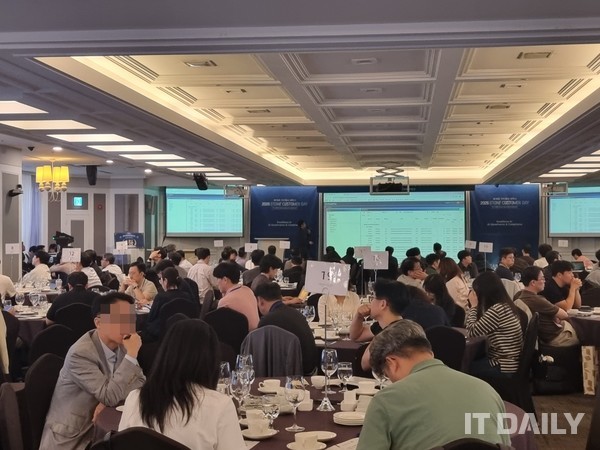
GT One also introduced governance and compliance strategies, as well as key technologies, for the AI era at Sonofelice Convention in Gangnam District, Seoul, on the 17th. The photo was credited to reporter Yang Seung-gap.
Lee Soo-yong, CEO of GT One, presented the direction of next-generation integrated governance and positioned AI governance as the central pillar. He said that as AI spreads across corporate operations and decision-making, the scope of management is expanding. Accordingly, he explained that management should not be limited to the AI model itself, and that a direction linking data governance, application governance, and financial compliance is needed.
Lee identified the quality and reliability of data used in AI, the stability and security of connected applications, and regulatory and compliance risks in the AI utilization process as items that companies must manage in an integrated framework. He said the scope companies need to manage is expanding beyond models to data, applications, and compliance, and proposed integrated governance to bring these elements together.
Lee stressed that regardless of the spread of sovereign AI, companies’ responsibility for control remains. He explained that even after adopting sovereign AI, companies still bear responsibility for customization and service deployment and operations. He added that regardless of whether a sovereign model or open LLM is used, full control over the entire AI ecosystem is necessary, and that securing AI governance is essential for this purpose.
The spread of agentic AI is expanding the scope of control. Traditional AI governance focused on managing the accuracy and appropriateness of model outputs, but the management targets for agentic AI expand to the data used for judgment and the actions actually carried out. Lee explained that the strength of traditional LLMs lies in prediction and reasoning, but they cannot act directly, while agentic AI acts with independent authority.
Lee explained that agentic AI requires control over data and context. He said a shift in the scope of governance is needed and that the focus must move away from simply judging whether model results are right or wrong. He also said the scope of governance must expand to include how agents execute and how they are controlled.
Lee said that in the process of connecting agents to real systems, there is a possibility that data consistency could be compromised and compliance could be violated. He added that once agents are linked to actual systems, data consistency or compliance issues may arise, increasing the need for governance across the entire execution process. He also said this is a time when the importance of end-to-end governance is growing.
GT One is pushing ahead with the advancement of its AI governance framework. The governance target is being expanded to include the context in which AI judgment is used, as well as the actions AI actually performs.
A prerequisite for building such a governance framework is that management of the data used by AI must be in place. This is because if decisions are based on incorrect or low-quality data, it is difficult to guarantee the reliability of the results and their execution, regardless of model performance.
Accordingly, GT One is focusing on building an "AI-ready data" framework. The goal is to manage data scattered across the company in a form that can be used by AI. The data under management includes structured data stored in databases and unstructured internal company data such as PDF, Excel, and Hangul documents. GT One is pushing ahead with a direction that manages even unstructured data as AI-usable data assets.
Lee said that without using unstructured data such as PDF, Excel, and Hangul documents, it is difficult to make effective use of AI. He added that unstructured data needs to be turned into assets, and that an AI-ready data foundation must be established. He also said that without securing data quality, AI has no ability to determine whether that data is correct or incorrect.
GT One held the "2026 GT One Customer Day Technology Seminar" at Sonofelice Convention in Gangnam District, Seoul, on the 17th. At the event, Lee Soo-yong, CEO of GT One, delivered a presentation, and the photo was taken by reporter Yang Seung-gap. GT One said it is expanding its existing data and application governance technologies into the AI domain.
GT One presented "AI Workbench" as the core of AI governance. AI Workbench is built around the Responsible AI (RAI) knowledge pack and includes AI lifecycle management as well as machine learning (ML) and generative AI monitoring functions. The platform serves to support the management of the entire AI project lifecycle, from planning and development to operations.
Lee explained that AI Workbench includes guidelines, AI lifecycle management, and monitoring functions. He also said the company has filed two patents for new technologies related to lifecycle management and integrated monitoring of different types of AI models. He said the company plans to further enhance the platform in the future with functions such as an agent registry and risk management agents.
Lee said that GT One's maintenance contract renewal rate has been around 96% since 2021. He said this reflects strong customer loyalty, including in data governance, application governance, and financial compliance.
The theme of the follow-up session was sovereign AI and AI governance. The session introduced AI control and management frameworks needed by companies in the sovereign AI era and explained the role of AI governance platforms. It also focused on various issues arising in the practical application of AI governance and shared best practices for building and operating AI governance, as well as directions for applying AI Workbench.
The theme of the third session was AI and data governance strategy. The session covered the direction of data governance development in the AI era. Based on the premise that AI quality and reliability are determined not only by AI models but also by the quality and management level of training and usage data, it proposed a way to expand existing data governance centered on structured data and manage unstructured data as AI-usable data assets.
The theme of the fourth session was "AI and application governance strategy." The session introduced new governance strategies for application development and operations environments that use generative AI and AI agents. It addressed the situation in which the expansion of AI-assisted development has improved application development productivity, but has also introduced new management challenges related to source code quality and security, change management, and control of development and operations environments.
In response, GT One proposed linking AI and application governance and presented a direction for building integrated governance across the full lifecycle from application development to operations and across the DevOps environment. It explained a path toward governance that spans development through operations.
The theme of the final session was "AI and financial compliance strategy." The session discussed response strategies for regulations and compliance as AI use expands in the financial sector. It noted that while AI-based productivity improvements and accelerated AI-based service enhancement are taking place in finance, companies must consider related regulations and internal control requirements, and that the importance of a management framework linking AI use and financial compliance is increasing. It also introduced key issues and response directions for financial regulatory response and SCO (Sanctions Control & Ownership), as well as key issues and response directions for CARF (Crypto-Asset Reporting Framework).
Source: IT DAILY · Yang Seung-gap
Original: https://www.itdaily.kr/news/articleView.html?idxno=241704
References
This article was produced with the help of an automated content generation algorithm.
Source: IT DAILY
View originalThis article was summarized and organized by BizCrush based on the original article from IT DAILY. For exact quotations and full details, please refer to the original article.