Uracle: Turning AI Capabilities Into Assets Will Become a Corporate Competitiveness Standard
IT DAILY ·
✦ AI Summary
Uracle held Uracle AI Summit 2026 at COEX in Seoul and presented ways to turn AI agents into assets and manage them.
It explained component asset management and reuse of execution experience through an 'Agent Pack' that modularizes skills, tools, MCP, and harnesses, along with a Merge Engine and Agentic Memory.
It also said Athena AI Studio, Orda, AI Portal, and Athena Code provide agent operations, security, development productivity, and governance functions.
Uracle said that turning AI capabilities into assets is a benchmark for corporate competitiveness.
As environments that divide work among multiple AI Agents and use them simultaneously become a reality, analysis has emerged that the standard for corporate competitiveness is changing. The point is that what matters more than the number of agents is the ability to accumulate and reuse assets of tasks performed and experience.
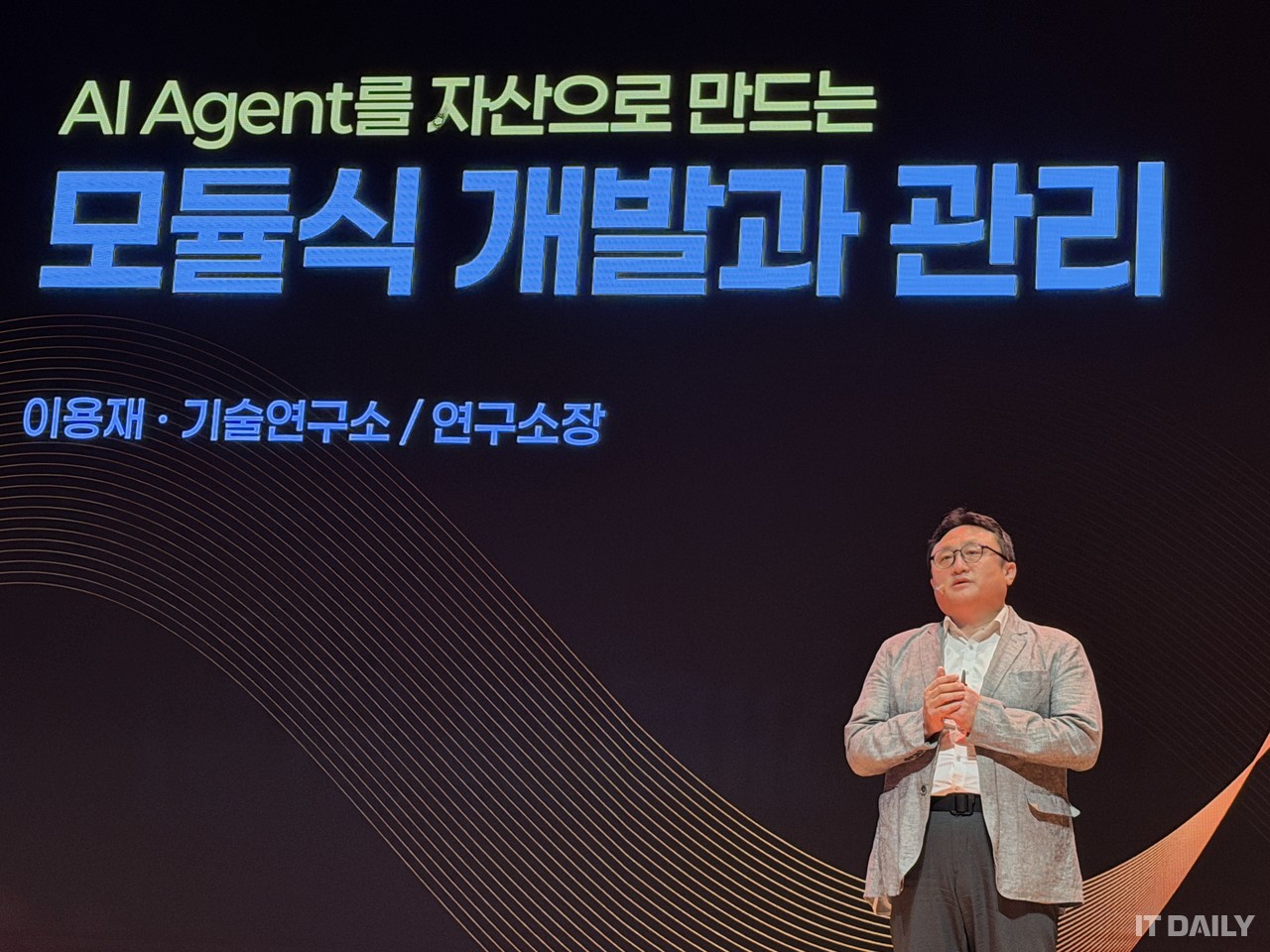
On the 17th at COEX in Seoul, Uracle held Uracle AI Summit 2026 and presented ways to turn AI agents into assets and manage them as a strategy for a situation in which AI agents become the standard for corporate work. Lee Yong-jae, head of Uracle's Technology Research Institute, took the stage to speak on modular management for AI agent assetization.
The subtitle is modularizing AI components into an 'Agent Pack.' The photo shows Lee Yong-jae, head of the research institute, giving his presentation, and the photographer is Sung Won-young.
Uracle described AI agents not as the response function of a single model but as a system in which multiple components operate step by step, and introduced modularization of skill, tool, MCP, and harness components. Lee Yong-jae, head of Uracle's Technology Research Institute, said AI agents are collaborative systems of multiple components rather than generating responses with LLM alone, and explained that even in the process of handling a single request, an AI agent derives an answer through multiple steps.
Uracle also presented the characteristics of each component. Skills are reusable elements for performing specific tasks, tools are elements that perform data retrieval and actual actions like an API, MCP, or model context protocol, is a standard that connects agents and external systems, and the harness is an element that controls the scope and quality of agent behavior.
Based on these components, Uracle presented a way to manage component assets and also introduced an approach to managing the AI agent lifecycle based on verified experience. Through this, it presented a flow that addresses both how agents are built and how they are managed.
Uracle explained that in the field, when there is a 1-to-1 level of one worker and one agent, errors can be handled, but the situation changes when the number of agents grows to 100. Accordingly, it said there is a need to design both how agents are built and how they are managed at the same time.
As a solution, Uracle proposed modularizing components. The method is to modularize skills, tools, and MCP into an 'Agent Pack' and standardize the specification for agent composition. It also presented a structure that increases combinability through lifecycle management of module specifications, verification, and use cases.
In this structure, rule conflicts can arise when packs are combined. Uracle said that when rule conflicts occur, priorities are determined by a Merge Engine.
Uracle also added a system that accumulates execution experience during an agent's work process and verifies that execution experience through Agentic Memory. The verified execution experience is then designed to be used for the next task.
Uracle applied the structure to its three-layer platform. Athena AI Studio supports Agent Pack design, verification, asset management, and reuse of execution experience. Orda provides an AI gateway, model serving, GPU resource management, and model routing, cost, performance, and security operations. AI Portal supports members in discovering agents, using agents suited to their organization and work, and leaving feedback.
In the second session, a way to simultaneously address AI-driven productivity gains and the need for corporate security management in code-based development environments was presented.
In the photo, Lee Chan-jung, head of Uracle's AI Development Division, gave the presentation.
Lee Chan-jung said AI can perform repetitive tasks in the development process, such as code generation, conversion, error analysis, and testing. He said this can improve productivity in development environments.
Lee Chan-jung said that when a company applies its source code, internal development standards, and security documents to the AI utilization process, concerns arise about information leaks and unauthorized training. He also pointed out that token costs rise as AI usage increases.
Lee Chan-jung said there are limits to approaches that use token consumption itself as a productivity standard. He also stressed the need for a governance system that can control costs and usage.
He proposed a 'Human in the Loop' approach for corporate AI use, combining prior approval and human review rather than uniformly restricting AI. He argued that this approach is necessary to manage the reliability and security of AI outputs.
Uracle's Athena Code reflects the needs of corporate environments and provides security, management, quality, and development-environment functions. As strengths of Athena Code, he cited a pre-trained model for development languages, data integration and context utilization, preserving the UX of existing IDE environments, and simple installation and adoption.
Athena Code supports various environments, including closed networks, On-premise, and private clouds, and also supports the use of internal AI models in those environments. It also provides permission management when using external public AI services, log and history management functions, and governance functions that allow monitoring of team-level usage and costs.
In terms of quality, it links internal corporate source code, documents, and development outputs, and supports code generation that reflects the characteristics of existing systems and development standards. It then uses a graph DB to analyze relationships and call structures between source code, and based on that, helps identify the impact of code changes.
In terms of usage, it can be used as a plugin in existing development environments such as VS Code, Eclipse, and IntelliJ. It also modularizes MCP, skills, commands, and rules, and provides a marketplace where they can be shared.
Source: IT DAILY · Seong Won-young
Original: https://www.itdaily.kr/news/articleView.html?idxno=241703
References
This article was produced with the help of an automated content generation algorithm.
Source: IT DAILY
View originalThis article was summarized and organized by BizCrush based on the original article from IT DAILY. For exact quotations and full details, please refer to the original article.