National Institute of Korean Language Discusses Language Resource Use in the AI Era... Hosts Expert Lecture on “The Common Corpus”
TECHWORLD ·
✦ AI Summary
The National Institute of Korean Language will hold the “2026 The Common Corpus Expert Knowledge Lecture” at Studio 159 in COEX in Samseong-dong, Seoul, on the 18th.
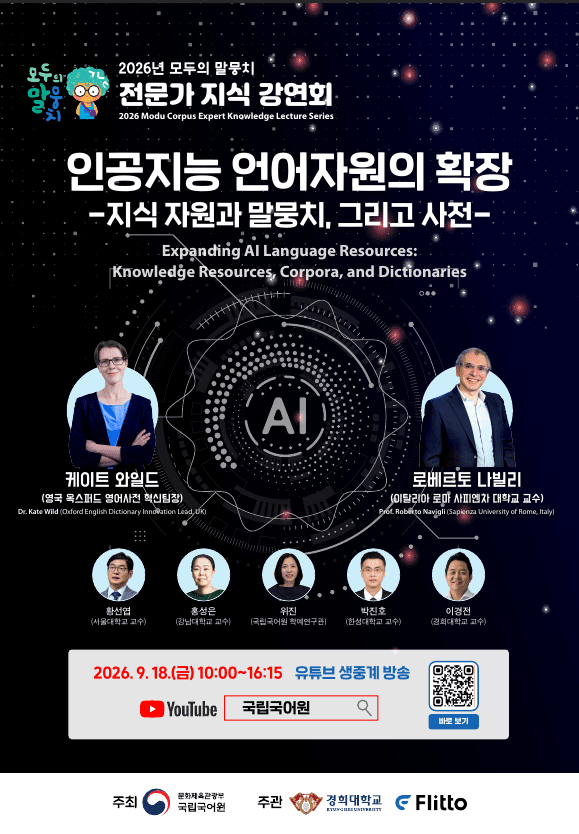
The lecture’s theme is “Expanding AI Language Resources: Knowledge Resources, Corpora, and Dictionaries,” and it will discuss case studies of language resources such as Korean dictionaries and corpora, as well as their potential uses in the AI era.
The National Institute of Korean Language will unveil the “Urimal Eohwi Yeoksa Dictionary,” compiled since 2023, for the first time, and will address directions for using dictionaries, corpora, and knowledge resources through presentations in the first and second sessions and a panel discussion.
The National Institute of Korean Language has set up a forum to discuss the direction of the use and development of Korean language resources in the AI era. The topics under discussion are ways to connect corpora, dictionaries, and multilingual knowledge resources with AI.
The National Institute of Korean Language said on the 18th that it will hold the “2026 The Common Corpus Expert Knowledge Lecture” at Studio 159 in COEX in Samseong-dong, Seoul. The theme of the lecture is “Expanding AI Language Resources: Knowledge Resources, Corpora, and Dictionaries.”
At the lecture, experts from home and abroad will share case studies on language resources such as Korean dictionaries and corpora, and discuss their potential uses in the AI era. The first session will feature presentations centered on Korean dictionaries and AI.
The National Institute of Korean Language plans to unveil the “Urimal Eohwi Yeoksa Dictionary,” which it has compiled since 2023, for the first time. It also plans to introduce the launch process and key features of the “Urimal Eohwi Yeoksa Dictionary.”
Professor Hong Seong-eun of Gangnam University will present on the topic “The Present and Future of the National Institute of Korean Language Sign Language Dictionary,” and Curator-Researcher Wi Jin of the National Institute of Korean Language will present on “The Past, Present, and Future of Korean Dictionaries.” Kate Wild, head of innovation at the Oxford English Dictionary, will then deliver the keynote address.
Kate Wild’s keynote topic is “The Oxford English Dictionary at 100: Lexicography in the AI Era.” The sequence will move from presentations on dictionaries and sign language dictionaries to the Oxford English Dictionary and lexicography in the AI era.
The second session will focus on corpora and AI knowledge resources. Professor Roberto Navili of Sapienza University of Rome will present on the topic “AI-BabelNet and the Lessons of ChatMinerva, Connecting Academia and Industry,” and introduce cases of AI and knowledge resource use. Professor Park Jin-ho of Hansung University will speak on “The Meaning of Building a Multilingual Concept Network for Korean Language and Culture,” and Professor Lee Kyung-jun of Kyung Hee University will present on “From the Era of Selling Corpora to the Era of Corpora at Work.” The main points are to go beyond the mere accumulation of corpus data and to discuss ways to expand corpora into AI-usable knowledge assets.
As the final item of the event, a panel discussion on the theme “Expanding AI Language Resources” is scheduled, with Professor Do Won-young of Korea University, Professor Hong Seong-eun of Gangnam University, Flitto CEO Lee Jeong-su, and Irtech CEO Kwak Yong-jin participating to discuss the future direction of dictionaries, corpora, and knowledge resources from the perspectives of academia and industry.
Source: TECHWORLD · Kim Seung-gi
Original: https://www.epnc.co.kr/news/articleView.html?idxno=407099
References
This article was produced with the help of an automated content generation algorithm.
Source: TECHWORLD
View originalThis article was summarized and organized by BizCrush based on the original article from TECHWORLD. For exact quotations and full details, please refer to the original article.