Defense Industry AX Gains Momentum as 'Defense AIDC Public-Private-Academia Council' Launches
IT DAILY ·
✦ AI Summary
In the defense sector, capabilities in using AI and data have emerged as a core element of competitiveness, but constraints on using commercial cloud services and the burden of building high-performance GPU and security infrastructure have led to efforts to build a defense-specific AI data center (AIDC).
On the 17th, the 'Defense AIDC Public-Private-Academia Council for a Leap Forward in K-defense AX' was launched at the National Assembly Library in Yeouido, Seoul, bringing together the government, industry, and academia to address infrastructure, institutional, and security issues.
The council plans to discuss building, operating, and jointly using a defense AIDC, improving institutions and security systems, expanding AI infrastructure access for small and midsize defense companies, linking domestic AI, AI semiconductors, and cloud services, and training specialized personnel.
In the defense sector, capabilities in using AI and data are emerging as a core element of defense competitiveness. However, the defense industry faces constraints on using commercial cloud services due to the nature of the sector, and individual companies also face a heavy burden in building high-performance GPU and security infrastructure on their own.
In particular, small and midsize defense companies are finding it difficult to secure their own AI infrastructure. In response, efforts are under way to build a defense-specific AI data center (AIDC) to address these limitations.
Public-private-academia cooperation to build such a defense AIDC has now moved into full gear. On the 17th, at the National Assembly Library in Yeouido, Seoul, the launch ceremony for the 'Defense AIDC Public-Private-Academia Council for a Leap Forward in K-defense AX' was held.
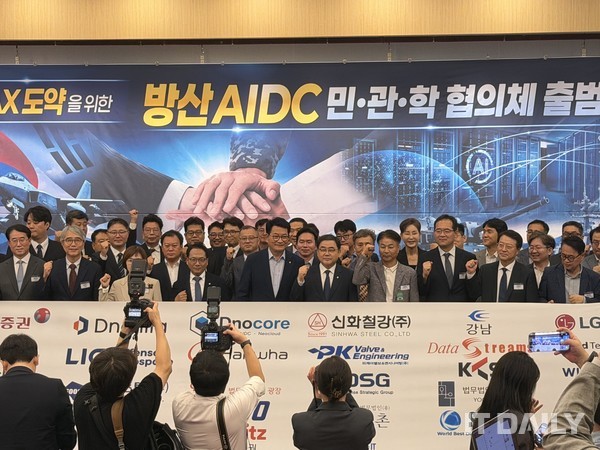
Participants at the launch ceremony posed for a commemorative photo. The photo was taken by reporter Yang Seung-gap.
The council was launched with a focus on jointly resolving infrastructure, institutional, and security issues needed for AI transformation in the defense sector among the government, industry, and academia. It will operate as a framework for multiple stakeholders to address together the foundations, norms, and security tasks required in the process of AI transformation in defense.
The council plans to discuss ways to build and operate a defense AIDC, as well as ways to use the defense AIDC jointly. It will also push ahead with reflecting on-site demand from the defense industry in policy and institutions. Key tasks include improving institutional and security systems for the safe use of defense data, establishing models for building, operating, and jointly using a defense AIDC, expanding AI infrastructure access for small and midsize defense companies, linking domestic AI, AI semiconductors, and cloud services with the defense industry, and training specialized personnel in defense and military AI.
Rep. Park Sun-won of the Democratic Party of Korea said that the sustainable competitiveness of K-defense cannot be maintained through manufacturing and exports alone, and that AX will determine success or failure. He also explained that a defense AIDC is not simply a construction project, but a virtuous cycle foundation for secure data training, on-site deployment, and feeding back export competitiveness. He went on to say that trust should come before speed and institutions before slogans, and expressed his commitment to carrying out the National Assembly's responsibility so that on-site needs lead to policy and legislation.
Rep. Heo Seong-moo of the Democratic Party of Korea said that AI and data capabilities were presented as the next battleground for leaping forward as one of the world's top four defense powers. He added that safe and non-discriminatory shared infrastructure at the national level is needed for an AI transformation across the entire K-defense value chain without leaving anyone behind.
Rep. Heo said that the push to build a dedicated AI data center for defense in Changwon National Industrial Complex is the catalyst, and that companies should be supported in carrying out AX smoothly through deregulation and institutional improvements. He also expressed his determination to create a policy support ecosystem.
Ryu Yeon-seung, director of the Defense and Security Research Institute at Myongji University and chair of the council, explained that to connect this task to the actual building and operation of an AIDC, security, legal, institutional, site, power, and investment conditions must be resolved at the same time in addition to technology. He said that such tasks cannot be solved by defense agencies alone, nor by AI companies, defense companies, or data center companies alone. He added that a council in which government agencies, companies, and academic experts collaborate is necessary.
The council will operate around five working subcommittees covering institutions, talent development, technology and infrastructure, industry demand, and security. Among them, Myongji University will handle the institutional area, and Changsin University will be in charge of talent development, while related companies and organizations will participate in the remaining subcommittees. Participating defense companies are Hanwha, Korean Air, and STX Engine, while participating AI, cloud, and data companies are Dnotitia, KT Cloud, NHN Cloud, LG CNS, DataStreams, and Open Source Consulting.
Among the participating companies, Dnotitia plans to take part in the technology and infrastructure subcommittee. Based on its capabilities in supplying products and AI solutions built on domestic AI semiconductors, Dnotitia plans to serve as a technology provider for building a sovereign defense AIDC.
Going forward, the council plans to identify on-site demand from defense companies and examine legal and institutional issues to select tasks for resolution. It will also establish a roadmap for related standards and benchmarks, and participating companies will jointly push ahead with demonstration and verification. In addition, it plans to hold regular seminars and public hearings and promote the training of specialized personnel.
Regarding the council's direction, Ryu said that it aims to push policy proposals, establish a reference architecture and security standards for responding to future changes, and connect these efforts to actual demonstration and commercialization, positioning the council as an action-oriented body.
Source: IT DAILY · Yang Seung-gap
Original: https://www.itdaily.kr/news/articleView.html?idxno=241696
References
This article was produced with the help of an automated content generation algorithm.
Source: IT DAILY
View originalThis article was summarized and organized by BizCrush based on the original article from IT DAILY. For exact quotations and full details, please refer to the original article.