National Intelligence Service Chief Lee Jong-seok:
IT DAILY ·
✦ AI Summary
National Intelligence Service Director Lee Jong-seok said that, amid the spread of AI and digital innovation, security is both a prerequisite and a condition for sustainability.
He said AI without trust cannot be safe, and that without secure data, national competitiveness has limits.
The National Intelligence Service strengthened pan-government, private-sector, and international cooperation and threat-intelligence sharing, and held CSK 2026 together with APEX 2026 and CCE 2026.
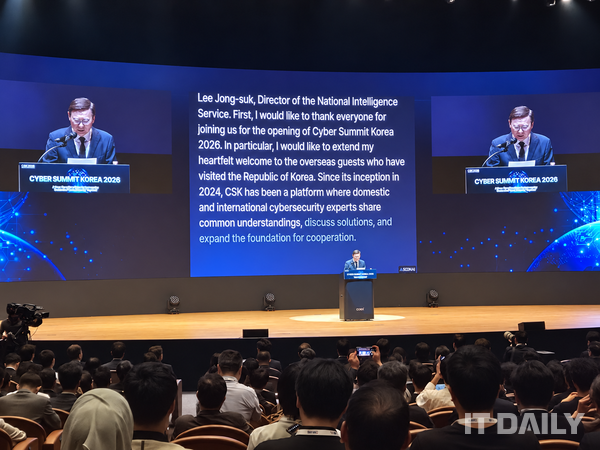
In his opening remarks at 'Cyber Summit Korea (CSK) 2026,' held on the 17th at COEX in Seoul, Lee Jong-seok, director of the National Intelligence Service, emphasized that security is a prerequisite and a continuing condition as AI spreads and digital innovation advances. He said that AI without trust cannot be safe.
Lee said that without secure data, there are limits to national competitiveness. He added that cybersecurity in the phase of AI expansion is the basic prerequisite for becoming an AI powerhouse.
He also said that a security framework suited to connected environments is needed for digital innovation to continue. He further assessed that the importance of cyber security is growing.
Lee said that the scope of cyber security's impact reaches into people's daily lives, the survival of companies, and trust in the international community. He explained that the theme of 'CSK 2026,' 'Connected World, Security Together,' reflects this current environment.
As IT infrastructure such as AI, cloud, data centers, satellite communications, and smart factories becomes interconnected and operates as a single structure, connectivity has become the basis for the creation of new services and industries, while also serving as a channel for the spread of cyber threats. He said that if roads, ports, and power grids were the foundation of the industrial era, cyber security is the foundation of the AI and digital era.
In particular, the emergence of high-performance AI has raised concerns that the level of threats targeting core national infrastructure has increased. Lee said security must keep pace as the speed of connectivity accelerates, and that if the response is inadequate, the future cannot be protected. He added that security is not an obstacle to innovation, but an essential condition for sustaining it.
Lee said that threat intelligence must be shared between governments and companies, and that a cooperative framework for sharing response experience between them is also needed. He described cybersecurity as the common language of a connected world. He also said that when technology and policy advance at the same time, the safety of a connected world can be improved.
To respond to cyber security threats, the government plans to strengthen pan-government cooperation, expand cooperation with the private sector, and pursue broader cooperation with the international community. In line with that, the National Intelligence Service plans to upgrade its system for rapid detection and analysis of cyber threats and its tightly coordinated response system with relevant agencies.
The National Intelligence Service will also pursue the establishment of cooperative networks with international organizations, global companies, and the domestic industrial sector. It also plans to broaden its scope to cover threats affecting points of contact in daily life, including voice phishing response and personal information leakage response.
Against this backdrop, CSK 2026 was held. Jointly hosted by the National Intelligence Service and the National Security Research Institute, CSK 2026 marked its third year, and the opening ceremony was attended by delegations from 56 overseas intelligence and security organizations across 31 countries, along with government, corporate, and academic officials. Lee said the event was intended to highlight the need to jointly consider and discuss ways to secure the safety of the links connecting people, companies, and the nation in a rapidly changing cyber environment, now that a connected world has become reality.
At the event, Kim Yu-won, CEO of Naver Cloud, delivered the keynote address and emphasized cross-border solidarity for security in the AI era. Hector Casas, director of Argentina's Federal Cyber Intelligence Agency, reviewed the cyber threat environment transformed by AI and shared response strategies.
During the event period from the 16th to the 18th, the international cyber drill 'APEX 2026' and the finals of the 'Cyber Attack and Defense Competition (CCE) 2026' are being held concurrently. More than 300 people from 23 countries are participating in 'APEX 2026,' while more than 50 teams are taking part in the finals of 'CCE 2026' in the general, public, and youth divisions.
Source: IT DAILY · Kim Ho-jun
Original: https://www.itdaily.kr/news/articleView.html?idxno=241690
References
This article was produced with the help of an automated content generation algorithm.
Source: IT DAILY
View originalThis article was summarized and organized by BizCrush based on the original article from IT DAILY. For exact quotations and full details, please refer to the original article.