How Far Can Surgical Assist Robots Go? Samsung Medical Center Unveils Research Results from Government-Funded 'Orchestra' Project
TECHWORLD ·
✦ AI Summary
Samsung Medical Center held a demonstration of a surgical-assistance humanoid physical AI robot as part of a Korean ARPA-H project government-funded task.
The robot recognizes voice commands from medical staff to deliver five types of surgical instruments and assist with endoscope direction and field-of-view adjustments.
In laboratory evaluations, the instrument pickup success rate was 100% and the delivery success rate was 98.7%, and additional safety verification is needed before the system can be applied in actual operating rooms.
As robot technology advances rapidly, the medical community is stepping up research into applying humanoid physical AI in surgical settings. For now, however, the scope remains limited to assisting medical staff with tasks such as handing over surgical instruments and holding endoscopes in place. Because human lives are involved, ensuring safety is essential, and it is expected to take time before the technology is actually used in operating rooms.
On the 16th, Samsung Medical Center held a demonstration as part of a Korean ARPA-H project government-funded task. The content unveiled that day highlighted research results for a surgical-assistance humanoid physical AI robot. The demonstration was intended as a midterm review to assess the technology level.
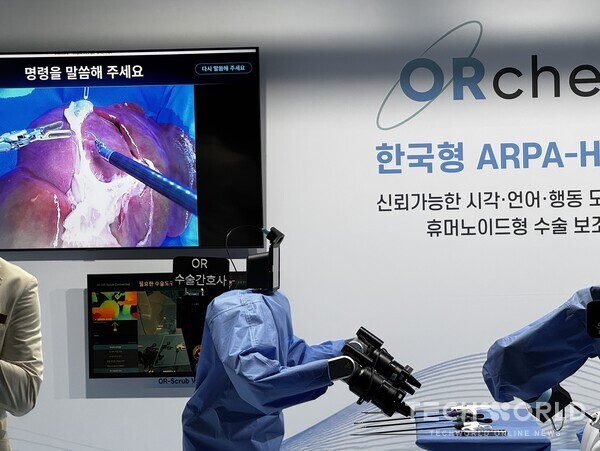
In the demonstration, three humanoids were positioned around the operating table. The humanoid robots showed how they assist surgery based on recognizing voice commands from medical staff. The three robots each carried out surgical assistance tasks according to the wishes of the medical team.
Samsung Medical Center presented an AI and robot system that delivers surgical instruments based on voice requests from medical staff. The technology works by having AI interpret spoken instructions from medical personnel, then identifying the type and location of instruments through cameras, after which the robot delivers the tools based on those results. At present, the system supports delivery of five surgical instruments through voice commands.
In laboratory evaluations, the success rate for picking up surgical instruments was 100%, and the delivery success rate was 98.7%. Voice command recognition exceeded the stage 1 target of 95%, and the motion success rate also exceeded the stage 1 target of 95%. Samsung Medical Center is also developing endoscope-assistance technology, and the current implementation level covers adjusting the endoscope's direction and field of view. Going forward, it plans to expand the system to tissue retraction, incision, and suturing.
However, additional verification of safety is needed before the system can be applied in actual operating rooms. An official who led the demonstration explained that AI must accurately recognize the surrounding environment even in variable conditions such as bleeding and smoke. The official also said that control technology is essential to prevent mistaken judgments from leading to physical actions.
With the use of humanoids in surgical settings in mind, Samsung Medical Center is developing multiple safety mechanisms for limiting robot movement and emergency stop functions. Conditions for movement limits include the application of force above a certain level and deviation from the normal operating range, and the center is considering three stages of safety mechanisms to ensure humanoid safety.
Jung Yong-gi, a professor in the Department of Otolaryngology at Samsung Medical Center's College of Medicine, said the level of physical AI readiness for use in operating rooms is still insufficient. Jung said this limitation is a common situation not only in South Korea but around the world, and added that the purpose of the demonstration was not to present a finished product ready for use in actual operating rooms, but to disclose the current level of technology secured.
The researchers said the humanoid's speed has not yet reached the level needed for actual operating room use. During the demonstration, the robot took time to execute movements after recognizing commands, and the current delay between command recognition and movement start is within 2 seconds. The researchers aim to reduce that to within 1 second.
At present, further technological advancement and verification in real surgical environments are still needed. After this R&D phase, once the technology moves into commercialization, it is expected to be used in medical settings facing a shortage of surgical assistants, helping ease the workload of medical staff.
Source: TECHWORLD · Kim Hye-jin
Original: https://www.epnc.co.kr/news/articleView.html?idxno=407088
References
This article was produced with the help of an automated content generation algorithm.
Source: TECHWORLD
View originalThis article was summarized and organized by BizCrush based on the original article from TECHWORLD. For exact quotations and full details, please refer to the original article.